This confirmed their own findings from 2016, when Haase and his team developed an experimental method based on magnetic resonance that can measure changes that are relevant to superconductivity in the structure of materials. They were the first team in the world to identify a measurable material parameter that predicts the maximum possible transition temperature – a condition required to achieve superconductivity at room temperature. Now they have discovered that cuprates, which under pressure enhance superconductivity, follow the charge distribution predicted in 2016. The researchers have published their new findings in the renowned journal PNAS.
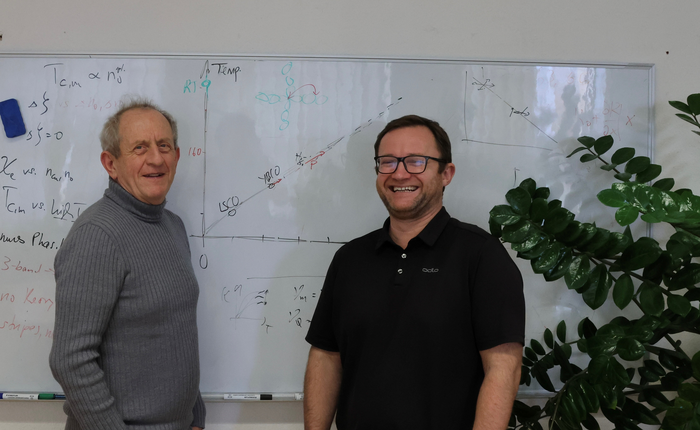
Credit: Photo: Daniel Bandur/Leipzig University
This confirmed their own findings from 2016, when Haase and his team developed an experimental method based on magnetic resonance that can measure changes that are relevant to superconductivity in the structure of materials. They were the first team in the world to identify a measurable material parameter that predicts the maximum possible transition temperature – a condition required to achieve superconductivity at room temperature. Now they have discovered that cuprates, which under pressure enhance superconductivity, follow the charge distribution predicted in 2016. The researchers have published their new findings in the renowned journal PNAS.
“The fact that the transition temperature of cuprates can be enhanced under pressure has puzzled researchers for 30 years. But until now we didn’t know which mechanism was responsible for this,” Haase said. He and his colleagues at the Felix Bloch Institute for Solid State Physics have now come a great deal closer to understanding the actual mechanism in these materials. “At Leipzig University – with support from the Graduate School Building with Molecules and Nano-objects (BuildMoNa) – we have established the basic conditions needed to research cuprates using nuclear resonance, and Michael Jurkutat was the first doctoral researcher to join us. Together, we established the Leipzig Relation, which says that you have to take electrons away from the oxygen in these materials and give them to the copper in order to increase the transition temperature. You can do this with chemistry, but also with pressure. But hardly anyone would have thought that we could measure all of this with nuclear resonance,” Haase said.
Their current research finding could be exactly what is needed to produce a superconductor at room temperature, which has been the dream of many physicists for decades and is now expected to take only a few more years, according to Haase. To date, this has only been possible at very low temperatures around minus 150 degrees Celsius and below, which are not easy to find anywhere on Earth. About a year ago, a Canadian research group verified the findings of Professor Haase’s team from 2016 using newly developed, computer-aided calculations and thus substantiated the findings theoretically.
Superconductivity is already used today in a variety of ways, for example, in magnets for MRI machines and in nuclear fusion. But it would be much easier and less expensive if superconductors operated at room temperature. The phenomenon of superconductivity was discovered in metals as early as 1911, but even Albert Einstein did not attempt to come up with an explanation back then. Nearly half a century passed before BCS theory provided an understanding of superconductivity in metals in 1957. In 1986, the discovery of superconductivity in ceramic materials (cuprate superconductors) at much higher temperatures by physicists Georg Bednorz and Karl Alexander Müller raised new questions, but also raised hopes that superconductivity could be achieved at room temperature.
Journal
Proceedings of the National Academy of Sciences
DOI
10.1073/pnas.2215458120
Method of Research
Experimental study
Subject of Research
Not applicable
Article Title
How pressure enhances the critical temperature of superconductivity in YBa2Cu3O6+y
Article Publication Date
6-Jan-2023