• HOME
  • NEWS
  • EXPLORE
    • CAREER
      • Companies
      • Jobs
    • EVENTS
    • iGEM
      • News
      • Team
    • PHOTOS
    • VIDEO
    • WIKI
  • BLOG
  • COMMUNITY
    • FACEBOOK
    • INSTAGRAM
    • TWITTER
Thursday, July 9, 2026
BIOENGINEER.ORG
No Result
View All Result
  • Login
  • HOME
  • NEWS
  • EXPLORE
    • CAREER
      • Companies
      • Jobs
        • Lecturer
        • PhD Studentship
        • Postdoc
        • Research Assistant
    • EVENTS
    • iGEM
      • News
      • Team
    • PHOTOS
    • VIDEO
    • WIKI
  • BLOG
  • COMMUNITY
    • FACEBOOK
    • INSTAGRAM
    • TWITTER
  • HOME
  • NEWS
  • EXPLORE
    • CAREER
      • Companies
      • Jobs
        • Lecturer
        • PhD Studentship
        • Postdoc
        • Research Assistant
    • EVENTS
    • iGEM
      • News
      • Team
    • PHOTOS
    • VIDEO
    • WIKI
  • BLOG
  • COMMUNITY
    • FACEBOOK
    • INSTAGRAM
    • TWITTER
No Result
View All Result
Bioengineer.org
No Result
View All Result
Home NEWS Science News Biology

Understanding the “eating just one potato chip is impossible” gene

Bioengineer by Bioengineer
December 23, 2022
in Biology
Reading Time: 2 mins read
0
Mechanism by which CREB-Regulated Transcription Coactivator 1 (CRTC1) suppresses overeating
Share on FacebookShare on TwitterShare on LinkedinShare on RedditShare on Telegram

High-calorie foods—high in fat, oil, and sugar—can taste good but often cause overeating, leading to obesity and major health problems. But what stimulates the brain to cause overeating?
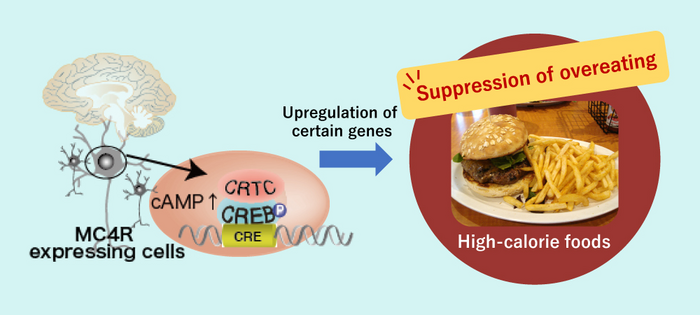
Mechanism by which CREB-Regulated Transcription Coactivator 1 (CRTC1) suppresses overeating

Credit: Shigenobu Matsumura, Osaka Metropolitan University

High-calorie foods—high in fat, oil, and sugar—can taste good but often cause overeating, leading to obesity and major health problems. But what stimulates the brain to cause overeating?

Recently, it has become clear that a gene called CREB-Regulated Transcription Coactivator 1 (CRTC1) is associated with obesity in humans. When CRTC1 is deleted in mice, they become obese, indicating that functioning CRTC1 suppresses obesity. However, since CRTC1 is expressed in all neurons in the brain, the specific neurons responsible for suppressing obesity and the mechanism present in those neurons remained unknown.

To elucidate the mechanism by which CRTC1 suppresses obesity, a research group led by Associate Professor Shigenobu Matsumura from the Graduate School of Human Life and Ecology at Osaka Metropolitan University focused on neurons expressing the melanocortin-4 receptor (MC4R). They hypothesized that CRTC1 expression in MC4R-expressing neurons suppressed obesity because mutations in the MC4R gene are known to cause obesity. Consequently, they created a strain of mice that expresses CRTC1 normally except in MC4R-expressing neurons where it is blocked to examine the effect that losing CRTC1 in those neurons had on obesity and diabetes.

When fed a standard diet, the mice without CRTC1 in MC4R-expressing neurons showed no changes in body weight compared to control mice. However, when the CRTC1-deficient mice were raised on a high-fat diet, they overate, then became significantly more obese than the control mice and developed diabetes.

“This study has revealed the role that the CRTC1 gene plays in the brain, and part of the mechanism that stops us from overeating high-calorie, fatty, and sugary foods,” said Professor Matsumura. “We hope this will lead to a better understanding of what causes people to overeat.”

The research results were published in the FASEB Journal on November 9, 2022.

###

Osaka Metropolitan University is a new public university established by a merger between Osaka City University and Osaka Prefecture University in April 2022. For more science news, see https://www.omu.ac.jp/en/info/research-news/, and follow @OsakaMetUniv_en, or search #OMUScience. 


Journal

The FASEB Journal

DOI

10.1096/fj.202200617R

Method of Research

Experimental study

Subject of Research

Animals

Article Title

CRTC1 deficiency, specifically in melanocortin-4 receptor-expressing cells, induces hyperphagia, obesity, and insulin resistance

Article Publication Date

9-Nov-2022

Share12Tweet8Share2ShareShareShare2

Related Posts

Caddisfly Silk Gene Rapidly Evolves While Keeping Its Stickiness

Caddisfly Silk Gene Rapidly Evolves While Keeping Its Stickiness

July 9, 2026
New Research Reveals Necks Exist in Fishes and Amphibians

New Research Reveals Necks Exist in Fishes and Amphibians

July 9, 2026

New Genetic Screen Advances Understanding of Human Development

July 9, 2026

California Gray Wolves Mainly Consume Cattle, Raising Human-Wildlife Conflicts

July 9, 2026

POPULAR NEWS

  • Detection of EDCs in Breast Milk and Infant Urine Up to Six Months Highlights Early Exposure Risks

    77 shares
    Share 31 Tweet 19
  • New Drug Candidate Developed at McMaster Shows Potential for Treating Brain Cancer

    58 shares
    Share 23 Tweet 15
  • KTU Researchers Explore Ultrasound’s Role in Enhancing Blood Flow Beyond Diagnostics

    53 shares
    Share 21 Tweet 13
  • 高齢者の骨粗鬆症治療の持続性比較

    51 shares
    Share 20 Tweet 13

About

We bring you the latest biotechnology news from best research centers and universities around the world. Check our website.

Follow us

Recent News

Scientists Discover How the Uterus Naturally Heals Itself

Cosmic Protons Used to Verify Outer Space Treaty Compliance

Smelling chocolate may ease leg day workouts, even when fasting

Subscribe to Blog via Email

Enter your email address to subscribe to this blog and receive notifications of new posts by email.

Join 83 other subscribers
  • Contact Us

Bioengineer.org © Copyright 2023 All Rights Reserved.

Welcome Back!

Login to your account below

Forgotten Password?

Retrieve your password

Please enter your username or email address to reset your password.

Log In
No Result
View All Result
  • Homepages
    • Home Page 1
    • Home Page 2
  • News
  • National
  • Business
  • Health
  • Lifestyle
  • Science

Bioengineer.org © Copyright 2023 All Rights Reserved.