Credit: University of Illinois/Technical University of Darmstadt
Through a new award program, the U.S. National Science Foundation and the Deutsche Forschungsgemeinschaft (German Research Foundation, DFG) have joined forces to award the University of Illinois Urbana-Champaign and Technical University of Darmstadt a three-year $720,000 research grant ($500,000 from NSF) to explore opportunities to more efficiently produce green hydrogen, a clean and renewable source of energy.
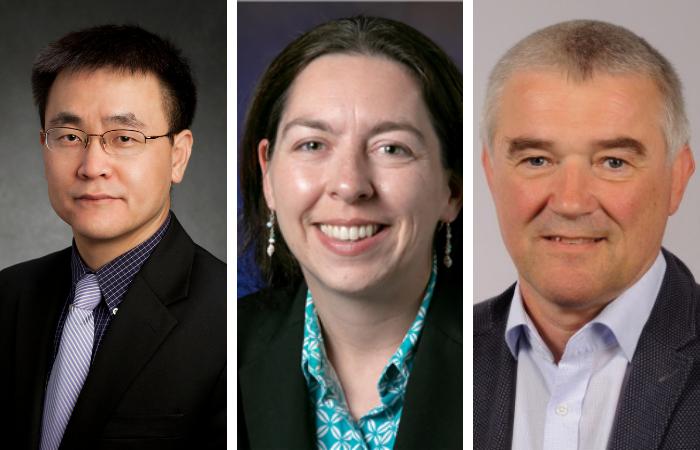
This project is among the first supported by the NSF-DFG Lead Agency Activity in Electrosynthesis and Electrocatalysis (NSF-DFG EChem), an international effort to support collaborative work between U.S. researchers and their German counterparts on engineering science projects for novel and fundamental electrochemical reactions and studies. The new project assembles a multidisciplinary team, comprising Professors Hong Yang and Nicola Perry at UIUC and Professor Andreas Klein at TU Darmstadt.
“Our society is making great strides toward a future powered by renewable sources,” said the project’s principal investigator Hong Yang, Alkire Chair professor of chemical and biomolecular engineering and affiliate professor of chemistry at UIUC. “Green hydrogen can fuel cars and semi-trucks or used as commodity chemicals for industrial manufacturing–but there is work to be done to ensure that green hydrogen production is viable and scalable.”
Green hydrogen is made from splitting water molecules with a device called an electrolyzer that uses electric energy from renewable sources–but this process currently requires a lot of energy, and it is still not cost-effective.
This newly funded research project aims to increase the efficiency and stability of electrolysis for water splitting via understanding the engineering science of new classes of electrocatalysts such as pyrochlores.
Catalysts speed up chemical reactions. The research team will use cutting-edge techniques to reveal their complex surface and bulk structures, which influence catalyst performance and reaction rates. Their goal is to identify the specific chemistry–down to the atomic level–that creates the most reactive and stable electrocatalysts for water splitting.
Ultimately, better catalysts are needed to reduce electricity usage and meet the stability requirement to produce green hydrogen at a reduced cost.
“Our team brings together diverse methods and disciplinary lenses that, when combined, have potential to provide unique insights for the development of practical green hydrogen catalysts,” said the project’s co-principal investigator Nicola Perry, a materials science and engineering professor at UIUC. “This interdisciplinary and internationally collaborative environment will also provide a rich, formative context for student researcher training.”
Perry will lead the growth of thin-film catalysts, as a model platform enabling fundamental insights. She will also oversee the analysis of defect chemistry, which is the study of populations of active atomic-scale anomalies under dynamic operating conditions and their impact on catalyst performance. Perry and Yang are also members of the Materials Research Lab, where some of this work will take place.
Andreas Klein, a professor of materials and earth sciences at TU Darmstadt, will develop a new framework to study the surface structures using X-ray photoelectron spectroscopy (XPS) in realistic conditions.
“Hydrogen is expected to play an important role for carbon-neutral technology,” Yang said. “I am excited to help develop the sustainable technologies to make green hydrogen to fuel cars, and one day, our society at large.”
###
Media Contact
Claire Benjamin
[email protected]
Original Source
https:/