• HOME
  • NEWS
  • EXPLORE
    • CAREER
      • Companies
      • Jobs
    • EVENTS
    • iGEM
      • News
      • Team
    • PHOTOS
    • VIDEO
    • WIKI
  • BLOG
  • COMMUNITY
    • FACEBOOK
    • INSTAGRAM
    • TWITTER
Saturday, February 7, 2026
BIOENGINEER.ORG
No Result
View All Result
  • Login
  • HOME
  • NEWS
  • EXPLORE
    • CAREER
      • Companies
      • Jobs
        • Lecturer
        • PhD Studentship
        • Postdoc
        • Research Assistant
    • EVENTS
    • iGEM
      • News
      • Team
    • PHOTOS
    • VIDEO
    • WIKI
  • BLOG
  • COMMUNITY
    • FACEBOOK
    • INSTAGRAM
    • TWITTER
  • HOME
  • NEWS
  • EXPLORE
    • CAREER
      • Companies
      • Jobs
        • Lecturer
        • PhD Studentship
        • Postdoc
        • Research Assistant
    • EVENTS
    • iGEM
      • News
      • Team
    • PHOTOS
    • VIDEO
    • WIKI
  • BLOG
  • COMMUNITY
    • FACEBOOK
    • INSTAGRAM
    • TWITTER
No Result
View All Result
Bioengineer.org
No Result
View All Result
Home NEWS Science News

The clean power of starch

Bioengineer by Bioengineer
September 6, 2025
in Science News
Reading Time: 2 mins read
0
IMAGE
Share on FacebookShare on TwitterShare on LinkedinShare on RedditShare on Telegram

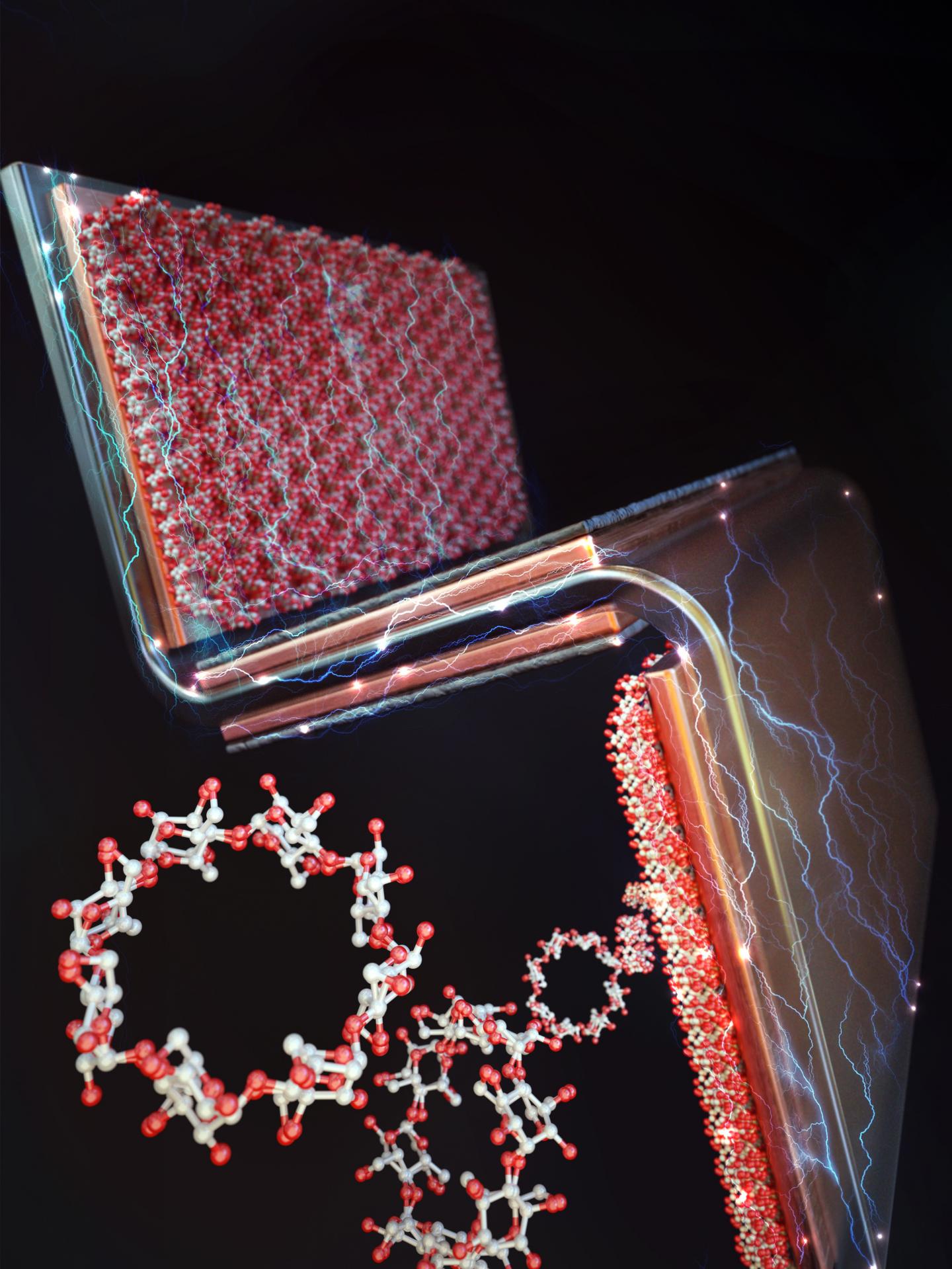
A tiny device incorporates a compound made from starch and baking soda to harvest energy from movement

Scientists have used a compound made from a starch derivative and baking soda to help convert mechanical to electrical energy. The approach, developed by scientists at Daegu Gyeongbuk Institute of Technology (DGIST), with colleagues in Korea and India, is cost-effective and biocompatible, and can help charge low-energy electronics like calculators and watches. The details were published in the journal Advanced Functional Materials.

“Triboelectric nanogenerators harvest mechanical energy and convert it into an electric current,” explains DGIST robotics engineer Hoe Joon Kim. “But many of the materials used in these devices are considered a biohazard and are not suitable for wearable applications. Our triboelectric nanogenerator incorporates cyclodextrin, a green material that is widely used for drug delivery in the human body, making it eco-friendly and hazard-free.”

Cyclodextrin is a polysaccharide compound produced from starch. The scientists used it to link sodium ions together in what is known as a metal-organic framework (MOF). MOFs form porous materials widely used in gas storage, catalysis and sensing.

Specifically, Kim and his team applied ultrasound to a mixture of cyclodextrin and sodium bicarbonate in water. They then added trimesic acid and applied another short round of ultrasound. The process happens at room temperature and leads to the formation of a MOF made of sodium ions linked together by cyclodextrin bonds.

The team incorporated the MOF into a nanogenerator by coating it onto a copper electrode, which sits on a plastic polyethylene terephthalate (PET) base. Opposite to the MOF layer is a Teflon layer placed on a second copper electrode that is also stuck to a PET sheet. The two sides of the nanogenerator open and close in response to movements, such as walking or jogging. Each time the MOF makes contact with the Teflon, electrons are exchanged and an electric current is generated. This process is called the triboelectric effect.

The team tested the device by attaching it to a shoe, a backpack, and a person’s knee and abdomen. They found it could harvest mechanical energy from walking, jogging and bending, and even from some typical yoga moves. The device was able to drive low-power electronics like a digital wristwatch, a hydrometer and a calculator.

“Our MOF extends the list of triboelectric materials,” says Kim. He and his team plan to continue looking for biocompatible materials that can be used in wearable applications. They are also working on developing super capacitors that can store energy generated from triboelectric nanogenerators. “Using the nanogenerator and super capacitor together, we believe we can develop next-generation energy systems for wearable electronics, biodevices and robots,” he says.

###

Media Contact
Kwanghoon Choi
[email protected]

Original Source

https://dgist.ac.kr/en/html/sub06/060202.html

Related Journal Article

http://dx.doi.org/10.1002/adfm.202101829

Tags: Electrical Engineering/ElectronicsElectromagneticsEnergy/Fuel (non-petroleum)MaterialsNanotechnology/MicromachinesTechnology/Engineering/Computer Science
Share13Tweet8Share2ShareShareShare2

Related Posts

Exploring Decision-Making in Dementia Caregivers’ Mobility

February 7, 2026

Succinate Receptor 1 Limits Blood Cell Formation, Leukemia

February 7, 2026

Palmitoylation of Tfr1 Drives Platelet Ferroptosis and Exacerbates Liver Damage in Heat Stroke

February 7, 2026

Oxygen-Enhanced Dual-Section Microneedle Patch Improves Drug Delivery and Boosts Photodynamic and Anti-Inflammatory Treatment for Psoriasis

February 7, 2026
Please login to join discussion

POPULAR NEWS

  • Robotic Ureteral Reconstruction: A Novel Approach

    Robotic Ureteral Reconstruction: A Novel Approach

    82 shares
    Share 33 Tweet 21
  • Digital Privacy: Health Data Control in Incarceration

    63 shares
    Share 25 Tweet 16
  • Study Reveals Lipid Accumulation in ME/CFS Cells

    57 shares
    Share 23 Tweet 14
  • Breakthrough in RNA Research Accelerates Medical Innovations Timeline

    53 shares
    Share 21 Tweet 13

About

We bring you the latest biotechnology news from best research centers and universities around the world. Check our website.

Follow us

Recent News

Exploring Decision-Making in Dementia Caregivers’ Mobility

Succinate Receptor 1 Limits Blood Cell Formation, Leukemia

Palmitoylation of Tfr1 Drives Platelet Ferroptosis and Exacerbates Liver Damage in Heat Stroke

Subscribe to Blog via Email

Enter your email address to subscribe to this blog and receive notifications of new posts by email.

Join 73 other subscribers
  • Contact Us

Bioengineer.org © Copyright 2023 All Rights Reserved.

Welcome Back!

Login to your account below

Forgotten Password?

Retrieve your password

Please enter your username or email address to reset your password.

Log In
No Result
View All Result
  • Homepages
    • Home Page 1
    • Home Page 2
  • News
  • National
  • Business
  • Health
  • Lifestyle
  • Science

Bioengineer.org © Copyright 2023 All Rights Reserved.