Mussels survive by sticking to rocks in the fierce waves or tides underwater. Materials mimicking this underwater adhesion are widely used for skin or bone adhesion, for modifying the surface of a scaffold, or even in drug or cell delivery systems. However, these materials have not entirely imitated the capabilities of mussels.
A joint research team from POSTECH and Kangwon National University (KNU) – led by Professor Hyung Joon Cha and Ph.D. candidate Mincheol Shin of the Department of Chemical Engineering at POSTECH with Professor Young Mee Jeong and Dr. Yeonju Park of the Department of Chemistry at KNU – has analyzed Dopa and lysine, which are the amino acids that make up the surface adhesive proteins secreted by mussels, and verified that their roles are related to their location. The team has taken a step closer to revealing the secret of underwater adhesion by uncovering that these amino acids can contribute to surface adhesion and cohesion differently depending on their specific location.
The characteristic of mussel adhesive proteins that have been mimicked so far is that they contain a large number of a unique amino acid called Dopa. Dopa is a modified amino acid with one more hydroxyl group attached to tyrosine, and research on underwater adhesion started with the fact that Dopa makes up a large component of the adhesive protein.
However, the research team questioned the fact that this excellent underwater adhesion of mussels is enabled by only one molecule and focused on observing the number and location of lysine, which is an amino acid as frequently occurring as Dopa.
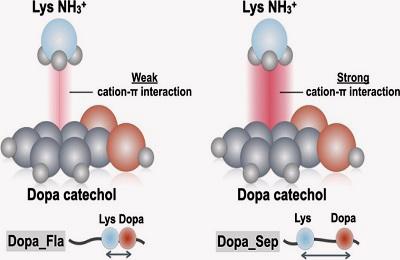
As a result, the research team uncovered that Dopa and lysine are attached to each other with about half the probability. On the other hand, it was revealed that unlike what has been known so far, when dopa and lysine are attached together, they do not always produce positive synergy. The researchers confirmed that in the case of the cation-π interaction, negative synergy is rather produced.
When Dopa and lysine are together, a difference in the density of water molecules occurs at the microscopic level and the concentration of water molecules around Dopa is lowered. This lowered concentration enables a difference in the hydrogen bonding strength between the benzene ring and the hydroxyl group of Dopa, thereby lowering the structural stability of the cation-π complex. Using the Raman spectroscopy, the research team confirmed that the CH2 group located in the lysine chain situated close to Dopa and catechol of the adjacent Dopa form an intramolecular interaction, thereby lowering its stability.
The findings of this study make it possible to confirm how adhesive protein of mussels was designed, and it shows promise to be applicable for research on adhesive proteins of other organisms in the future.
“With this new discovery on the synergy between Dopa and lysine, which are known to always play a positive role in underwater adhesion, it will change the framework of the way adhesive materials are designed,” remarked Professor Hyung Joon Cha who led the research.
This research, which was recently published in Chemistry of Materials, was conducted as a part of the study titled “Understanding the underwater adhesion mechanism of adhesive organisms: controlling the balance between surface adhesion and cohesion,” which is a Mid-career Researcher Program of the Ministry of Science and ICT and the National Research Foundation of Korea.
###
Media Contact
Jinyoung Huh
[email protected]
Original Source
https:/
Related Journal Article
http://dx.