• HOME
  • NEWS
  • EXPLORE
    • CAREER
      • Companies
      • Jobs
    • EVENTS
    • iGEM
      • News
      • Team
    • PHOTOS
    • VIDEO
    • WIKI
  • BLOG
  • COMMUNITY
    • FACEBOOK
    • INSTAGRAM
    • TWITTER
Thursday, March 26, 2026
BIOENGINEER.ORG
No Result
View All Result
  • Login
  • HOME
  • NEWS
  • EXPLORE
    • CAREER
      • Companies
      • Jobs
        • Lecturer
        • PhD Studentship
        • Postdoc
        • Research Assistant
    • EVENTS
    • iGEM
      • News
      • Team
    • PHOTOS
    • VIDEO
    • WIKI
  • BLOG
  • COMMUNITY
    • FACEBOOK
    • INSTAGRAM
    • TWITTER
  • HOME
  • NEWS
  • EXPLORE
    • CAREER
      • Companies
      • Jobs
        • Lecturer
        • PhD Studentship
        • Postdoc
        • Research Assistant
    • EVENTS
    • iGEM
      • News
      • Team
    • PHOTOS
    • VIDEO
    • WIKI
  • BLOG
  • COMMUNITY
    • FACEBOOK
    • INSTAGRAM
    • TWITTER
No Result
View All Result
Bioengineer.org
No Result
View All Result
Home NEWS Science News Biology

Cheap alloy rivals expensive platinum to boost fuel cells

Bioengineer by Bioengineer
September 6, 2025
in Biology
Reading Time: 2 mins read
0
IMAGE
Share on FacebookShare on TwitterShare on LinkedinShare on RedditShare on Telegram

As the cleanest renewable energy, hydrogen energy has attracted special attention in the research. Yet the commercialization of traditional proton exchange membrane fuel cells (PEMFCs), which consume hydrogen and produce electricity, is seriously restricted due to the chemical reaction of PEMFCs cathode largely relies on expensive platinum-based catalysts.

A solution is to change the acidic electrolyte of PEMFCs to alkaline. Such fuel cells are called anion exchange membrane fuel cells (AEMFCs), and they allow for the use of cheaper metal elements like Co, Ni or Mn to design electrocatalysts.

The research team led by Prof. GAO Minrui from University of Science and Technology of China (USTC) followed this solution and developed a practical and scalable way to manufacture a novel Ni-W-Cu alloy, Ni5.2WCu2.2, as the cathode for AEMFCs. The result was published on Nature Communications.

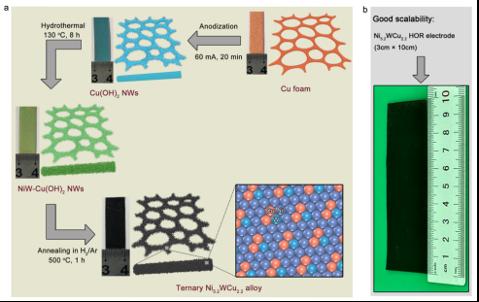
The team first grew Cu(OH)2 nanowires from a three-dimensional foam copper skeleton by anodic oxidation. The obtained nanowires were then immersed in a solution containing Ni and W elements. After hydrothermal synthesis and annealing, the Ni-W-Cu alloy is produced.

The ternary Ni5.2WCu2.2 alloy can catalyze the oxidation of hydrogen in alkaline medium 4.31 times more efficient than the benchmark platinum/carbon anode.

It has an oxidation potential as high as 0.3V in comparison with the reversible hydrogen electrode and can maintain high activity for up to 20h under such overpotential, proceeding anodes based on non-platinum-group metals.

The alloy catalyst also showed excellent resistance to CO poisoning, and maintained high activity in 20000 ppm CO/H2 mixed atmosphere.

Analysis showed that the projected density of states of Ni5.2WCu2.2 alloy lies in the lowest at Fermi level, which indicates that the alloy has the optimal hydrogen binding energy. The multiple-element alloying effect renders the Ni-based alloy a high activity catalyst and offers oxidation resistance.

This work sheds light on further exploration of multiple-element alloys composed of cheap metals, thereby aiding the development of more efficient hydrogen oxidation catalysts for AEMFC anodes.

###

Media Contact
Jane FAN Qiong
[email protected]

Related Journal Article

http://dx.doi.org/10.1038/s41467-021-22996-2

Tags: Biomedical/Environmental/Chemical EngineeringChemistry/Physics/Materials SciencesEnergy/Fuel (non-petroleum)Industrial Engineering/ChemistryMaterialsResearch/DevelopmentTechnology/Engineering/Computer Science
Share12Tweet8Share2ShareShareShare2

Related Posts

How to sway group opinions: Encourage opponents to stay undecided

How to sway group opinions: Encourage opponents to stay undecided

March 23, 2026
Deep Learning Model Maps How Individual Cells Shape Disease Outcomes

Deep Learning Model Maps How Individual Cells Shape Disease Outcomes

March 20, 2026

Removing only 15 female sharks annually could endanger the entire population, scientists warn

March 20, 2026

Scientists Urge Fragrance Industry to Transition from Sustainability Talk to Active Funding of Plant Conservation

March 20, 2026
Please login to join discussion

POPULAR NEWS

  • blank

    Revolutionary AI Model Enhances Precision in Detecting Food Contamination

    96 shares
    Share 38 Tweet 24
  • Imagine a Social Media Feed That Challenges Your Views Instead of Reinforcing Them

    1003 shares
    Share 397 Tweet 248
  • Uncovering Functions of Cavernous Malformation Proteins in Organoids

    54 shares
    Share 22 Tweet 14
  • Promising Outcomes from First Clinical Trials of Gene Regulation in Epilepsy

    51 shares
    Share 20 Tweet 13

About

We bring you the latest biotechnology news from best research centers and universities around the world. Check our website.

Follow us

Recent News

In-Sensor Cryptography Links Physical Process to Digital Identity

Can Psychosocial Factors Influence Cancer Risk?

Depression Factors in Elderly: Pre vs. Post-COVID Analysis

Subscribe to Blog via Email

Success! An email was just sent to confirm your subscription. Please find the email now and click 'Confirm' to start subscribing.

Join 78 other subscribers
  • Contact Us

Bioengineer.org © Copyright 2023 All Rights Reserved.

Welcome Back!

Login to your account below

Forgotten Password?

Retrieve your password

Please enter your username or email address to reset your password.

Log In
No Result
View All Result
  • Homepages
    • Home Page 1
    • Home Page 2
  • News
  • National
  • Business
  • Health
  • Lifestyle
  • Science

Bioengineer.org © Copyright 2023 All Rights Reserved.