• HOME
  • NEWS
  • EXPLORE
    • CAREER
      • Companies
      • Jobs
    • EVENTS
    • iGEM
      • News
      • Team
    • PHOTOS
    • VIDEO
    • WIKI
  • BLOG
  • COMMUNITY
    • FACEBOOK
    • INSTAGRAM
    • TWITTER
Saturday, February 7, 2026
BIOENGINEER.ORG
No Result
View All Result
  • Login
  • HOME
  • NEWS
  • EXPLORE
    • CAREER
      • Companies
      • Jobs
        • Lecturer
        • PhD Studentship
        • Postdoc
        • Research Assistant
    • EVENTS
    • iGEM
      • News
      • Team
    • PHOTOS
    • VIDEO
    • WIKI
  • BLOG
  • COMMUNITY
    • FACEBOOK
    • INSTAGRAM
    • TWITTER
  • HOME
  • NEWS
  • EXPLORE
    • CAREER
      • Companies
      • Jobs
        • Lecturer
        • PhD Studentship
        • Postdoc
        • Research Assistant
    • EVENTS
    • iGEM
      • News
      • Team
    • PHOTOS
    • VIDEO
    • WIKI
  • BLOG
  • COMMUNITY
    • FACEBOOK
    • INSTAGRAM
    • TWITTER
No Result
View All Result
Bioengineer.org
No Result
View All Result
Home NEWS Science News

Skeletal muscle loss exacerbated by diabetes improved with oligo DNA

Bioengineer by Bioengineer
May 26, 2021
in Science News
Reading Time: 2 mins read
0
IMAGE
Share on FacebookShare on TwitterShare on LinkedinShare on RedditShare on Telegram

IMAGE

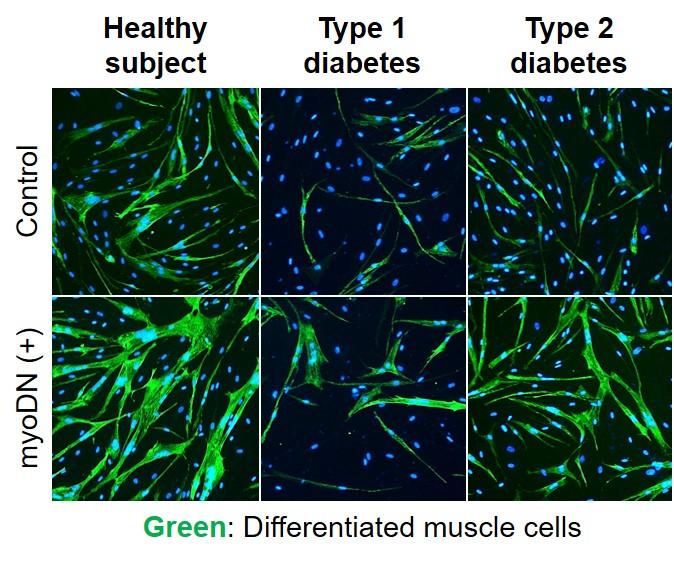
Credit: Modified from Nakamura et al., Frontiers in Physiology (2021) 12: 679152

Skeletal muscle is the largest organ in the body that accounts for 30 to 40% of body weight and is responsible for multiple functions such as energy metabolism and heat production. However, skeletal muscle mass is reduced in some diabetics, and that muscle loss correlates with mortality. It has been reported that the differentiation of myoblasts, which are the muscle precursor cells, is reduced in diabetic patients, and this is thought to be one of the underlying causes of muscle loss.

Assistant Professor Tomohide Takaya of Shinshu University recently reported that oligo DNA derived from the genome sequence of lactic acid bacteria promotes differentiation into skeletal muscle by binding to the target protein nucleolin in myoblasts. This “muscle-forming oligo DNA” (myoDN) has potential for use in nucleic acid drugs for various muscle diseases. In this study, the group examined whether myoDN improves the differentiation of myoblasts, which is exacerbated by diabetes.

Myoblasts collected from healthy subjects, patients with type 1 diabetes, and patients with type 2 diabetes were used for this experiment. Compared to healthy subjects, diabetic myoblasts had a reduced ability to differentiate into skeletal muscle. Remarkably, administration of myoDN improved skeletal muscle differentiation exacerbated by diabetes. The group also found that glucose and fatty acids, which are increased in the blood of diabetic patients, induce an inflammatory response in myoblasts, and myoDN suppresses these inflammatory responses.

It is thought that myoDN is a nucleic acid molecule that is effective in reducing muscle mass associated with diabetics. Currently, there is no effective therapeutic agent for muscle wasting, and the action of myoDN, which promotes skeletal muscle differentiation, is unique. myoDN is effective for healthy subjects with various backgrounds and type 1 and type 2 patients. On the other hand, analysis using multiple myoblasts revealed that there are individual differences in the effects of myoDN, and issues for clinical application were also clarified.

In the future, it will be necessary to expand the scope and test in order to clarify the cause of individual differences. Diseases other than diabetes such as cancer and heart failure also cause muscle wasting. The group hopes to verify whether myoDN promotes skeletal muscle differentiation in these diseases as well. The ultimate goal is to apply myoDN as an effective nucleic acid drug for muscle wasting associated with various diseases.

###

Find out more about the previous study here:

https://www.frontiersin.org/articles/10.3389/fcell.2020.616706/full

https://www.eurekalert.org/pub_releases/2021-01/su-ioo012521.php

FUNDING

This study was supported in part by a Grant-in-Aid from the Japan Society for the Promotion of Science (19K05948) to TT.

Media Contact
Hitomi Thompson
[email protected]

Related Journal Article

http://dx.doi.org/10.3389/fphys.2021.679152

Tags: BiologyBiomedical/Environmental/Chemical EngineeringBiotechnologyCell BiologyDiabetesGeneticsMusculaturePharmaceutical SciencePhysiology
Share12Tweet8Share2ShareShareShare2

Related Posts

Evaluating Pediatric Emergency Care Quality in Ethiopia

February 7, 2026

TPMT Expression Predictions Linked to Azathioprine Side Effects

February 7, 2026

Improving Dementia Care with Enhanced Activity Kits

February 7, 2026

Decoding Prostate Cancer Origins via snFLARE-seq, mxFRIZNGRND

February 7, 2026
Please login to join discussion

POPULAR NEWS

  • Robotic Ureteral Reconstruction: A Novel Approach

    Robotic Ureteral Reconstruction: A Novel Approach

    82 shares
    Share 33 Tweet 21
  • Digital Privacy: Health Data Control in Incarceration

    63 shares
    Share 25 Tweet 16
  • Study Reveals Lipid Accumulation in ME/CFS Cells

    57 shares
    Share 23 Tweet 14
  • Breakthrough in RNA Research Accelerates Medical Innovations Timeline

    53 shares
    Share 21 Tweet 13

About

We bring you the latest biotechnology news from best research centers and universities around the world. Check our website.

Follow us

Recent News

Evaluating Pediatric Emergency Care Quality in Ethiopia

TPMT Expression Predictions Linked to Azathioprine Side Effects

Improving Dementia Care with Enhanced Activity Kits

Subscribe to Blog via Email

Success! An email was just sent to confirm your subscription. Please find the email now and click 'Confirm' to start subscribing.

Join 73 other subscribers
  • Contact Us

Bioengineer.org © Copyright 2023 All Rights Reserved.

Welcome Back!

Login to your account below

Forgotten Password?

Retrieve your password

Please enter your username or email address to reset your password.

Log In
No Result
View All Result
  • Homepages
    • Home Page 1
    • Home Page 2
  • News
  • National
  • Business
  • Health
  • Lifestyle
  • Science

Bioengineer.org © Copyright 2023 All Rights Reserved.