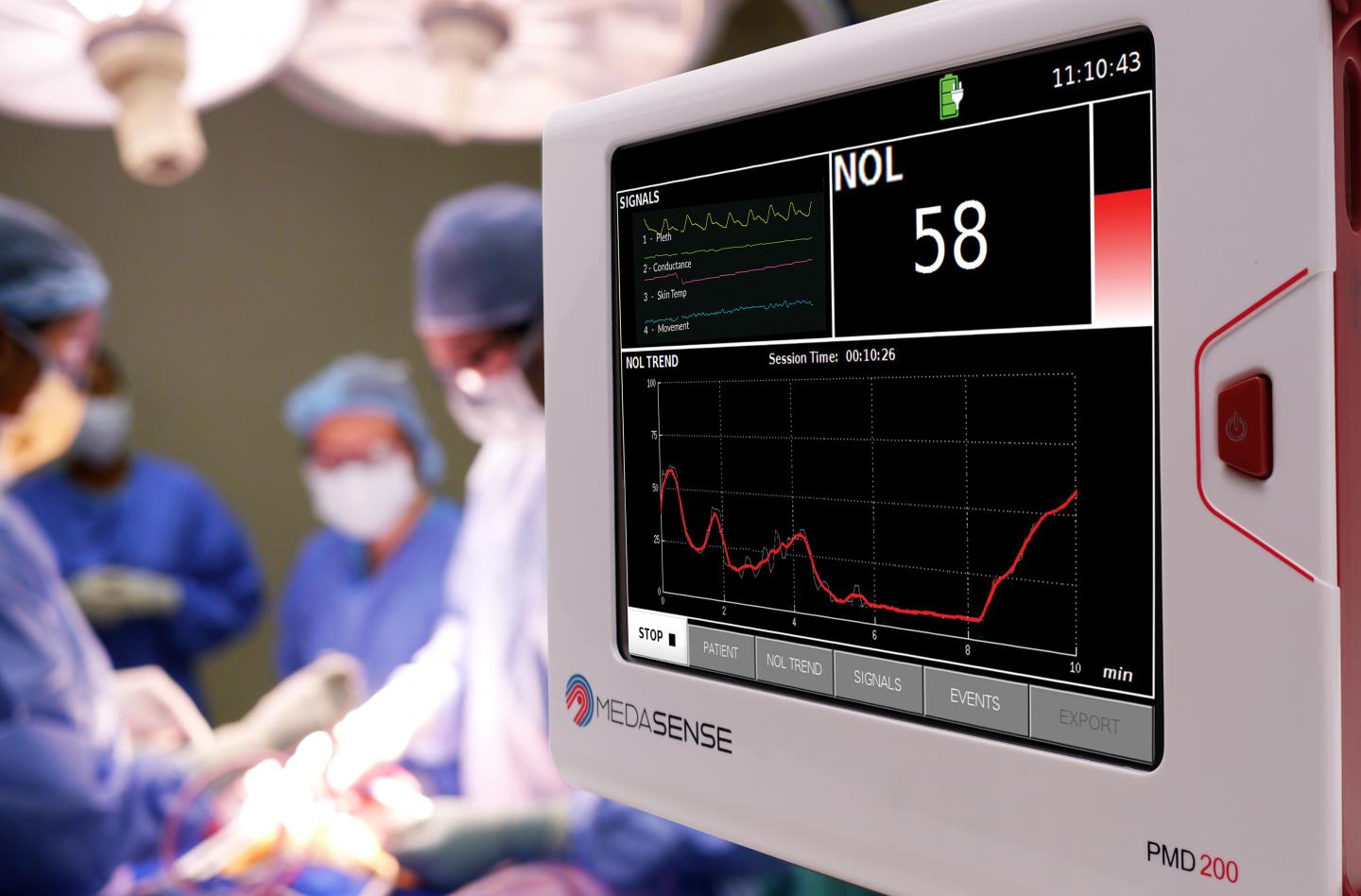
Credit: Medasense
A new study has shown that effective opioid-sparing anaesthesia with dexmedetomidine can be guided with NOL pain monitoring technology (Medasense, Israel). The study showed that the NOL monitor is able to detect the effect of dexmedetomidine on the patient’s pain response and enable administration of less intraoperative opioids.
Patients undergoing anaesthesia for surgical procedures are traditionally treated with opioids (e.g., remifentanil) to manage intraoperative pain. But clinicians are progressively seeking to reduce opioid use by introducing multimodal analgesia, a technique that involves a combination of medications that often includes a central alpha agonist, such as dexmedetomidine. This approach may offer pain relief, offset potentially adverse effects of individual drugs in larger doses and enable a reduction of opioid use during surgery.1 With this strategy, however, clinicians are not always able to predict whether the impact of the drug combination will be effective or excessive.
The current study addressed this challenge in multimodal analgesia and examined its effectiveness by monitoring pain response (nociception) levels in patients with the NOL monitoring system.
NOL monitoring is a non-invasive multi-sensor AI technology that provides a reliable index to objectively detect and quantify the patient’s physiological response to painful stimuli during anaesthesia, when patients can’t communicate. This index guides the clinical team in tailored pain medication for each patient. Earlier studies have shown that the NOL index outperforms other indexes2 for monitoring of pain response to surgical stimuli and that NOL-guided analgesia has resulted in reduced intraoperative opioid consumption3 as well as less pain after surgery.4
Led by Dr. Sean Coeckelenbergh of Erasme University Hospital in Brussels, Belgium, the new randomised controlled study examined 58 patients undergoing NOL-guided analgesia. Patients were randomised to receive either placebo or low-dose dexmedetomidine and both groups received intraoperative antinociception with a target-controlled infusion of remifentanil guided by the NOL index. The study, just published in the European Journal of Anaesthesiology,5 has shown that NOL can provide an objective reflection of dexmedetomidine’s effects, helping the clinician in the decision-making process when applying multimodal pain relief, with the potential for significant opioid sparing during surgery.
“Multimodal anaesthesia has benefits, but it is limited in that we often do not know the exact depth of anaesthesia and antinociception,” explains Dr. Coeckelenbergh. “The NOL index offers us a new way to quantify nociception when combining alpha agonists and opioids,” he says.
###
About Medasense and NOL Technology
Medasense offers a breakthrough technology that enables clinicians to optimize and personalize pain control and avoid overmedication. Medasense’s flagship product, the PMD-200™ with its NOL® index, is a unique platform that objectively monitors and quantifies the patient’s pain response by means of artificial intelligence and a proprietary non-invasive sensor platform.
The PMD-200 is used to optimize pain management in critical care and operating rooms settings, where patients are unable to communicate.
Clinical studies have demonstrated its impact on patient safety and outcomes, including opioid sparing and less pain reported by patients following surgery.
The PMD-200 is distributed in Europe by Medtronic, is cleared for marketing also in Canada, Latin America, Israel, Australia and the United Arab Emirates, and enables connectivity with Philips patient monitors.
1. Kehlet H, Dahl JB. The value of ‘multimodal’ or ‘balanced analgesia’ in postoperative pain treatment. Anesth Analg 1993; 77: 1048-1056.
2. Edry R, Recea V, Dikust Y, Sessler DI. Preliminary intraoperative validation of the nociception level index: a noninvasive nociception monitor. Anesthesiology 2016; 125:193-203.
3. Meijer FS, Martini CH, Broens S, et al. Nociception-guided versus standard care during remifentanil-propofol anesthesia: a randomized controlled trial. Anesthesiology 2019; 130:745-755.
4. Meijer, F. et al. Reduced postoperative pain using Nociception Level-guided fentanyl dosing during sevoflurane anaesthesia: a randomised controlled trial. British Journal of Anaesthesia, 2020;125(6):1070-1078.
5. Coeckelenbergh S, Doria S, Patricio D, Perrin L, Engelman E, Rodriguez A, Di Marco L, Van Obbergh L, Estebe JP, Barvais L, Kapessidou P. Effect of dexmedetomidine on Nociception Level Index-guided remifentanil antinociception: A randomised controlled trial. Eur J Anaesthesiol. 2021 May 1;38(5):524-533. doi: 10.1097/EJA.0000000000001402. PMID: 33259449.
Media Contact
Rachel Feldman
[email protected]
Related Journal Article
http://dx.