• HOME
  • NEWS
  • EXPLORE
    • CAREER
      • Companies
      • Jobs
    • EVENTS
    • iGEM
      • News
      • Team
    • PHOTOS
    • VIDEO
    • WIKI
  • BLOG
  • COMMUNITY
    • FACEBOOK
    • INSTAGRAM
    • TWITTER
Saturday, February 7, 2026
BIOENGINEER.ORG
No Result
View All Result
  • Login
  • HOME
  • NEWS
  • EXPLORE
    • CAREER
      • Companies
      • Jobs
        • Lecturer
        • PhD Studentship
        • Postdoc
        • Research Assistant
    • EVENTS
    • iGEM
      • News
      • Team
    • PHOTOS
    • VIDEO
    • WIKI
  • BLOG
  • COMMUNITY
    • FACEBOOK
    • INSTAGRAM
    • TWITTER
  • HOME
  • NEWS
  • EXPLORE
    • CAREER
      • Companies
      • Jobs
        • Lecturer
        • PhD Studentship
        • Postdoc
        • Research Assistant
    • EVENTS
    • iGEM
      • News
      • Team
    • PHOTOS
    • VIDEO
    • WIKI
  • BLOG
  • COMMUNITY
    • FACEBOOK
    • INSTAGRAM
    • TWITTER
No Result
View All Result
Bioengineer.org
No Result
View All Result
Home NEWS Science News Biology

Rooting the bacterial tree of life

Bioengineer by Bioengineer
May 11, 2021
in Biology
Reading Time: 2 mins read
0
IMAGE
Share on FacebookShare on TwitterShare on LinkedinShare on RedditShare on Telegram

IMAGE

Credit: The University of Queensland

Scientists now better understand early bacterial evolution, thanks to new research featuring University of Queensland researchers.

Bacteria comprise a very diverse domain of single-celled organisms that are thought to have evolved from a common ancestor that lived more than three billion years ago.

Professor Phil Hugenholtz, from the Australian Centre for Ecogenomics in UQ’s School of Chemistry and Molecular Biosciences, said the root of the bacterial tree, which would reveal the nature of the last common ancestor, is not agreed upon.

“There’s great debate about the root of this bacterial tree of life and indeed whether bacterial evolution should even be described as a tree has been contested,” Professor Hugenholtz said.

“This is in large part because genes are not just shared ‘vertically’ from parents to offspring, but also ‘horizontally’ between distant family members.

“We’ve all inherited certain traits from our parents, but imagine going to a family BBQ and suddenly inheriting your third cousin’s red hair.

“As baffling as it sounds, that’s exactly what happens in the bacterial world, as bacteria can frequently transfer and reconfigure genes horizontally across populations quite easily.

“This might be useful for bacteria but makes it challenging to reconstruct bacterial evolution.”

For the bacterial world, many researchers have suggested throwing the ‘tree of life’ concept out the window and replacing it with a network that reflects horizontal movement of genes.

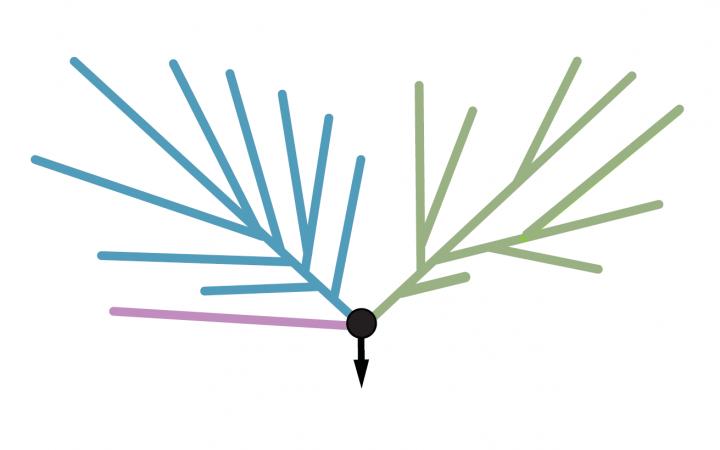
“However, by integrating vertical and horizontal gene transmission, we found that bacterial genes travel vertically most of the time – on average two-thirds of the time – suggesting that a tree is still an apt representation of bacterial evolution,” Professor Hugenholtz said.

“The analysis also revealed that the root of the tree lies between two supergroups of bacteria, those with one cell membrane and those with two.

“Their common ancestor was already complex, predicted to have two membranes, the ability to swim, sense its environment, and defend itself against viruses.”

The University of Bristol’s Dr Tom Williams said this fact led to another big question.

“Given the common ancestor of all living bacteria already had two membranes, we now need to understand how did single-membrane cells evolve from double-membraned cells, and whether this occurred once or on multiple occasions,” Dr Williams said.

“We believe that our approach to integrating vertical and horizontal gene transmission will answer these and many other open questions in evolutionary biology.”

The research was a collaboration between UQ, the University of Bristol in the UK, Eötvös Loránd University in Hungary, and NIOZ in the Netherlands, and has been published in Science (DOI: 10.1126/science.abe5011).

###

Media Contact
Professor Phil Hugenholtz
[email protected]

Original Source

https://science.uq.edu.au/article/2021/05/rooting-bacterial-tree-life

Related Journal Article

http://dx.doi.org/10.1126/science.abe5011

Tags: BacteriologyBiologyEvolutionMicrobiology
Share12Tweet8Share2ShareShareShare2

Related Posts

New Study Uncovers Mechanism Behind Burn Pit Particulate Matter–Induced Lung Inflammation

New Study Uncovers Mechanism Behind Burn Pit Particulate Matter–Induced Lung Inflammation

February 6, 2026

DeepBlastoid: Advancing Automated and Efficient Evaluation of Human Blastoids with Deep Learning

February 6, 2026

Navigating the Gut: The Role of Formic Acid in the Microbiome

February 6, 2026

AI-Enhanced Optical Coherence Photoacoustic Microscopy Revolutionizes 3D Cancer Model Imaging

February 6, 2026
Please login to join discussion

POPULAR NEWS

  • Robotic Ureteral Reconstruction: A Novel Approach

    Robotic Ureteral Reconstruction: A Novel Approach

    82 shares
    Share 33 Tweet 21
  • Digital Privacy: Health Data Control in Incarceration

    63 shares
    Share 25 Tweet 16
  • Study Reveals Lipid Accumulation in ME/CFS Cells

    57 shares
    Share 23 Tweet 14
  • Breakthrough in RNA Research Accelerates Medical Innovations Timeline

    53 shares
    Share 21 Tweet 13

About

We bring you the latest biotechnology news from best research centers and universities around the world. Check our website.

Follow us

Recent News

Exploring Decision-Making in Dementia Caregivers’ Mobility

Succinate Receptor 1 Limits Blood Cell Formation, Leukemia

Palmitoylation of Tfr1 Drives Platelet Ferroptosis and Exacerbates Liver Damage in Heat Stroke

Subscribe to Blog via Email

Enter your email address to subscribe to this blog and receive notifications of new posts by email.

Join 73 other subscribers
  • Contact Us

Bioengineer.org © Copyright 2023 All Rights Reserved.

Welcome Back!

Login to your account below

Forgotten Password?

Retrieve your password

Please enter your username or email address to reset your password.

Log In
No Result
View All Result
  • Homepages
    • Home Page 1
    • Home Page 2
  • News
  • National
  • Business
  • Health
  • Lifestyle
  • Science

Bioengineer.org © Copyright 2023 All Rights Reserved.