• HOME
  • NEWS
  • EXPLORE
    • CAREER
      • Companies
      • Jobs
    • EVENTS
    • iGEM
      • News
      • Team
    • PHOTOS
    • VIDEO
    • WIKI
  • BLOG
  • COMMUNITY
    • FACEBOOK
    • INSTAGRAM
    • TWITTER
Sunday, December 21, 2025
BIOENGINEER.ORG
No Result
View All Result
  • Login
  • HOME
  • NEWS
  • EXPLORE
    • CAREER
      • Companies
      • Jobs
        • Lecturer
        • PhD Studentship
        • Postdoc
        • Research Assistant
    • EVENTS
    • iGEM
      • News
      • Team
    • PHOTOS
    • VIDEO
    • WIKI
  • BLOG
  • COMMUNITY
    • FACEBOOK
    • INSTAGRAM
    • TWITTER
  • HOME
  • NEWS
  • EXPLORE
    • CAREER
      • Companies
      • Jobs
        • Lecturer
        • PhD Studentship
        • Postdoc
        • Research Assistant
    • EVENTS
    • iGEM
      • News
      • Team
    • PHOTOS
    • VIDEO
    • WIKI
  • BLOG
  • COMMUNITY
    • FACEBOOK
    • INSTAGRAM
    • TWITTER
No Result
View All Result
Bioengineer.org
No Result
View All Result
Home NEWS Science News Biology

New ancient shark discovered

Bioengineer by Bioengineer
May 11, 2021
in Biology
Reading Time: 2 mins read
0
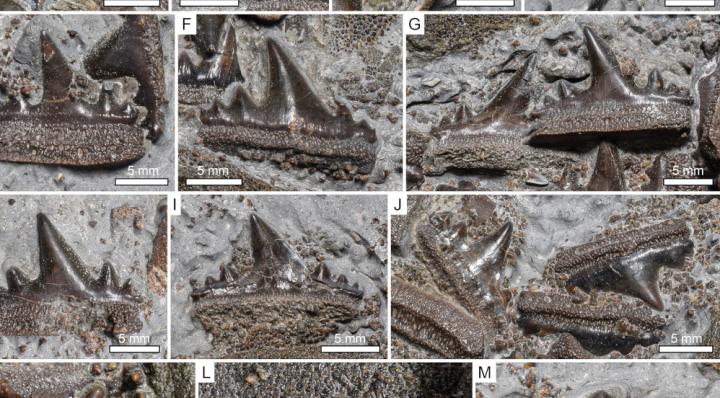
IMAGE
Share on FacebookShare on TwitterShare on LinkedinShare on RedditShare on Telegram

IMAGE

Credit: (© Sebastian Stumpf)

This rare fossil find comes from the Kimmeridge Clay Formation in England, a series of sedimentary rocks that was formed in a shallow, tropical-subtropical sea during the Upper Jurassic, about 150 million years ago. The fossil shark skeleton was found more than 20 years ago on the southern coast of England and is now held in the Etches Collection. Additional fossil shark specimens from it will be investigated in the years to come.

Due to their life-long tooth replacement shark teeth are among the most common vertebrate finds encountered in the fossil record. The low preservation potential of their poorly mineralized cartilaginous skeletons, on the other hand, prevents fossilization of completely preserved specimens in most cases.

The new study published in the journal PeerJ and led by Sebastian Stumpf from the University of Vienna now presents the fossil skeleton of a new ancient shark from the Kimmeridge Clay Formation of England, a fossiliferous rock sequence that was formed during the Late Jurassic in a shallow, tropical-subtropical sea.

The new shark fossil, which is about 150 million years old, is assigned to a previously unknown genus and species of hybodontiform sharks named Durnonovariaodus maiseyi. This extremely rare fossil find was made almost 20 years ago on the southern coast of England and is now held and curated in the Etches Collection, which houses one of the most scientifically significant fossil collections in England.

Hybodontiform sharks are one of the most species-rich groups of extinct sharks and represent the closest relatives to modern sharks. They first appeared during the latest Devonian, about 361 million years ago, and went extinct together with dinosaurs at the end of the Cretaceous, about 66 million years ago. The new genus and species Durnonovariaodus maiseyi differs from all other previously described hybodontiform sharks, including those that are characterized by having similarly shaped teeth. “Durnonovariaodus maiseyi represents an important source of information for better understanding the diversity of sharks in the past as well as for new interpretations of the evolution of hybodontiform sharks, whose relationships are still poorly understood, even after more than 150 years of research,” says Stumpf.

The scientific importance of the Kimmeridge Clay Formation is underlined by additional, but still undescribed hybodontiform shark skeletons, which are also held in the Etches Collection. The research of fossil sharks from the Kimmeridge Clay Formation of England, which will be continued in the years to come, will certainly contain further surprises to be yet discovered.

###

Publication in PeerJ: Stumpf, S., Etches, S., Underwood, C.J., Kriwet, J. 2021. Durnonovariaodus maiseyi gen. et sp. nov., a new hybodontiform shark-like chondrichthyan from the Upper Jurassic Kimmeridge Clay Formation of England. PeerJ. DOI: 10.7717/peerj.11362

Media Contact
Dr. Sebastian Stumpf
[email protected]

Related Journal Article

http://dx.doi.org/10.7717/peerj.11362

Tags: ArchaeologyBiologyEvolutionPaleontology
Share13Tweet8Share2ShareShareShare2

Related Posts

blank

Black Soldier Fly Larvae Boost African Catfish Growth

December 21, 2025
Gene Variations Enhance Beef Cattle Efficiency and Immunity

Gene Variations Enhance Beef Cattle Efficiency and Immunity

December 21, 2025

GBLUP vs. WGBLUP: Genomic Selection in Beef Cattle

December 21, 2025

Anopheles gambiae Habitat and Public Health in Osun

December 21, 2025
Please login to join discussion

POPULAR NEWS

  • Nurses’ Views on Online Learning: Effects on Performance

    Nurses’ Views on Online Learning: Effects on Performance

    70 shares
    Share 28 Tweet 18
  • NSF funds machine-learning research at UNO and UNL to study energy requirements of walking in older adults

    71 shares
    Share 28 Tweet 18
  • Unraveling Levofloxacin’s Impact on Brain Function

    54 shares
    Share 22 Tweet 14
  • Exploring Audiology Accessibility in Johannesburg, South Africa

    51 shares
    Share 20 Tweet 13

About

We bring you the latest biotechnology news from best research centers and universities around the world. Check our website.

Follow us

Recent News

MINFLUX Reveals Cardiac Ryanodine Receptor Structure in 3D

Antisense Therapy Reverses Developmental Defects in SMA Organoids

Black Soldier Fly Larvae Boost African Catfish Growth

Subscribe to Blog via Email

Enter your email address to subscribe to this blog and receive notifications of new posts by email.

Join 70 other subscribers
  • Contact Us

Bioengineer.org © Copyright 2023 All Rights Reserved.

Welcome Back!

Login to your account below

Forgotten Password?

Retrieve your password

Please enter your username or email address to reset your password.

Log In
No Result
View All Result
  • Homepages
    • Home Page 1
    • Home Page 2
  • News
  • National
  • Business
  • Health
  • Lifestyle
  • Science

Bioengineer.org © Copyright 2023 All Rights Reserved.