Credit: ORNL, U.S. Dept. of Energy
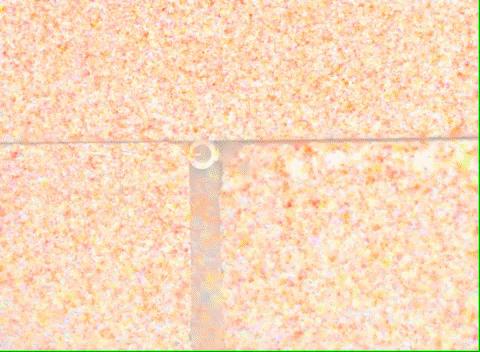
Buildings – The mirage effect
A team of researchers at Oak Ridge National Laboratory has developed a method to detect and measure air leaking from a building’s walls and roof that is quicker, cheaper and less disruptive to occupants.
Current air leak detection options, such as using a blower door and smoke or infrared thermography, are costly and invasive. ORNL’s method is conducted from outside, using an imaging technique to visualize the flow of air leaks and calculate the volumetric flow of air based on the refraction effects imaged by cameras.
“Similar to a mirage over a black top road in the middle of summer, which looks fuzzy because air above the road is hotter than surrounding air, a building’s wall becomes blurry when indoor air meets outdoor air,” ORNL’s Philip Boudreaux said. “Refraction imaging allows us to see this.”
Correcting excess air leakage can decrease energy consumption in buildings and reduce potential for mold growth.
Media contact: Jennifer Burke, 865.414.6835, [email protected]
Image: https:/
Caption: ORNL’s non-disruptive air leak detector captures air escaping from exterior walls and uses refractive imaging to calculate the leakage flow rate. Credit: ORNL, U.S. Dept. of Energy
Microbes – Carbon to chemicals
A research team led by Oak Ridge National Laboratory bioengineered a microbe to efficiently turn waste into itaconic acid, an industrial chemical used in plastics and paints.
Producing itaconic acid currently involves fungi feeding on relatively pure sugars, which can be expensive. In ORNL’s demonstration, the team used lignin, a waste product from biorefineries and paper mills, to grow the bacterium Pseudomonas putida for potentially cheaper itaconic production.
The trick was to separate the microbes’ growth phase from itaconic production using dynamic controls. ORNL designed and deployed a biosensor that triggers the metabolic pathway for itaconic acid production only after the microbes consume all the nitrogen that fuels their growth.
“This technology could provide additional revenue for biorefineries by turning lignin into a high-value chemical,” ORNL’s Adam Guss said. “One strain achieved nearly 90% of theoretical yield during the production phase and could be further optimized. We can also apply these methods to a range of carbon waste streams.”
Media contact: Kim Askey, 865.576.2841, [email protected]
Image: https:/
Caption: Scientists genetically engineered bacteria for itaconic acid production, creating dynamic controls that separate microbial growth and production phases for increased efficiency and acid yield. Credit: NREL
Manufacturing – Recycling goes large
Oak Ridge National Laboratory researchers, in collaboration with Cincinnati Inc., demonstrated the potential for using multimaterials and recycled composites in large-scale applications by 3D printing a mold that replicated a single facet of a precast concrete tool.
The team added a dual feed system to the Big Area Additive Manufacturing machine that enabled printing with multiple materials in a single build using one extruder. Within seven hours, the large 3D printer produced a 400-pound mold measuring 10 feet in length made of recycled carbon fiber reinforced thermoplastic and syntactic foam.
Large-scale printing with multimaterials and recycled composites is anticipated to lower the cost of tooling and open opportunities for printing structures with lightweight cores and tailored properties.
“New mechanical responses can be achieved with multimaterial printing such as soft and rigid segments within a part and impact resistant structures,” said ORNL’s Vidya Kishore.
Media contact: Jennifer Burke, 865.414.6835, [email protected]
Image: https:/
Caption: ORNL, in collaboration with Cincinnati Inc., used the Big Area Additive Manufacturing machine to 3D print a mold made of recycled thermoplastic composite and syntactic foam, demonstrating the potential for multimaterials in large-scale applications. Credit: ORNL, U.S. Dept. of Energy
###
Media Contact
Sara Shoemaker
[email protected]
Original Source
https:/
Related Journal Article
http://dx.