• HOME
  • NEWS
  • EXPLORE
    • CAREER
      • Companies
      • Jobs
    • EVENTS
    • iGEM
      • News
      • Team
    • PHOTOS
    • VIDEO
    • WIKI
  • BLOG
  • COMMUNITY
    • FACEBOOK
    • INSTAGRAM
    • TWITTER
Wednesday, May 13, 2026
BIOENGINEER.ORG
No Result
View All Result
  • Login
  • HOME
  • NEWS
  • EXPLORE
    • CAREER
      • Companies
      • Jobs
        • Lecturer
        • PhD Studentship
        • Postdoc
        • Research Assistant
    • EVENTS
    • iGEM
      • News
      • Team
    • PHOTOS
    • VIDEO
    • WIKI
  • BLOG
  • COMMUNITY
    • FACEBOOK
    • INSTAGRAM
    • TWITTER
  • HOME
  • NEWS
  • EXPLORE
    • CAREER
      • Companies
      • Jobs
        • Lecturer
        • PhD Studentship
        • Postdoc
        • Research Assistant
    • EVENTS
    • iGEM
      • News
      • Team
    • PHOTOS
    • VIDEO
    • WIKI
  • BLOG
  • COMMUNITY
    • FACEBOOK
    • INSTAGRAM
    • TWITTER
No Result
View All Result
Bioengineer.org
No Result
View All Result
Home NEWS Science News Biology

‘Pokemonas’: Bacteria related to lung parasites discovered, named after Pokémon

Bioengineer by Bioengineer
April 30, 2021
in Biology
Reading Time: 3 mins read
0
IMAGE
Share on FacebookShare on TwitterShare on LinkedinShare on RedditShare on Telegram

IMAGE

Credit: Marcel Dominik Solbach

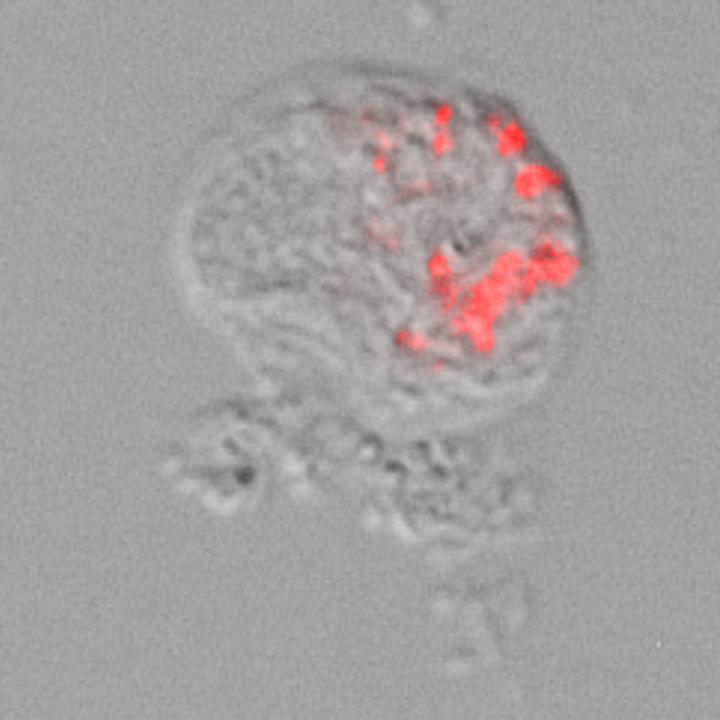
A research team at the University of Cologne has discovered previously undescribed bacteria in amoebae that are related to Legionella and may even cause disease. The researchers from Professor Dr Michael Bonkowski’s working group at the Institute of Zoology have named one of the newly discovered bacteria ‘Pokemonas’ because they live in spherical amoebae, comparable to Pokémon in the video game, which are caught in balls. The results of their research have been published in the journal Frontiers in Cellular and Infection Microbiology.

Bacteria of the order Legionellales have long been of scientific interest because some of these bacteria are known to cause lung disease in humans and animals – such as ‘Legionnaires’ disease’, which is caused by the species Legionella pneumophila and can sometimes be fatal. Legionellales bacteria live and multiply as intracellular parasites in the cells of organisms as hosts. In particular, the hosts of Legionellales are amoebae. The term ‘amoeba’ is used to describe a variety of microorganisms that are not closely related, but share a variable shape and crawling locomotion by means of pseudopods. ‘We wanted to screen amoebae for Legionellales and chose a group of amoebae for our research that had no close relationship to the hosts that were previously studied. The choice fell on the amoeba group Thecofilosea, which is often overlooked by researchers,’ explains Marcel Dominik Solbach.

And indeed, the spherical Thecofilosea serve as host organisms for Legionellales. In Thecofilosea amoebae from environmental samples, the scientists were able to detect various Legionellales species, including two previously undescribed genera and one undescribed species from the genus Legionella. ‘The results show that the range of known host organisms of these bacteria is considerably wider than previously thought. In addition, these findings suggest that many more amoebae may serve as hosts for Legionellales – and thus potentially as vectors of disease. To investigate this further, we are now sequencing the complete genome of these bacteria,’ said Dr Kenneth Dumack, who led the project.

In the future, these new findings should help to better understand how Legionellales bacteria are related amongst each other, and clarify their interactions with their hosts as well as the routes of infection in order to prevent outbreaks of the diseases in humans.

The researchers named one of the genera of bacteria they discovered ‘Pokemonas.’ The genus name ‘Pokemonas’ is a play on words based on the video game franchise ‘Pokémon,’ which celebrates its 25th anniversary this year and which most schoolchildren, students, and their parents should be familiar with. The name alludes to the intracellular lifestyle of the bacteria in the ball-shaped Thecofilosea amoebae, because in the ‘Pokémon’ series games, little monsters are caught in balls, much like ‘Pokemonas’ in the Thecofilosea.

###

Media Contact
Kenneth Dumack
[email protected]

Original Source

https://www.frontiersin.org/articles/10.3389/fcimb.2021.642216/full

Related Journal Article

http://dx.doi.org/10.3389/fcimb.2021.642216/full

Tags: BacteriologyBiology
Share13Tweet8Share2ShareShareShare2

Related Posts

Cutting-Edge Genomic Techniques Reveal Unexpected Cellular Changes in the Aging Brain — Biology

Cutting-Edge Genomic Techniques Reveal Unexpected Cellular Changes in the Aging Brain

May 12, 2026
USC Researchers Initiate Study on the Most Advanced Lab-Grown Kidney Structures — Biology

USC Researchers Initiate Study on the Most Advanced Lab-Grown Kidney Structures

May 12, 2026

Childbirth in Humans Is Not Uniquely Challenging Among Mammals, New Research Shows

May 12, 2026

From Complexity to Clarity: Unraveling the “Topological Laws” Governing Cell Death

May 11, 2026
Please login to join discussion

POPULAR NEWS

  • Research Indicates Potential Connection Between Prenatal Medication Exposure and Elevated Autism Risk

    842 shares
    Share 337 Tweet 211
  • New Study Reveals Plants Can Detect the Sound of Rain

    728 shares
    Share 290 Tweet 182
  • Salmonella Haem Blocks Macrophages, Boosts Infection

    62 shares
    Share 25 Tweet 16
  • Breastmilk Balances E. coli and Beneficial Bacteria in Infant Gut Microbiomes

    57 shares
    Share 23 Tweet 14

About

We bring you the latest biotechnology news from best research centers and universities around the world. Check our website.

Follow us

Recent News

Older Adults’ Views on Medication After Hospital Discharge

Flexible Carbon Nanotube Transistors Surpass 100 GHz

Glycocalyx Exchange Powers Liquid Biopsies of Endothelium

Subscribe to Blog via Email

Enter your email address to subscribe to this blog and receive notifications of new posts by email.

Join 82 other subscribers
  • Contact Us

Bioengineer.org © Copyright 2023 All Rights Reserved.

Welcome Back!

Login to your account below

Forgotten Password?

Retrieve your password

Please enter your username or email address to reset your password.

Log In
No Result
View All Result
  • Homepages
    • Home Page 1
    • Home Page 2
  • News
  • National
  • Business
  • Health
  • Lifestyle
  • Science

Bioengineer.org © Copyright 2023 All Rights Reserved.