• HOME
  • NEWS
  • EXPLORE
    • CAREER
      • Companies
      • Jobs
    • EVENTS
    • iGEM
      • News
      • Team
    • PHOTOS
    • VIDEO
    • WIKI
  • BLOG
  • COMMUNITY
    • FACEBOOK
    • INSTAGRAM
    • TWITTER
Sunday, January 11, 2026
BIOENGINEER.ORG
No Result
View All Result
  • Login
  • HOME
  • NEWS
  • EXPLORE
    • CAREER
      • Companies
      • Jobs
        • Lecturer
        • PhD Studentship
        • Postdoc
        • Research Assistant
    • EVENTS
    • iGEM
      • News
      • Team
    • PHOTOS
    • VIDEO
    • WIKI
  • BLOG
  • COMMUNITY
    • FACEBOOK
    • INSTAGRAM
    • TWITTER
  • HOME
  • NEWS
  • EXPLORE
    • CAREER
      • Companies
      • Jobs
        • Lecturer
        • PhD Studentship
        • Postdoc
        • Research Assistant
    • EVENTS
    • iGEM
      • News
      • Team
    • PHOTOS
    • VIDEO
    • WIKI
  • BLOG
  • COMMUNITY
    • FACEBOOK
    • INSTAGRAM
    • TWITTER
No Result
View All Result
Bioengineer.org
No Result
View All Result
Home NEWS Science News Chemistry

Polarized photovoltaic properties emerge

Bioengineer by Bioengineer
April 1, 2021
in Chemistry
Reading Time: 2 mins read
0
IMAGE
Share on FacebookShare on TwitterShare on LinkedinShare on RedditShare on Telegram

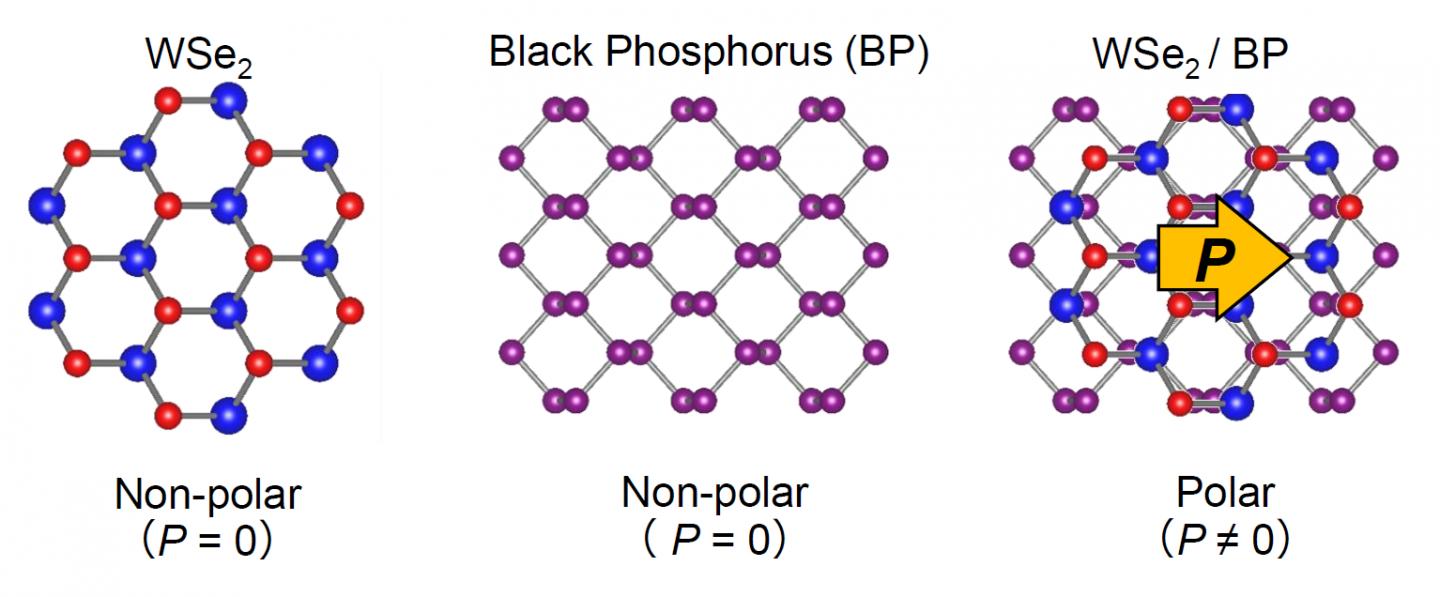
2D materials combine, becoming polarized and giving rise to photovoltaic effect
IMAGE

Credit: ©2021 Ideue et al.

For the first time, researchers have discovered a way to obtain polarity and photovoltaic behavior from certain nonphotovoltaic, atomically flat (2D) materials. The key lies in the special way in which the materials are arranged. The resulting effect is different from, and potentially superior to, the photovoltaic effect commonly found in solar cells.

Solar power is considered a key technology in the move away from fossil fuels. Researchers continually innovate more efficient means to generate solar energy. And many of these innovations come from the world of materials research. Research Associate Toshiya Ideue from the University of Tokyo’s Department of Applied Physics and his team are interested in the photovoltaic properties of 2D materials and their interfaces where these materials meet.

“Quite often, interfaces of multiple 2D materials exhibit different properties to the individual crystals alone,” said Ideue. “We have discovered that two specific materials which ordinarily exhibit no photovoltaic effect do so when stacked in a very particular way.”

The two materials are tungsten selenide (WSe2) and black phosphorus (BP), both of which have different crystal structures. Originally, both materials are nonpolar (do not have a preferred direction of conduction) and do not generate a photocurrent under light. However, Ideue and his team found that by stacking sheets of WSe2 and BP together in the right way, the sample exhibited polarization, and when a light was cast on the material, it generated a current. The effect takes place even if the area of illumination is far from the electrodes at either end of the sample; this is different from how the ordinary photovoltaic effect works.

Key to this behavior is the way the WSe2 and BP are aligned. The crystalline structure of BP has reflective, or mirror, symmetry in one plane, whereas WSe2 has three lines of mirror symmetry. When the symmetry lines of the materials align, the sample gains polarity. This kind of layer stacking is delicate work, but it also reveals to researchers new properties and functions that could not be predicted just by looking at the ordinary form of the materials.

“The biggest challenge for us will be to find a good combination of 2D materials with higher electric-generation efficiency and also to study the effect of changing the angles of the stacks,” said Ideue. “But it’s so rewarding to discover never-before-seen emergent properties of materials. Hopefully, one day this research could improve solar panels. We would like to explore more unprecedented properties and functionalities in nanomaterials.”

###

Media Contact
Research Associate Toshiya Ideue
[email protected]

Original Source

https://www.u-tokyo.ac.jp/focus/en/press/z0508_00172.html

Tags: Chemistry/Physics/Materials SciencesElectrical Engineering/ElectronicsElectromagneticsEnergy/Fuel (non-petroleum)Industrial Engineering/ChemistryMaterials
Share12Tweet8Share2ShareShareShare2

Related Posts

blank

Advancing Alkene Chemistry: Homologative Difunctionalization Breakthrough

January 8, 2026
Biocompatible Ligand Enables Safe In-Cell Protein Arylation

Biocompatible Ligand Enables Safe In-Cell Protein Arylation

January 8, 2026

Monovalent Pseudo-Natural Products Boost IDO1 Degradation

January 7, 2026

Catalytic Enantioselective [1,2]-Wittig Rearrangement Breakthrough

January 7, 2026
Please login to join discussion

POPULAR NEWS

  • Enhancing Spiritual Care Education in Nursing Programs

    154 shares
    Share 62 Tweet 39
  • PTSD, Depression, Anxiety in Childhood Cancer Survivors, Parents

    146 shares
    Share 58 Tweet 37
  • Robotic Ureteral Reconstruction: A Novel Approach

    56 shares
    Share 22 Tweet 14
  • Impact of Vegan Diet and Resistance Exercise on Muscle Volume

    47 shares
    Share 19 Tweet 12

About

We bring you the latest biotechnology news from best research centers and universities around the world. Check our website.

Follow us

Recent News

Empowering Hong Kong Teens: Mental Health Leadership Training

Self-Care and Efficacy in Older Adults’ Health

Risk Factors for Psychological Symptoms in Older Turks

Subscribe to Blog via Email

Success! An email was just sent to confirm your subscription. Please find the email now and click 'Confirm' to start subscribing.

Join 71 other subscribers
  • Contact Us

Bioengineer.org © Copyright 2023 All Rights Reserved.

Welcome Back!

Login to your account below

Forgotten Password?

Retrieve your password

Please enter your username or email address to reset your password.

Log In
No Result
View All Result
  • Homepages
    • Home Page 1
    • Home Page 2
  • News
  • National
  • Business
  • Health
  • Lifestyle
  • Science

Bioengineer.org © Copyright 2023 All Rights Reserved.