• HOME
  • NEWS
  • EXPLORE
    • CAREER
      • Companies
      • Jobs
    • EVENTS
    • iGEM
      • News
      • Team
    • PHOTOS
    • VIDEO
    • WIKI
  • BLOG
  • COMMUNITY
    • FACEBOOK
    • INSTAGRAM
    • TWITTER
Wednesday, June 24, 2026
BIOENGINEER.ORG
No Result
View All Result
  • Login
  • HOME
  • NEWS
  • EXPLORE
    • CAREER
      • Companies
      • Jobs
        • Lecturer
        • PhD Studentship
        • Postdoc
        • Research Assistant
    • EVENTS
    • iGEM
      • News
      • Team
    • PHOTOS
    • VIDEO
    • WIKI
  • BLOG
  • COMMUNITY
    • FACEBOOK
    • INSTAGRAM
    • TWITTER
  • HOME
  • NEWS
  • EXPLORE
    • CAREER
      • Companies
      • Jobs
        • Lecturer
        • PhD Studentship
        • Postdoc
        • Research Assistant
    • EVENTS
    • iGEM
      • News
      • Team
    • PHOTOS
    • VIDEO
    • WIKI
  • BLOG
  • COMMUNITY
    • FACEBOOK
    • INSTAGRAM
    • TWITTER
No Result
View All Result
Bioengineer.org
No Result
View All Result
Home NEWS Science News Chemistry

Smart glass has a bright future

Bioengineer by Bioengineer
April 1, 2021
in Chemistry
Reading Time: 3 mins read
0
IMAGE
Share on FacebookShare on TwitterShare on LinkedinShare on RedditShare on Telegram

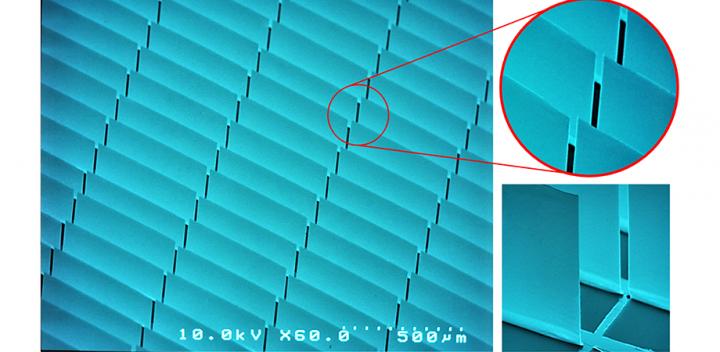
Light modulation via optical MEMS microshutter and micromirror arrays could provide huge energy savings
IMAGE

Credit: Hillmer et al.

Buildings are responsible for 40 percent of primary energy consumption and 36 percent of total CO2 emissions. And, as we know, CO2 emissions trigger global warming, sea level rise, and profound changes in ocean ecosystems. Substituting the inefficient glazing areas of buildings with energy efficient smart glazing windows has great potential to decrease energy consumption for lighting and temperature control.

Harmut Hillmer et al. of the University of Kassel in Germany demonstrate that potential in “MOEMS micromirror arrays in smart windows for daylight steering,” a paper published recently in the inaugural issue of the Journal of Optical Microsystems.

“Our smart glazing is based on millions of micromirrors, invisible to the bare eye, and reflects incoming sunlight according to user actions, sun positions, daytime, and seasons, providing a personalized light steering inside the building,” Hillmer said.

The micromirror array is invulnerable to wind, window cleaning, or any weather conditions because it is located in the space between the windowpanes filled with noble gas such as argon or krypton. The glazing provides free solar heat in winter and overheating prevention in summer, and it enables healthy natural daylight, huge energy savings (up to 35 percent), massive CO2 reduction (up to 30 percent), and a reduction of 10 percent steel and concrete in high-rise buildings.

Apart from the energy problem, artificial lighting also has consequences for health and well-being. Various studies have linked artificial lighting to lack of concentration, high susceptibility to illness, disturbed biorhythms, and sleeplessness. Smart glass can reduce reliance on artificial lighting by optimizing natural daylight in a room.

Current state-of-the-art smart glazings are currently optimized either for winter or for summer-and not able to ensure energy-saving performance year-round. There has been a need for a smart and automatic technology that can react to local climate (daytime, season), uses available sunlight, regulates light and temperature, and saves substantial energy.

The researchers’ MEMS micromirror arrays are integrated inside insulation glazing and are operated by an electronic control system. The orientation of mirrors is controlled by the voltage between respective electrodes. Motion sensors in the room detect the number, position, and movement of users in the room.

The results include much higher actuation speed in the sub-ms range, 40-times lower power consumption than electrochromic or liquid crystal concepts, reflection instead of absorption, and color neutrality. Rapid aging tests of the micromirror structure were performed to study reliability and revealed sustainability, robustness, and long lifetimes of the micromirror arrays.

And with positive results like that, the benefits of this smart glass are crystal clear.

###

Read the open access research article: Harmut Hillmer, Mustaqim Siddi Que Iskhandar, Muhammad Kamrul Hasan, Sapida Akhundzada, Basim Al-Qargholi, Andreas Tatzel, “MOEMS micromirror arrays in smart windows for daylight steering,” J. Optical Microsyst. 1(1), 014502 (2021). DOI: 10.1117/1.JOM.1.1.014502

Media Contact
Daneet Steffens
[email protected]

Original Source

https://spie.org/news/smart-glass-has-a-bright-future?SSO=1

Related Journal Article

http://dx.doi.org/10.1117/1.JOM.1.1.014502

Tags: Biomedical/Environmental/Chemical EngineeringChemistry/Physics/Materials SciencesEnergy/Fuel (non-petroleum)Industrial Engineering/ChemistryMaterialsNanotechnology/MicromachinesOpticsResearch/DevelopmentUrbanization
Share13Tweet8Share2ShareShareShare2

Related Posts

Electric Field and Oxygen Spillover Collaborate to Control Electrode Migration in SOECs

June 24, 2026
Innovative Speckle-Based Metrology System Advances Precision Measurement of Next-Generation X-Ray Mirrors — Chemistry

Innovative Speckle-Based Metrology System Advances Precision Measurement of Next-Generation X-Ray Mirrors

June 24, 2026

Water-Activated PVA Film Transforms from Bioplastic to High-Performance Wood Adhesive

June 24, 2026

SwRI and St. Mary’s University Partner to Forecast Durability of Metal Hydride Hydrogen Storage

June 24, 2026
Please login to join discussion

POPULAR NEWS

  • Saying Goodbye to PGY-6: Pediatric Fellowship Realities

    103 shares
    Share 41 Tweet 26
  • Multi-Hospital Study Reveals Long Covid Burden Is Twice as High as Current Estimates

    92 shares
    Share 36 Tweet 23
  • Detection of EDCs in Breast Milk and Infant Urine Up to Six Months Highlights Early Exposure Risks

    77 shares
    Share 31 Tweet 19
  • New Drug Candidate Developed at McMaster Shows Potential for Treating Brain Cancer

    58 shares
    Share 23 Tweet 15

About

We bring you the latest biotechnology news from best research centers and universities around the world. Check our website.

Follow us

Recent News

Acute Psychedelic Effects on Brain Entropy Revealed

Building Trust as the Foundation of Digital Behavioral Health

Virtual Reality Study Conducted Remotely Advances Insights into Cybersickness

Subscribe to Blog via Email

Enter your email address to subscribe to this blog and receive notifications of new posts by email.

Join 82 other subscribers
  • Contact Us

Bioengineer.org © Copyright 2023 All Rights Reserved.

Welcome Back!

Login to your account below

Forgotten Password?

Retrieve your password

Please enter your username or email address to reset your password.

Log In
No Result
View All Result
  • Homepages
    • Home Page 1
    • Home Page 2
  • News
  • National
  • Business
  • Health
  • Lifestyle
  • Science

Bioengineer.org © Copyright 2023 All Rights Reserved.