One-of-a-kind instrument measures humidity’s effects on smoke, filling a key data gap in predicting the scale and long-term impact of fire
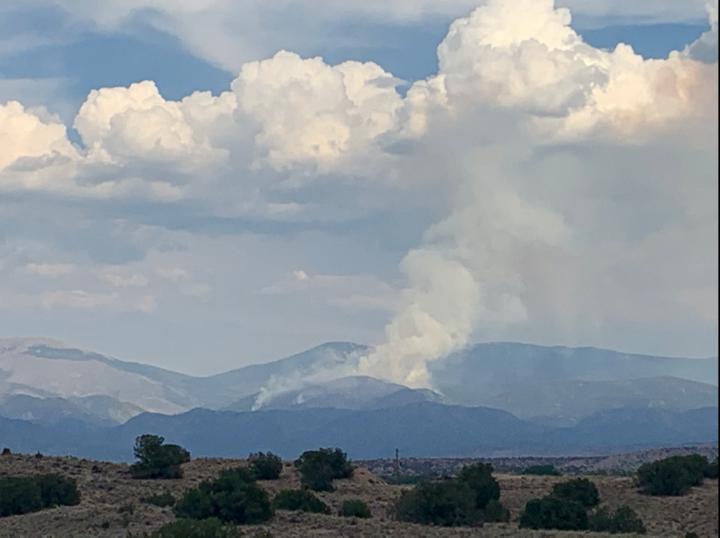
Credit: Photo by Manvendra Dubey.
LOS ALAMOS, N.M., March 29, 2021–A first-of-its-kind instrument that samples smoke from megafires and scans humidity will help researchers better understand the scale and long-term impact of fires–specifically how far and high the smoke will travel; when and where it will rain; and whether the wet smoke will warm the climate by absorbing sunlight.
“Smoke containing soot and other toxic particles from megafires can travel thousands of kilometers at high altitudes where winds are fast and air is dry,” said Manvendra Dubey, a Los Alamos National Laboratory atmospheric scientist and co-author on a paper published last week in Aerosol Science and Technology. “These smoke-filled clouds can absorb much more sunlight than dry soot–but this effect on light absorption has been difficult to measure because laser-based techniques heat the particles and evaporate the water, which corrupts observations.”
The new instrument circumvents this problem by developing a gentler technique that uses a low-power, light-emitting diode to measure water’s effect on scattering and absorbtion by wildfire smoke and hence its growth. By sampling the smoke and scanning the humidity from dry to very humid conditions while measuring its optical properties, the instrument mimicks what happens during cloud and rain formation, and the effects of water are measured immediately. Laboratory experiments show for the first time that water coating the black soot-like material can enhance the light absorption by up to 20 percent.
The instrument will next be tested and the water effects probed in smoke from wildfires sampled at Los Alamos’ Center for Aerosol-gas Forensics (CAFÉ). In addition, the effect of water uptake by soot in polluted air on deep convective storms will be measured at the DOE’s Atmospheric Radiation Monitoring TRACER-CAT campaign led by Los Alamos in Houston next year.
Dubey worked with Christian M. Carrico of the New Mexico Institute of Mining and Technology on a research team that included scientists from Los Alamos, New Mexico Tech, Michigan Technological University, and Aerodyne Research, Inc. The novel findings of experiments were performed by the Los Alamos Director’s postdoctoral fellow Kyle Gorkowski and Department of Energy graduate awardee Tyler Capek.
###
Paper: “Humidified Single Scattering Albedometer (H-CAPS-PMSSA): Design, Data-Analysis, and Validation,” Christian M. Carrico, Tyler J. Capek, Kyle J. Gorkowski, Jared T. Lam, Sabina Gulick, Jaimy Karacaoglu, James E. Lee, Charlotte Dungan, Allison C. Aiken, Timothy B. Onasch, Andrew Freedman, Claudio Mazzoleni, and Manvendra K. Dubey, Aerosol Science and Technology, volume 55, issue 4,
https:/
Funding: This work was supported by the U.S. DOE, Office of Science, Office of Workforce Development for Teachers and Scientists (WDTS) under the Visiting Faculty Program (VFP) for Carrico and Lam and the DOE Science Undergraduate Laboratory Internships (SULI) program for Karacaoglu. Capek was partially supported by an award through the DOE Office of Science Graduate Student Research (SCGSR) program. Additional support was provided by the Office of Biological and Environmental Research’s Atmospheric System Research program. Research at Los Alamos National Laboratory was supported by the DOE’s Office of Biological and Environmental Research (BER) and Atmospheric System Research (ASR) Program, the Lab’s Directed Research portion of the Laboratory Directed Research and Development program and Gorkowski as a Director’s postdoctoral fellow.
About Los Alamos National Laboratory (www.lanl.gov)
Los Alamos National Laboratory, a multidisciplinary research institution engaged in strategic science on behalf of national security, is managed by Triad, a public service oriented, national security science organization equally owned by its three founding members: Battelle Memorial Institute (Battelle), the Texas A&M University System (TAMUS), and the Regents of the University of California (UC) for the Department of Energy’s National Nuclear Security Administration.
Los Alamos enhances national security by ensuring the safety and reliability of the U.S. nuclear stockpile, developing technologies to reduce threats from weapons of mass destruction, and solving problems related to energy, environment, infrastructure, health, and global security concerns.
LA-UR-21-22850
Media Contact
Charles Poling
[email protected]
Original Source
https:/
Related Journal Article
http://dx.