The blinking frequency affects the behaviour of the other fish in the school.
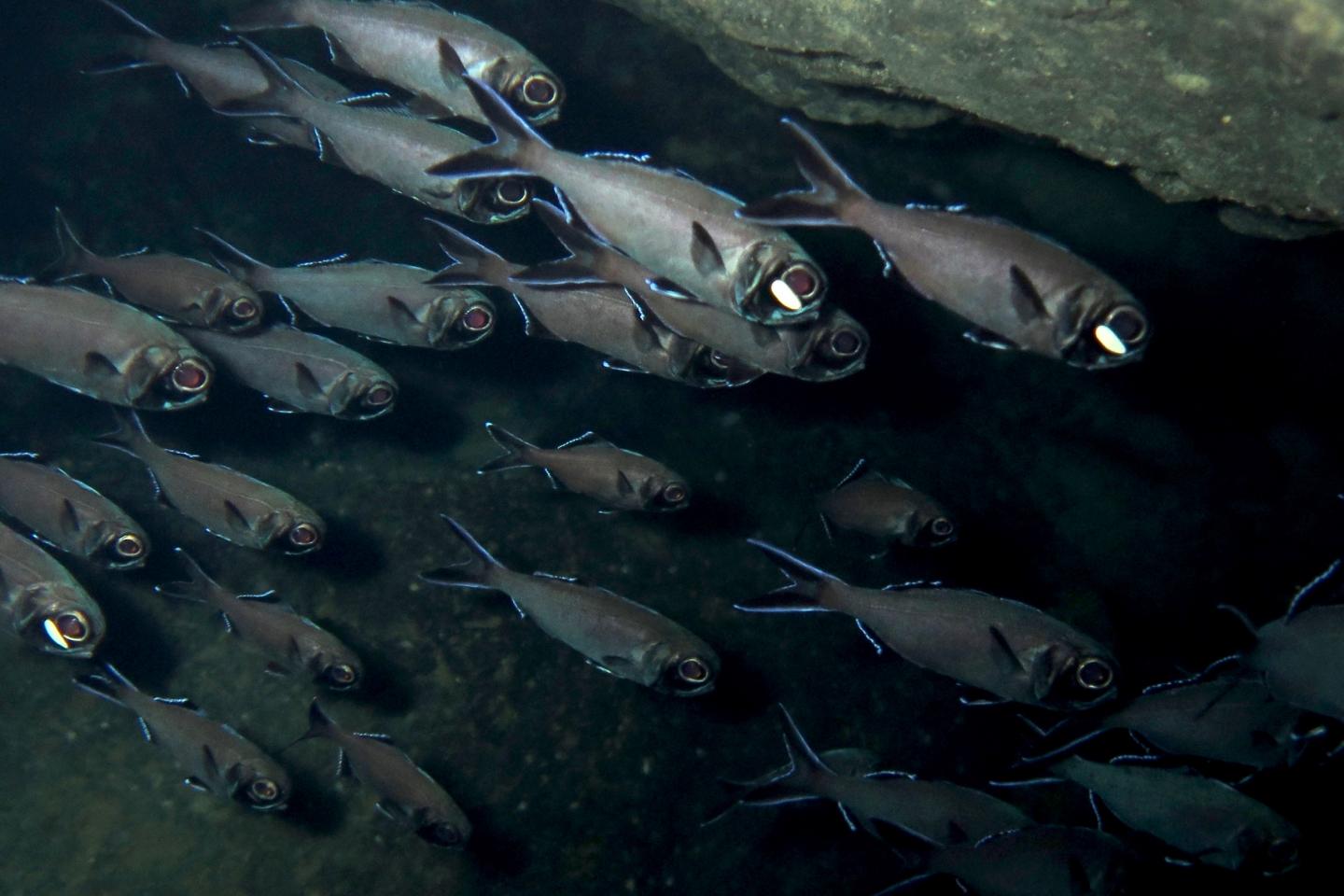
Credit: RUB, Department of General Zoology and Neurobiology, Stefan Herlitze
Flashlight fish have the ability to generate situation-specific blink patterns resembling a visual Morse code. Researchers at Ruhr-Universität Bochum have shown in laboratory and field experiments that the animals use these light signals to coordinate their behaviour in the school when visibility is limited. Both the light intensity and the blinking frequency affected the animals’ behaviour. The team headed by Peter Jägers and Professor Stefan Herlitze from the Department of General Zoology and Neurobiology has shared their findings in the journal Scientific Reports, published online on 19 March 2021. “Our data show that flashlight fish are attracted by the light signals emitted by other school members,” points out Jägers.
Milky Way in the water
Flashlight fish of the species Anomalops katoptron have a luminescent organ under their eyes that is filled with luminescent bacteria and which they can occlude so that it looks as if they are blinking. During the day, the animals hide in caves, rock crevices or in dark, deep water. “On moonless nights, up to a thousand individuals migrate in a school into the plankton-rich surface water,” says Peter Jägers, who observed the fish in the wild during a diving expedition in the Indo-Pacific. “It is a surreal experience to see the schools – like a Milky Way in the water.”
To understand the function of the flashing patterns, the researchers first studied Anomalops katoptron in the lab in a large water tank containing fish dummies that could be digitally controlled to mimic the animals’ light signals. They also used infrared cameras to record the movements of individual animals in response to the artificial flashing lights. During the experiments, only one animal was in the tank at a time, with several individuals being tested one after the other.
Flashlight dummies attract fish
When the researchers placed a single dummy that was flashing light in the middle of the tank, the fish moved closer to it the faster the light flashed. In another experiment, 13 lights were positioned around the tank and lit up one after the other at varying time intervals. “We observed a high motivation among the flashlight fish to head towards the light,” says Peter Jägers.
Based on the laboratory experiments, the researchers deduced that a faster flashing is a signal for Anomalops katoptron to stay closer to their fellow fish in the school, as the group offers, for example, protection from predators. This theory was confirmed in field experiments. On a diving expedition, the researchers showed that the animals reacted to stress by blinking more rapidly.
Waiting for the school at night in the sea
Diving at night in the dark, the researchers waited until a school of flashlight fish got close. The animals avoided light brighter than moonlight by fleeing immediately. The Bochum team triggered the escape response with dim red light and simultaneously recorded the animals and their blinking patterns with special cameras. This is how they showed that stress was associated with an increased blinking frequency. “We assume that the increased blinking frequency is the signal to follow the other group members more closely under stress,” concludes Peter Jägers. “In our study, we demonstrated for the first time that there is a direct link between visually communicated signals under limited light conditions, such as those prevailing at night or in the deep sea, and the school formation of fish. We hope that this can be of help in future studies of, for example, the largely unexplored deep sea.”
###
Media Contact
Peter Jägers
[email protected]
Original Source
https:/
Related Journal Article
http://dx.