• HOME
  • NEWS
  • EXPLORE
    • CAREER
      • Companies
      • Jobs
    • EVENTS
    • iGEM
      • News
      • Team
    • PHOTOS
    • VIDEO
    • WIKI
  • BLOG
  • COMMUNITY
    • FACEBOOK
    • INSTAGRAM
    • TWITTER
Sunday, December 21, 2025
BIOENGINEER.ORG
No Result
View All Result
  • Login
  • HOME
  • NEWS
  • EXPLORE
    • CAREER
      • Companies
      • Jobs
        • Lecturer
        • PhD Studentship
        • Postdoc
        • Research Assistant
    • EVENTS
    • iGEM
      • News
      • Team
    • PHOTOS
    • VIDEO
    • WIKI
  • BLOG
  • COMMUNITY
    • FACEBOOK
    • INSTAGRAM
    • TWITTER
  • HOME
  • NEWS
  • EXPLORE
    • CAREER
      • Companies
      • Jobs
        • Lecturer
        • PhD Studentship
        • Postdoc
        • Research Assistant
    • EVENTS
    • iGEM
      • News
      • Team
    • PHOTOS
    • VIDEO
    • WIKI
  • BLOG
  • COMMUNITY
    • FACEBOOK
    • INSTAGRAM
    • TWITTER
No Result
View All Result
Bioengineer.org
No Result
View All Result
Home NEWS Science News Chemistry

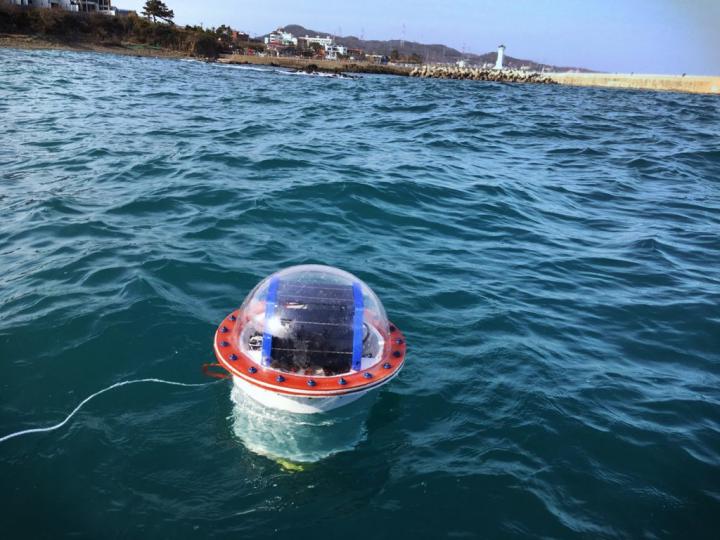
Unveiling smart buoys for marine environment monitoring!

Bioengineer by Bioengineer
March 19, 2021
in Chemistry
Reading Time: 2 mins read
0
IMAGE
Share on FacebookShare on TwitterShare on LinkedinShare on RedditShare on Telegram

IMAGE

Credit: Seawater Resources Technology Research Center of UNIST

“Seawater battery-based smart buoys can monitor and collect over 15 different marine data, such as salinity, pH, and water temperature, as well as the location and range of fishing grounds. As it is a promising alternative for safe and scalable energy storage, we expect its further applications in the ocean sector!”

The 2020 Regional Vitality Project Project, carried out among UNIST and Korea Institute of Maritime Science and Technology (KIOST) is producing concrete results. The company to benefit from this project is KLabs Inc., which is about to launch smart buoys that applied seawater batteries.

The “Seawater Battery-based Multi-Purpose Buoy” by KLabs Inc. is a device that can monitor and collect various data on the marine environment. A seawater battery that uses the naturally-abundant seawater as a sodium source to charge and discharge electricity is a key feature of this device. Besides, with 3D printing, mass-customized products are also possible without having any bearing on costs.

The demonstration of new product development is significant in that both research institutes and private companies have cooperated since the early phases of the new product development process. In addition, it is expected that both the commercialization and on-site application will be accelerated, as prototypes have been customized to meet specific business needs.

This prototype demonstration is part of the Regional Vitality Project Project, promoted by the Ministry of Trade, Industry and Energy (MOTIE). Since the selection of demonstration project to lay the groundwork for the development of ‘Maritime-Specialized Power Supply System and Maritime Equipment,” in May 2020, UNIST and KIOST have actively been working with the companies in the Ulsan region to produce and demonstrate seawater battery-based products.

Meanwhile, UNIST has been leading the seawater battery research since the development of the world’s first seawater battery in 2014. With the support from the Korea Electric Power Corporation (KEPCO), Korea East-West Power Company Ltd. (EWP), and KIOST, the center continues to push forwards commercializing the seawater batteries. Besides, with the completion of the construction of the Seawater Resources Technology Research Center of UNIST in November 2020, UNIST is taking the lead in upgrading research on seawater batteries.

###

Media Contact
JooHyeon Heo
[email protected]

Original Source

https://news.unist.ac.kr/unveiling-smart-buoys-for-marine-environment-monitoring/

Tags: Chemistry/Physics/Materials SciencesElectrical Engineering/ElectronicsEnergy/Fuel (non-petroleum)Industrial Engineering/ChemistryMaterialsResearch/DevelopmentTechnology Transfer
Share12Tweet8Share2ShareShareShare2

Related Posts

Cutting Electrolyte Reduction Boosts High-Energy Battery Performance

Cutting Electrolyte Reduction Boosts High-Energy Battery Performance

December 19, 2025
Microenvironment Shapes Gold-Catalysed CO2 Electroreduction

Microenvironment Shapes Gold-Catalysed CO2 Electroreduction

December 11, 2025

Photoswitchable Olefins Enable Controlled Polymerization

December 11, 2025

Cation Hydration Entropy Controls Chloride Ion Diffusion

December 10, 2025
Please login to join discussion

POPULAR NEWS

  • Nurses’ Views on Online Learning: Effects on Performance

    Nurses’ Views on Online Learning: Effects on Performance

    70 shares
    Share 28 Tweet 18
  • NSF funds machine-learning research at UNO and UNL to study energy requirements of walking in older adults

    71 shares
    Share 28 Tweet 18
  • Unraveling Levofloxacin’s Impact on Brain Function

    53 shares
    Share 21 Tweet 13
  • Exploring Audiology Accessibility in Johannesburg, South Africa

    51 shares
    Share 20 Tweet 13

About

We bring you the latest biotechnology news from best research centers and universities around the world. Check our website.

Follow us

Recent News

Insights from Canadian Physicians on Deprescribing in Seniors

Staphylococcus Fatty Acids Control Joint Infection Aggregation

Unlocking Genetic Links Between Obesity and Autoimmunity

Subscribe to Blog via Email

Enter your email address to subscribe to this blog and receive notifications of new posts by email.

Join 70 other subscribers
  • Contact Us

Bioengineer.org © Copyright 2023 All Rights Reserved.

Welcome Back!

Login to your account below

Forgotten Password?

Retrieve your password

Please enter your username or email address to reset your password.

Log In
No Result
View All Result
  • Homepages
    • Home Page 1
    • Home Page 2
  • News
  • National
  • Business
  • Health
  • Lifestyle
  • Science

Bioengineer.org © Copyright 2023 All Rights Reserved.