• HOME
  • NEWS
  • EXPLORE
    • CAREER
      • Companies
      • Jobs
    • EVENTS
    • iGEM
      • News
      • Team
    • PHOTOS
    • VIDEO
    • WIKI
  • BLOG
  • COMMUNITY
    • FACEBOOK
    • INSTAGRAM
    • TWITTER
Sunday, October 4, 2026
BIOENGINEER.ORG
No Result
View All Result
  • Login
  • HOME
  • NEWS
  • EXPLORE
    • CAREER
      • Companies
      • Jobs
        • Lecturer
        • PhD Studentship
        • Postdoc
        • Research Assistant
    • EVENTS
    • iGEM
      • News
      • Team
    • PHOTOS
    • VIDEO
    • WIKI
  • BLOG
  • COMMUNITY
    • FACEBOOK
    • INSTAGRAM
    • TWITTER
  • HOME
  • NEWS
  • EXPLORE
    • CAREER
      • Companies
      • Jobs
        • Lecturer
        • PhD Studentship
        • Postdoc
        • Research Assistant
    • EVENTS
    • iGEM
      • News
      • Team
    • PHOTOS
    • VIDEO
    • WIKI
  • BLOG
  • COMMUNITY
    • FACEBOOK
    • INSTAGRAM
    • TWITTER
No Result
View All Result
Bioengineer.org
No Result
View All Result
Home NEWS Science News

Novel targeted modification strategy improves selectivity of polyamide nanofiltration membranes

Bioengineer by Bioengineer
March 11, 2021
in Science News
Reading Time: 2 mins read
0
IMAGE
Share on FacebookShare on TwitterShare on LinkedinShare on RedditShare on Telegram

IMAGE

Credit: WANG Jingyu

Recently, a research group led by Prof. WAN Yinhua from the Institute of Process Engineering (IPE) of the Chinese Academy of Sciences developed a novel targeted modification strategy to improve the separation selectivity of polyamide NF membranes.

The study was published in Journal of Membrane Science on March 10.

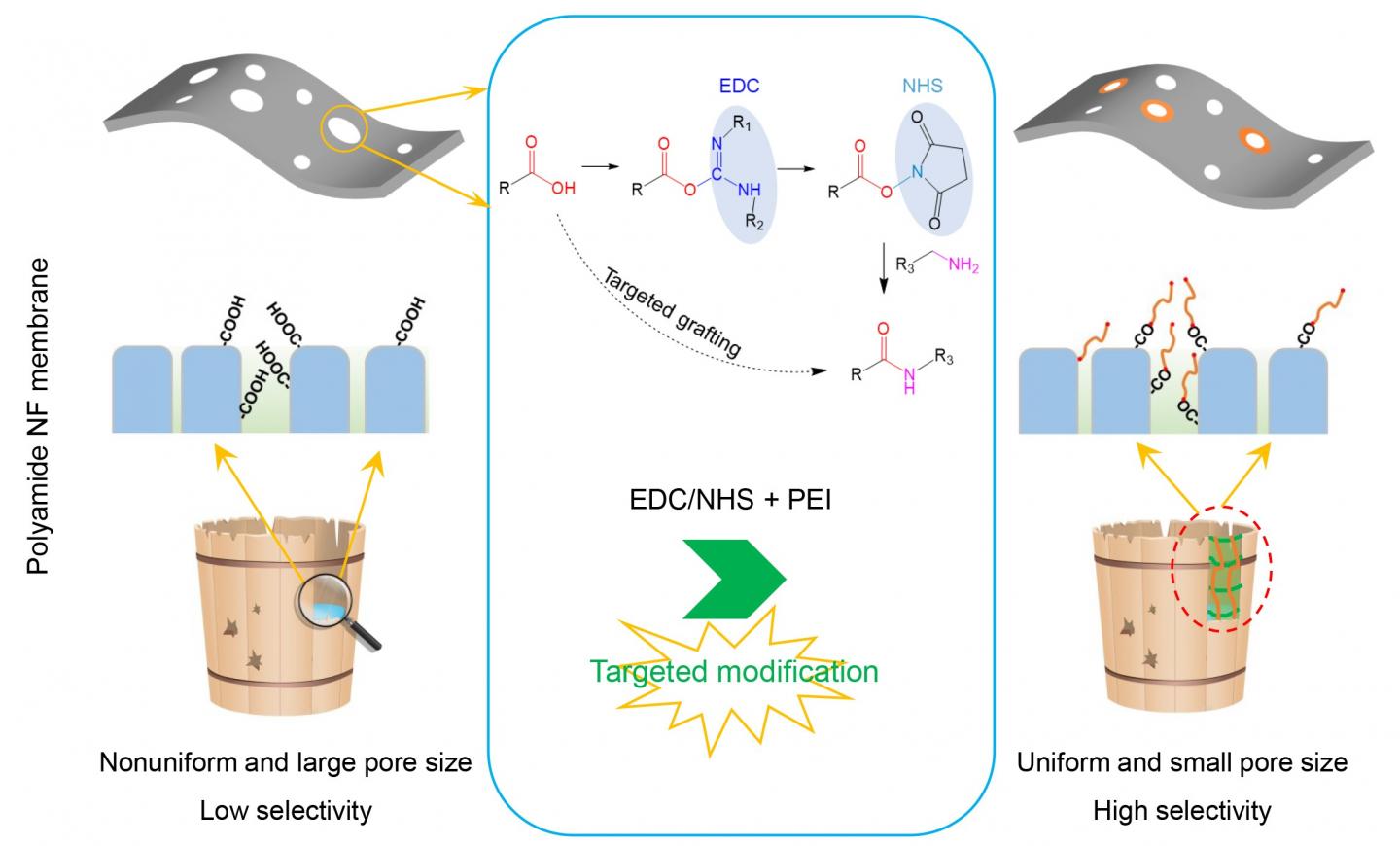
The low selectivity of commercial nanofiltration (NF) membranes to monosaccharides and monovalent salts is mainly due to the nonuniform pore size distribution and strong electronegativity.

Targeted modification can regulate the pore size distribution and electronegativity of polyamide NF membranes, and thus improve the separation selectivity.

In the strategy, carboxyl groups (-COOH) on the surface are activated by N-(3-Dimethylaminopropyl)-N’-ethyl carbodiimide (EDC) and N-Hydroxy succinimide (NHS), and subsequently grafted onto monomer or polymer containing amino groups (-NH2) for more precise separation.

The novel targeted modification strategy reduced the effective mean pore size while maintaining the porosity of the NF membrane, due to pore segmentation. This resulted in a remarkable improvement in glucose/fructose rejection (from 67.96% to 84.14%) and separation factor (from 2.20 to 6.78), with only a 4.70% permeability loss.

“The outcome of this work not only improves the separation efficiency of small organic and inorganic salts by NF, but also provides a new perspective in regulating pore size distribution and surface charge of NF membranes for precisely separating small molecules,” said Prof. LUO Jianquan from IPE, the corresponding author of the study.

The modified membrane also maintained separation performance in crossflow filtration and after alkaline cleaning, which outperformed the pristine NF membrane and those modified by uniform coating and simple physical adsorption.

###

Media Contact
LI Xiangyu
[email protected]

Related Journal Article

http://dx.doi.org/10.1016/j.memsci.2021.119250

Tags: Atomic/Molecular/Particle PhysicsChemistry/Physics/Materials SciencesIndustrial Engineering/ChemistryMaterials
Share12Tweet8Share2ShareShareShare2

Related Posts

Miniature Perfusion Screens and a Manufacturability Index Reshape How Biotech Picks Its Best Cell Clones

Miniature Perfusion Screens and a Manufacturability Index Reshape How Biotech Picks Its Best Cell Clones

October 4, 2026
Shrubs, Rain and Plant Traits Decide How Well Alpine Meadows Work

Shrubs, Rain and Plant Traits Decide How Well Alpine Meadows Work

October 4, 2026

Green Solvent and Supercomputer Simulations Unlock a Stubborn Tea Enzyme

October 4, 2026

Artificial Bees Crack the Rubber Blend Puzzle for Cheaper, Tougher Car Parts

October 4, 2026
Please login to join discussion

POPULAR NEWS

  • Alloys That Shrink Their Own Grains: New PIX Mechanism Refines Metals With Heat Alone

    Alloys That Shrink Their Own Grains: New PIX Mechanism Refines Metals With Heat Alone

    29 shares
    Share 12 Tweet 7
  • Endurance Exercise Reshapes the Liver in Males and Females Through Distinct Molecular Routes

    29 shares
    Share 12 Tweet 7
  • Single Transcription Factor PU.1 Rapidly Converts Fibroblasts into Macrophage-Lineage Cells

    29 shares
    Share 12 Tweet 7
  • New Scale Measures How Ready Nurse Educators Really Are for the AI Era

    29 shares
    Share 12 Tweet 7

About

We bring you the latest biotechnology news from best research centers and universities around the world. Check our website.

Follow us

Recent News

Alloys That Shrink Their Own Grains: New PIX Mechanism Refines Metals With Heat Alone

Endurance Exercise Reshapes the Liver in Males and Females Through Distinct Molecular Routes

Single Transcription Factor PU.1 Rapidly Converts Fibroblasts into Macrophage-Lineage Cells

Subscribe to Blog via Email

Enter your email address to subscribe to this blog and receive notifications of new posts by email.

Join 85 other subscribers
  • Contact Us

Bioengineer.org © Copyright 2023 All Rights Reserved.

Welcome Back!

Login to your account below

Forgotten Password?

Retrieve your password

Please enter your username or email address to reset your password.

Log In
No Result
View All Result
  • Homepages
    • Home Page 1
    • Home Page 2
  • News
  • National
  • Business
  • Health
  • Lifestyle
  • Science

Bioengineer.org © Copyright 2023 All Rights Reserved.