• HOME
  • NEWS
  • EXPLORE
    • CAREER
      • Companies
      • Jobs
    • EVENTS
    • iGEM
      • News
      • Team
    • PHOTOS
    • VIDEO
    • WIKI
  • BLOG
  • COMMUNITY
    • FACEBOOK
    • INSTAGRAM
    • TWITTER
Saturday, February 7, 2026
BIOENGINEER.ORG
No Result
View All Result
  • Login
  • HOME
  • NEWS
  • EXPLORE
    • CAREER
      • Companies
      • Jobs
        • Lecturer
        • PhD Studentship
        • Postdoc
        • Research Assistant
    • EVENTS
    • iGEM
      • News
      • Team
    • PHOTOS
    • VIDEO
    • WIKI
  • BLOG
  • COMMUNITY
    • FACEBOOK
    • INSTAGRAM
    • TWITTER
  • HOME
  • NEWS
  • EXPLORE
    • CAREER
      • Companies
      • Jobs
        • Lecturer
        • PhD Studentship
        • Postdoc
        • Research Assistant
    • EVENTS
    • iGEM
      • News
      • Team
    • PHOTOS
    • VIDEO
    • WIKI
  • BLOG
  • COMMUNITY
    • FACEBOOK
    • INSTAGRAM
    • TWITTER
No Result
View All Result
Bioengineer.org
No Result
View All Result
Home NEWS Science News Chemistry

Scientists found new way to synthesize chiral tetraarylmethanes

Bioengineer by Bioengineer
March 11, 2021
in Chemistry
Reading Time: 2 mins read
0
IMAGE
Share on FacebookShare on TwitterShare on LinkedinShare on RedditShare on Telegram

IMAGE

Credit: The Hong Kong University of Science and Technology

The research was published on the journal Nature Catalysis on December 14, 2020.

A strong bias towards linear and disc-shaped molecules has long been observed in drug molecules. In contrast, spherical molecules have been utilized on far fewer occasions, due to the lack of efficient access to the latter chemical space. Specifically, efficient strategies to synthesize tetraarylmethanes, a unique family of spherical molecules, have remained scarce.

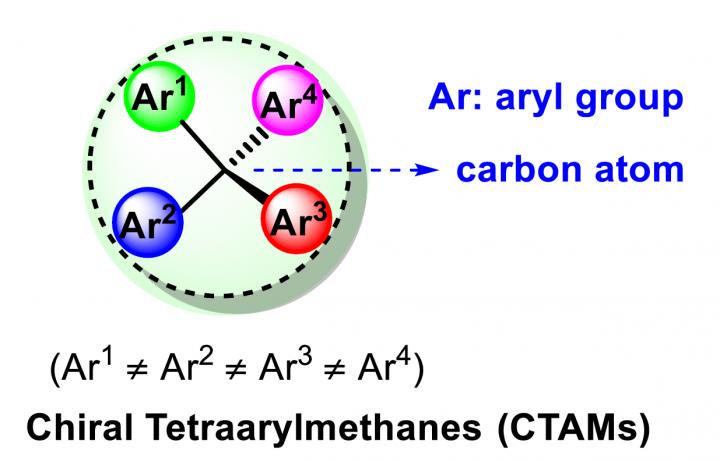
Chiral tetraarylmethanes (CTAMs), a unique family of spherical molecules which bear four different aryl groups with defined stereochemistry, remain as a mystery due to the lack of efficient asymmetric synthesis. The challenge in asymmetric synthesis of CTAMs lies in not only the high barrier in making the extremely congested C?C bond connecting the central carbon and the aryl rings by conventional strategies, but also the difficulty in stereodifferentiation between the existing and likely similar aryl rings when attaching a new aryl ring to the central carbon.

“The difficulty associated with the synthesis of chiral tetraarylmethanes is that forming extremely crowded bonds around a small carbon atom requires overcoming a substantial energy barrier,” said Jianwei Sun, the group’s leading researcher and Professor at the Department of Chemistry, HKUST. “The other difficulty is that the bond has to be made in a defined 3D orientation. These two requirements substantially reduce the chance of success, but we were able to overcome by using a tagging strategy.”

Starting from suitably tagged triarylmethanols, the protocol takes advantage of the hydrogen bonding interactions in the key para-quinone methide and indole iminium intermediates to build two libraries of enantioenriched CTAMs.

“Initially, we hypothesized that a racemic triarylmethane with a leaving group on the central carbon would be easily activated by a catalyst to generate the triarylmethyl cation intermediate,” Sun continued. “We tagged two of the three aryl groups differently. When a hydroxy group is attached to one of the aryl groups, the chiral ion pair intermediate could be further stabilized as a hydrogen-bonded quinone methide (QM). The other tag then provides a secondary hydrogen bond interaction to provide the key differentiation.”

Chiral spherical molecules synthesized with this method have shown promising activity against cancer cells as well as enterovirus. The group expects to establish a large and diversified library of such spherical molecules for lead optimization and structure activity relationship study, which would eventually lead to further collaborative opportunities with expertise in medicinal chemistry, chemical biology, viral biology, and pharmacology.

“High efficiency and selectivity are where our catalytic asymmetric approach really shines,” noted Sun. “We are excited to start this exploration of a new paradigm of chemical space previously left overlooked.”

###

Media Contact
Jamie Wong
[email protected]

Original Source

https://www.nature.com/articles/s41929-020-00535-4

Related Journal Article

http://dx.doi.org/10.1038/s41929-020-00535-4

Tags: Chemistry/Physics/Materials SciencesMolecular Physics
Share12Tweet8Share2ShareShareShare2

Related Posts

blank

Breakthrough in Environmental Cleanup: Scientists Develop Solar-Activated Biochar for Faster Remediation

February 7, 2026
blank

Cutting Costs: Making Hydrogen Fuel Cells More Affordable

February 6, 2026

Scientists Develop Hand-Held “Levitating” Time Crystals

February 6, 2026

Observing a Key Green-Energy Catalyst Dissolve Atom by Atom

February 6, 2026
Please login to join discussion

POPULAR NEWS

  • Robotic Ureteral Reconstruction: A Novel Approach

    Robotic Ureteral Reconstruction: A Novel Approach

    82 shares
    Share 33 Tweet 21
  • Digital Privacy: Health Data Control in Incarceration

    63 shares
    Share 25 Tweet 16
  • Study Reveals Lipid Accumulation in ME/CFS Cells

    57 shares
    Share 23 Tweet 14
  • Breakthrough in RNA Research Accelerates Medical Innovations Timeline

    53 shares
    Share 21 Tweet 13

About

We bring you the latest biotechnology news from best research centers and universities around the world. Check our website.

Follow us

Recent News

Personalized Guide to Understanding and Reducing Chemicals

Inflammasome Protein ASC Drives Pancreatic Cancer Metabolism

Phage-Antibiotic Combo Beats Resistant Peritoneal Infection

Subscribe to Blog via Email

Enter your email address to subscribe to this blog and receive notifications of new posts by email.

Join 73 other subscribers
  • Contact Us

Bioengineer.org © Copyright 2023 All Rights Reserved.

Welcome Back!

Login to your account below

Forgotten Password?

Retrieve your password

Please enter your username or email address to reset your password.

Log In
No Result
View All Result
  • Homepages
    • Home Page 1
    • Home Page 2
  • News
  • National
  • Business
  • Health
  • Lifestyle
  • Science

Bioengineer.org © Copyright 2023 All Rights Reserved.