• HOME
  • NEWS
  • EXPLORE
    • CAREER
      • Companies
      • Jobs
    • EVENTS
    • iGEM
      • News
      • Team
    • PHOTOS
    • VIDEO
    • WIKI
  • BLOG
  • COMMUNITY
    • FACEBOOK
    • INSTAGRAM
    • TWITTER
Saturday, February 7, 2026
BIOENGINEER.ORG
No Result
View All Result
  • Login
  • HOME
  • NEWS
  • EXPLORE
    • CAREER
      • Companies
      • Jobs
        • Lecturer
        • PhD Studentship
        • Postdoc
        • Research Assistant
    • EVENTS
    • iGEM
      • News
      • Team
    • PHOTOS
    • VIDEO
    • WIKI
  • BLOG
  • COMMUNITY
    • FACEBOOK
    • INSTAGRAM
    • TWITTER
  • HOME
  • NEWS
  • EXPLORE
    • CAREER
      • Companies
      • Jobs
        • Lecturer
        • PhD Studentship
        • Postdoc
        • Research Assistant
    • EVENTS
    • iGEM
      • News
      • Team
    • PHOTOS
    • VIDEO
    • WIKI
  • BLOG
  • COMMUNITY
    • FACEBOOK
    • INSTAGRAM
    • TWITTER
No Result
View All Result
Bioengineer.org
No Result
View All Result
Home NEWS Science News Biology

Unfavorable weather conditions were the main cause of the fog-haze events over the Beijing-Tianjin-Hebei region during the COVID-19 lockdown

Bioengineer by Bioengineer
March 10, 2021
in Biology
Reading Time: 2 mins read
0
IMAGE
Share on FacebookShare on TwitterShare on LinkedinShare on RedditShare on Telegram

IMAGE

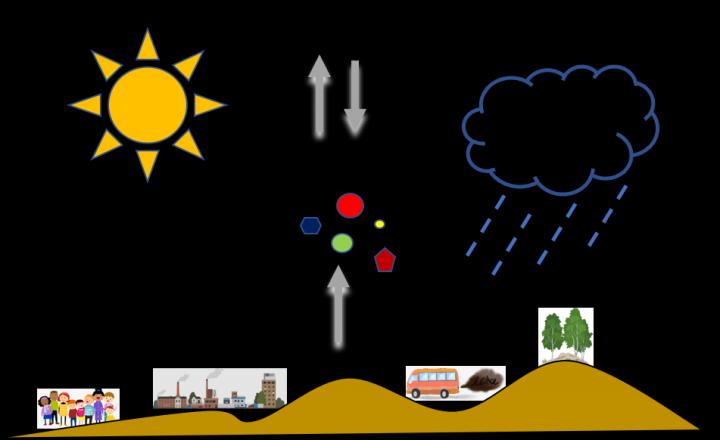
Credit: GAO Yi

At the end of December 2019, Coronavirus Disease 2019 (COVID-19) quickly spread throughout Hubei Province and other parts of China. During the 2020 Spring Festival, public activities were cancelled, people tried their best to stay at home, and human and industrial activities were reduced to a basic or minimum level. However, during this period, severe fog-haze events occurred over the North China Plain. What was the leading factor that caused these severe smog incidents? And what were the individual impacts of meteorological conditions and emission reductions?

To evaluate the impacts of meteorological conditions and emission reduction measures on the near-surface PM2.5 (fine particulate matter) during the COVID-19 lockdown, three numerical experiments with different meteorological fields and emission sources were carried out with a coupled meteorology and aerosol/chemistry model (WRF-Chem) by Professor Zhang Meigen and his team from the Institute of Atmospheric Physics, Chinese Academy of Sciences, and the findings have recently been published in Atmospheric and Oceanic Science Letters.

The results of the study found that, compared with the same period in 2019, the PM2.5 concentration in the Beijing-Tianjin-Hebei region increased by 50-70 μg m?3 from 7 to 14 February 2020, during which time the daily average PM2.5 concentration in Beijing reached 175 μg m?3. Results from sensitivity tests showed that the main cause was that the increase in PM2.5 caused by meteorological conditions was greater than the decrease in PM2.5 caused by emission reductions.

“Higher temperatures and relative humidity usually hasten the formation of secondary aerosols by accelerating chemical reactions”, explains Prof. Zhang. “Meanwhile, the lower wind speed in the Beijing-Tianjin-Hebei region inhibits the diffusion of air pollutants and the lower planetary boundary layer height enhances atmospheric stability. These unfavorable meteorological conditions led to these haze events in the Beijing-Tianjin-Hebei region.”

Therefore, it is necessary to consider meteorological conditions when assessing the effectiveness of emission control policies on changes in air pollutants. Doing so is likely to be very helpful for the formulation of future air pollution reduction policies.

###

Media Contact
Ms. LIN Zheng
[email protected]

Original Source

http://aosl.iapjournals.ac.cn/EN/news/news128.shtml

Related Journal Article

http://dx.doi.org/10.1016/j.aosl.2020.100014

Tags: Atmospheric ChemistryAtmospheric ScienceClimate ChangePollution/Remediation
Share12Tweet8Share2ShareShareShare2

Related Posts

Florida Cane Toad: Complex Spread and Selective Evolution

Florida Cane Toad: Complex Spread and Selective Evolution

February 7, 2026
New Study Uncovers Mechanism Behind Burn Pit Particulate Matter–Induced Lung Inflammation

New Study Uncovers Mechanism Behind Burn Pit Particulate Matter–Induced Lung Inflammation

February 6, 2026

DeepBlastoid: Advancing Automated and Efficient Evaluation of Human Blastoids with Deep Learning

February 6, 2026

Navigating the Gut: The Role of Formic Acid in the Microbiome

February 6, 2026
Please login to join discussion

POPULAR NEWS

  • Robotic Ureteral Reconstruction: A Novel Approach

    Robotic Ureteral Reconstruction: A Novel Approach

    82 shares
    Share 33 Tweet 21
  • Digital Privacy: Health Data Control in Incarceration

    63 shares
    Share 25 Tweet 16
  • Study Reveals Lipid Accumulation in ME/CFS Cells

    57 shares
    Share 23 Tweet 14
  • Breakthrough in RNA Research Accelerates Medical Innovations Timeline

    53 shares
    Share 21 Tweet 13

About

We bring you the latest biotechnology news from best research centers and universities around the world. Check our website.

Follow us

Recent News

Evaluating Pediatric Emergency Care Quality in Ethiopia

TPMT Expression Predictions Linked to Azathioprine Side Effects

Improving Dementia Care with Enhanced Activity Kits

Subscribe to Blog via Email

Success! An email was just sent to confirm your subscription. Please find the email now and click 'Confirm' to start subscribing.

Join 73 other subscribers
  • Contact Us

Bioengineer.org © Copyright 2023 All Rights Reserved.

Welcome Back!

Login to your account below

Forgotten Password?

Retrieve your password

Please enter your username or email address to reset your password.

Log In
No Result
View All Result
  • Homepages
    • Home Page 1
    • Home Page 2
  • News
  • National
  • Business
  • Health
  • Lifestyle
  • Science

Bioengineer.org © Copyright 2023 All Rights Reserved.