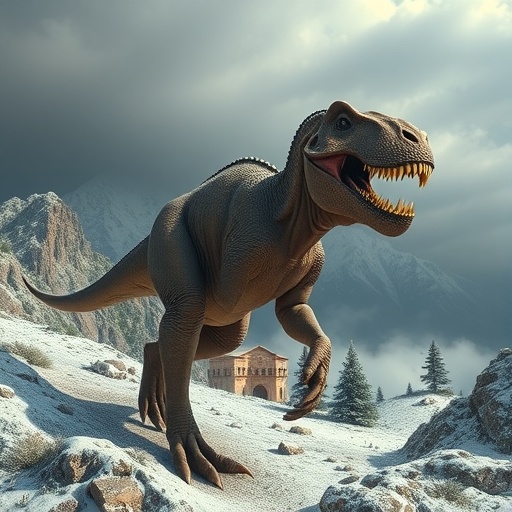
An international team of researchers has reconstructed how the body sizes of Europe’s ancient carnivorous mammals changed during the Paleogene, a period spanning roughly 66 to 23 million years ago when mammals rapidly diversified after the extinction of the non-avian dinosaurs. Their findings challenge a widely repeated evolutionary story: that the ancestors of modern cats, dogs, bears, and walruses rose to ecological dominance by simply outcompeting a rival group of predators known as hyaenodonts. Instead, the new analysis suggests that climate change played the central role, reshaping predator communities in ways that differed sharply from one continent to another.
The study, published in Biology Letters, examines the evolutionary history of carnivoramorphans, the broader group that includes living carnivorans and their extinct relatives. These mammals shared Paleogene ecosystems with hyaenodonts, a separate lineage of meat-eating mammals that included some of the most formidable predators of the era. Hyaenodonts evolved large bodies early in the Paleogene and occupied the highest levels of many food webs. For millions of years, they hunted alongside carnivoramorphans, before disappearing gradually and unevenly across different regions.
The traditional explanation for their eventual decline has focused on competition. Carnivoramorphans possess a distinctive arrangement of cutting teeth, including blade-like carnassial structures capable of slicing flesh. Because these teeth are often considered more versatile than the dental equipment of hyaenodonts, scientists have proposed that carnivoramorphans gained a decisive advantage in hunting and processing food. Much of the evidence for that interpretation, however, comes from North America. The researchers behind the new study asked whether the same evolutionary pattern could be detected in Europe, where the fossil record preserves a different history of predator coexistence.
To investigate the question, the team assembled body-mass estimates for 155 fossil species representing nearly the entire Paleogene period. Body mass is a critical ecological variable because it influences what an animal could eat, how much energy it required, the size of prey it could overpower, and its position within an ecosystem. Although soft tissues rarely survive in the fossil record, researchers can estimate the size of extinct predators by measuring features of their teeth. Dental dimensions and proportions are linked to skull size, jaw mechanics, bite performance, and overall body size, allowing statistical models to translate fossilized teeth into estimates of mass.
The resulting dataset revealed a striking pattern. European carnivoramorphans increased in size and expanded dramatically across the body-mass spectrum soon after the Middle Eocene Climatic Optimum, or MECO, an abrupt global warming episode that occurred approximately 40 million years ago. The event disrupted environments across the planet, altering vegetation, prey communities, and the availability of resources. Rather than showing a gradual rise caused by the steady elimination of competitors, carnivoramorphans appear to have undergone a rapid ecological expansion closely associated with a major climate disturbance.
The European hyaenodont record tells a different story from the one expected under a simple competition model. Hyaenodonts did not immediately decline as carnivoramorphans became larger and more diverse. Instead, they remained diverse for millions of years after the carnivoramorphans’ expansion. The two predator groups therefore coexisted for a substantial period, occupying ecosystems in which both lineages continued to evolve. If carnivoramorphans had possessed a universal competitive advantage that automatically displaced hyaenodonts, the fossil record would be expected to show a more direct and synchronized collapse of the older group.
A major turning point came later, around 34 million years ago, during a pronounced global cooling event known as the Grande Coupure. This climatic transition marked the boundary between the Eocene and Oligocene epochs and brought substantial environmental changes to Europe. Temperatures fell, habitats shifted, and many animal communities were reorganized. European hyaenodont diversity declined after this cooling event, suggesting that the group’s disappearance was more closely linked to environmental transformation than to a long-running contest that carnivoramorphans had already won.
The findings do not mean that competition was irrelevant. Predator species inevitably interacted, and differences in teeth, jaw structure, hunting strategy, and diet could have influenced how individual species used their environments. However, the study indicates that competition alone cannot explain the continent-wide pattern. Body-size evolution tracked climate events more closely than it tracked changes in diversity. The timing also varied geographically: the relationship between carnivoramorphan expansion and hyaenodont decline in Europe was not the same as the pattern documented in North America.
That regional contrast is one of the study’s most important implications. Evolutionary outcomes are often presented as if a single superior design inevitably conquers the planet, but fossil evidence increasingly shows that geography and climate can produce different results from the same starting conditions. In Europe, warming appears to have opened new ecological opportunities for carnivoramorphans without immediately eliminating hyaenodonts. Later cooling helped destabilize the ecosystems that had supported hyaenodont diversity. The ancestors of today’s lions, wolves, bears, and raccoons were therefore shaped not by one uninterrupted march toward superiority, but by a shifting sequence of environmental pressures.
The study also offers a warning for the present. Modern carnivorans are among the most recognizable and ecologically influential mammals on Earth, yet many species are now threatened by habitat loss, warming temperatures, prey depletion, and other effects of human-driven climate change. The Paleogene record shows that climate can reorganize predator communities over geological time, altering body size, diversity, and ecological dominance. By tracing those changes through fossil teeth and body-mass estimates, the researchers provide a long-term perspective on how vulnerable large predators can be when the environmental conditions supporting them change. The rise of carnivorans was not simply a story of better teeth defeating weaker rivals; it was, to a considerable extent, a story written by climate.
Subject of Research: Not applicable
Article Title: The rise of carnivoran mammals in Europe through the lens of body mass
News Publication Date: 5-Aug-2026
Web References: https://doi.org/10.1098/rsbl.2026.0319
References: Biology Letters, DOI: 10.1098/rsbl.2026.0319
Image Credits: ULiège / Valentin Fischer
Keywords: carnivorans, hyaenodonts, Paleogene, mammalian evolution, body mass, climate change, Middle Eocene Climatic Optimum, Grande Coupure, fossil mammals, predator evolution, Europe, paleontology
Tags: ancient mammal food websbody size evolution in ancient mammalsclimate change impact on predator dominanceecological shifts in Paleogene ecosystemsEurope’s prehistoric predator communitiesevolution of carnivorans and hyaenodontsextinction of hyaenodontsimpact of climate change on predator successinfluence of climate on predator competitionmegafauna evolution during PaleogenePaleogene carnivorous mammals evolutionrole of climate in mammal diversification