Credit: N. Hazzi
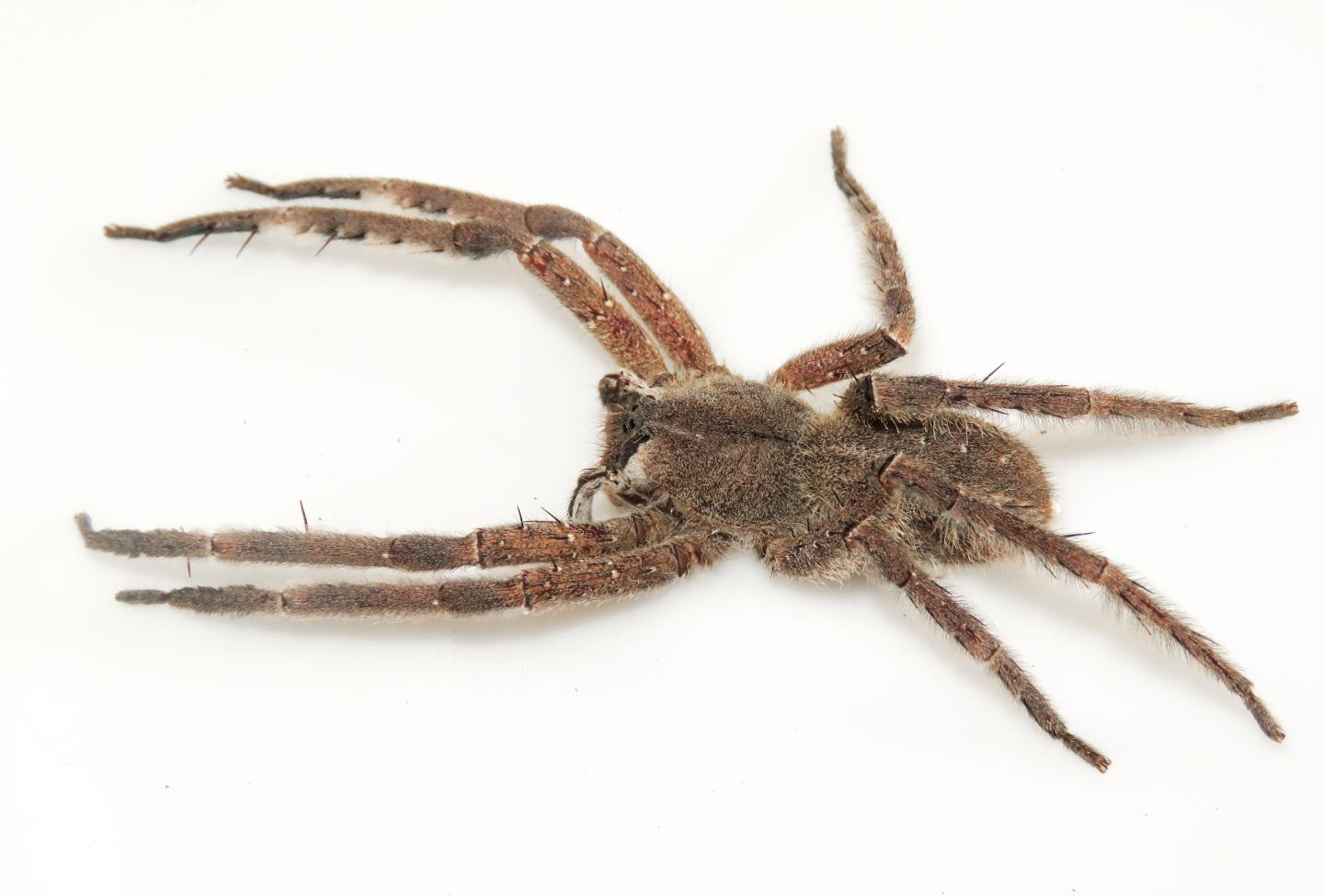
Spiders from the genus Phoneutria – also known as banana spiders – are considered aggressive and among the most venomous spiders in the world, with venom that has a neurotoxic action. These large nocturnal spiders usually inhabit environments disturbed by humans and are often found in banana plantations in the Neotropical region.
One of these spiders, P. boliviensis, is a medically important species widely distributed in Central and South America, whose behaviour, habitat, venom composition, toxicity and bites on humans have already been paid considerable attention in previous research work. Nevertheless, after examining a large pool of museum specimens, biologists from The George Washington University (N. Hazzi and G. Hormiga) began to wonder if samples named P. boliviensis were actually belonging to one and the same species.
Everything started when N. Hazzi was examining specimens of banana spiders identified in the past by experts as P. boliviensis. The research team quickly realized that the morphological features currently used to identify this species were not sufficient. Then, they discovered two well-defined morphological groups of P. boliviensis that were separated by the Andean mountain range, a geographic barrier that separates many other species.
To prove that these two “forms” were different species, the authors conducted fieldwork in the Amazon, Andes, and Central America, collecting specimens of these venomous spiders to explore if the genomic signal also suggests two species. They discovered that genetic differences separating these two forms were similar compared to the genetic differences separating other recognized species of banana spiders. Using morphological, genomic and geographic distribution data, the authors concluded that P. boliviensis represents not a single species, but two different ones. They uncovered that the true P. boliviensis was only found in the Amazonian region, and the second species, P. depilata (an old name revalidated by the research team), was found in the Andes, Chocó and Caribbean regions. Their findings are published in the open-access, peer-reviewed journal ZooKeys.
To obtain more distribution records for these species, the research team used the citizen science platform iNaturalist. Since the two species are among the few spiders that can be identified using only images, the platform turned out to be a very helpful tool. Data submitted by the iNaturalist community helped identify where the two species of Phoneutria are found. Curiously enough, for these two species, iNaturalist presented higher and more widely distributed records than the scientists’ own database.
“To our knowledge, this is the first study that has used iNaturalist to gather occurrence records on venomous species to estimate distribution models,” the researchers say.
This is how the two spiders can be distinguished using only photographs: P. boliviensis has two lateral white-yellow bands in the anterior area of the carapace, while P. depilata has four series of yellow dots in the ventral side of the abdomen. In addition, for P. depilata’s identification, information is needed on where the image was taken, because this is the only species of Phoneutria found in the Andes, Chocó, and Central America. However, the most reliable approach to identify these species requires examination under a stereomicroscope.
Interestingly, P. depilata has been mislabeled as P. boliviensis throughout many studies, including works on venom composition and toxicity, ecology, geographic distribution, and human epidemiology of bites. There have been human bite records of this species reported in Costa Rica and in banana plantations in Colombia, most of them with mild to moderate envenomation symptoms. Except for brief anecdotal mentions by field explorers in the Amazon, little is known about P. depilata.
The study provides detailed diagnoses with images to distinguish both species and distribution maps.
“This valuable information will help identify risk areas of accidental bites and assist health professionals in determining the identity of the species involved, especially for P. depilata. This is a significant discovery that will affect studies about toxicology, opening new opportunities to compare the venom composition and the effect of these two species,” the authors conclude.
###
Research article:
Hazzi NA, Hormiga G (2021) Morphological and molecular evidence support the taxonomic separation of the medically important Neotropical spiders Phoneutria depilata (Strand, 1909) and P. boliviensis (F.O. Pickard-Cambridge, 1897) (Araneae, Ctenidae). ZooKeys 1022: 13-50. https:/
Corresponding authors:
Nicolas A. Hazzi
Email: [email protected]
https:/
Gustavo Hormiga
Email: [email protected]
https:/
Media Contact
Nicolas A. Hazzi
[email protected]
Related Journal Article
http://dx.