• HOME
  • NEWS
  • EXPLORE
    • CAREER
      • Companies
      • Jobs
    • EVENTS
    • iGEM
      • News
      • Team
    • PHOTOS
    • VIDEO
    • WIKI
  • BLOG
  • COMMUNITY
    • FACEBOOK
    • INSTAGRAM
    • TWITTER
Friday, June 26, 2026
BIOENGINEER.ORG
No Result
View All Result
  • Login
  • HOME
  • NEWS
  • EXPLORE
    • CAREER
      • Companies
      • Jobs
        • Lecturer
        • PhD Studentship
        • Postdoc
        • Research Assistant
    • EVENTS
    • iGEM
      • News
      • Team
    • PHOTOS
    • VIDEO
    • WIKI
  • BLOG
  • COMMUNITY
    • FACEBOOK
    • INSTAGRAM
    • TWITTER
  • HOME
  • NEWS
  • EXPLORE
    • CAREER
      • Companies
      • Jobs
        • Lecturer
        • PhD Studentship
        • Postdoc
        • Research Assistant
    • EVENTS
    • iGEM
      • News
      • Team
    • PHOTOS
    • VIDEO
    • WIKI
  • BLOG
  • COMMUNITY
    • FACEBOOK
    • INSTAGRAM
    • TWITTER
No Result
View All Result
Bioengineer.org
No Result
View All Result
Home NEWS Science News

Magnetic whirls in confined spaces

Bioengineer by Bioengineer
March 4, 2021
in Science News
Reading Time: 2 mins read
0
IMAGE
Share on FacebookShare on TwitterShare on LinkedinShare on RedditShare on Telegram

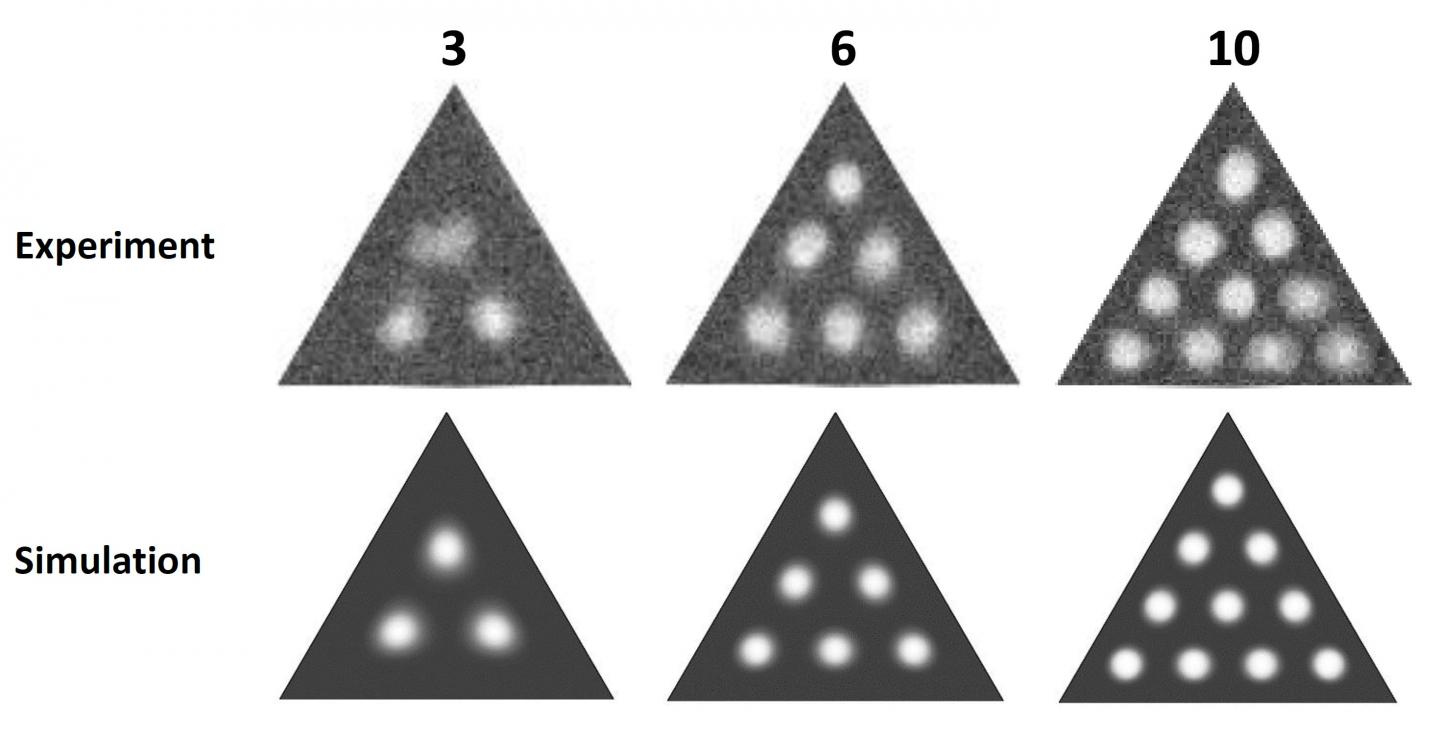
Mobility of skyrmions in geometric structures depends on their arrangement
IMAGE

Credit: ill./©: Jan Rothörl and Chengkun Song

In a close collaboration between experimental and theoretical physicists at Johannes Gutenberg University Mainz (JGU), the research groups of Professor Mathias Kläui and Dr. Peter Virnau investigated the behavior of magnetic whirls within nanoscale geometric structures. In their work published in Advanced Functional Materials, the researchers confined small magnetic whirls, so-called skyrmions, in geometric structures. Skyrmions can be created in thin metal films and have particle-like properties: They exhibit high stability and are repelled from each other and from specially prepared walls. Experiments and accompanying computer simulations showed that the mobility of skyrmions within these geometric structures depends massively on their arrangement. In triangles, for example, three, six, or ten skyrmions arranged like bowling pins are particularly stable.

“These studies lay the foundation for the development of novel non-conventional computing and storage media based on the movement of magnetic vortices through microscopic corridors and chambers,” explained Professor Mathias Kläui. The research was funded by the Dynamics and Topology (TopDyn) Top-level Research Area, which was founded in 2019 as a collaboration between Johannes Gutenberg University Mainz, TU Kaiserslautern, and the Max Planck Institute for Polymer Research in Mainz. “This work is an excellent example for the interdisciplinary cooperation between simulation and experiment, which was only made possible by TopDyn’s funding,” emphasized Dr. Peter Virnau.

###

Related links:

https://www.klaeui-lab.physik.uni-mainz.de – Kläui Lab at the JGU Institute of Physics ;

https://www.komet1.physik.uni-mainz.de/ – Statistical Physics and Soft Matter Theory group at the JGU Institute of Physics ;

https://topdyn.uni-mainz.de/ – Dynamics and Topology (TopDyn) Top-level Research Area at JGU

Read more:

https://www.uni-mainz.de/presse/aktuell/12071_ENG_HTML.php – press release “Magnetic whirls crystallize in two dimensions” (9 Sept. 2020)

Media Contact
PD Dr. Peter Virnau
[email protected]

Original Source

https://www.uni-mainz.de/presse/aktuell/13181_ENG_HTML.php

Related Journal Article

http://dx.doi.org/10.1002/adfm.202010739

Tags: Atomic/Molecular/Particle PhysicsChemistry/Physics/Materials SciencesElectrical Engineering/ElectronicsElectromagneticsMaterialsMathematics/StatisticsNanotechnology/MicromachinesResearch/DevelopmentTechnology/Engineering/Computer Science
Share12Tweet8Share2ShareShareShare2

Related Posts

Tracking Lanthanide-Labeled Microplastics in Plants

June 25, 2026

POSTECH Researchers Slash Cost of Reconstituted Cell-Free Systems by 95%

June 25, 2026

AI and Physics Collaborate to Design Advanced Hydrogen Storage Materials

June 25, 2026

Natural Hallucinogens: Evolution’s Ecological Tools, Not Mere Chemical Byproducts

June 25, 2026
Please login to join discussion

POPULAR NEWS

  • Saying Goodbye to PGY-6: Pediatric Fellowship Realities

    103 shares
    Share 41 Tweet 26
  • Multi-Hospital Study Reveals Long Covid Burden Is Twice as High as Current Estimates

    92 shares
    Share 36 Tweet 23
  • Detection of EDCs in Breast Milk and Infant Urine Up to Six Months Highlights Early Exposure Risks

    77 shares
    Share 31 Tweet 19
  • New Drug Candidate Developed at McMaster Shows Potential for Treating Brain Cancer

    58 shares
    Share 23 Tweet 15

About

We bring you the latest biotechnology news from best research centers and universities around the world. Check our website.

Follow us

Recent News

Tracking Lanthanide-Labeled Microplastics in Plants

POSTECH Researchers Slash Cost of Reconstituted Cell-Free Systems by 95%

AI and Physics Collaborate to Design Advanced Hydrogen Storage Materials

Subscribe to Blog via Email

Success! An email was just sent to confirm your subscription. Please find the email now and click 'Confirm' to start subscribing.

Join 82 other subscribers
  • Contact Us

Bioengineer.org © Copyright 2023 All Rights Reserved.

Welcome Back!

Login to your account below

Forgotten Password?

Retrieve your password

Please enter your username or email address to reset your password.

Log In
No Result
View All Result
  • Homepages
    • Home Page 1
    • Home Page 2
  • News
  • National
  • Business
  • Health
  • Lifestyle
  • Science

Bioengineer.org © Copyright 2023 All Rights Reserved.