Development of a rapid recovery method of target protein biomarkers using dissolvable polyacrylamide gel and its application to mass spectrometry
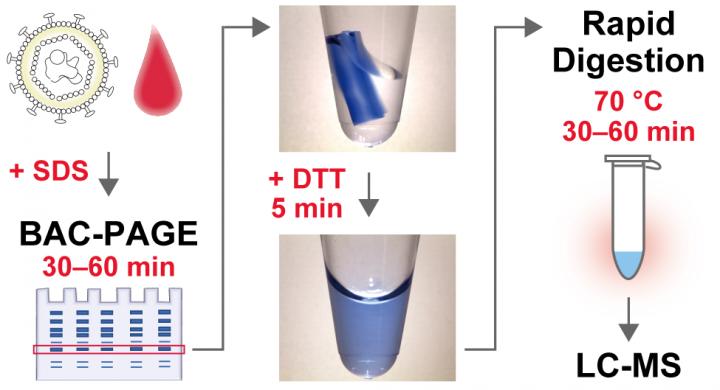
Credit: Reprinted with permission from Journal of Proteome Research © 2020 American Chemical Society (ACS)
Mass spectrometry (MS) is a powerful method for biomarker analysis because it enables highly sensitive and accurate measurement of target molecules in clinical samples. The application of MS to clinical diagnosis, such as neonatal metabolic screening, has been progressing with a focus on metabolite markers. MS measurement of proteins is currently mainly used for novel marker discovery studies, but there is a growing interest in its application in clinical marker diagnosis as an alternative to immunoassays.
MS-based quantification of protein biomarkers is mainly performed by a bottom-up approach using peptide fragments obtained by enzymatic protein digestion with trypsin. Standard digestion protocols require a reaction time of more than 20 hours, which is a rate-limiting factor in sample preparation workflows.
Although protein quantification by MS is highly sensitive, plasma and serum proteome are highly complex, and interference by other components poses a significant challenge. For high-precision detection of target markers, approaches for pre-removal of major serum protein components such as albumin or selective enrichment of target markers using antibody columns have been reported, but the off-target effect on quantitative results and the difficulty of processing multiple samples remain obstacles.
In this study, we focused on dissolvable polyacrylamide gels using N,N’-Bis(acryloyl)cystamine (BAC) as a cross-linker to solve these problems. BAC cross-linked polyacrylamide gels readily dissolve by reduction treatment, allowing the recovery of proteins that have escaped into the solution. We found that the recovered proteins were suitable for rapid trypsin digestion under high temperature conditions, and we succeeded in establishing a high-throughput sample preparation method for MS-based biomarker quantification, which we named BAC-DROP (BAC-Gel Dissolution to Digest PAGE-Resolved Objective Proteins).
High-resolution proteome fractionation with BAC-DROP is particularly effective for MS quantification of targeted trace marker proteins derived from clinical samples. By introducing BAC-DROP into the MS-based quantification workflow of the inflammatory biomarker C-reactive protein (CRP), we were able to complete the sample pretreatment in only 5 hours and successfully quantified CRP from a 0.5 μL human serum sample. We also succeeded in a serological diagnosis of hepatitis B virus (HBV) infection by HBsAg quantification combined with BAC-DROP and MS. Recently, interest in MS diagnosis of viral infections has been rapidly increasing, as exemplified by the diagnosis of COVID-19. The high-throughput sample preparation approach by BAC-DROP shown in this study will be applicable not only to HBV but also to other infectious viral disease samples.
###
This research was conducted by a collaborative research group of Ehime University, Hamamatsu University School of Medicine, and Kitasato University, and the research results were published online in the Journal of Proteome Research of the American Chemical Society on December 24, 2020.
Media Contact
Nobuaki Takemori
[email protected]
Original Source
https:/
Related Journal Article
http://dx.