• HOME
  • NEWS
  • EXPLORE
    • CAREER
      • Companies
      • Jobs
    • EVENTS
    • iGEM
      • News
      • Team
    • PHOTOS
    • VIDEO
    • WIKI
  • BLOG
  • COMMUNITY
    • FACEBOOK
    • INSTAGRAM
    • TWITTER
Friday, April 3, 2026
BIOENGINEER.ORG
No Result
View All Result
  • Login
  • HOME
  • NEWS
  • EXPLORE
    • CAREER
      • Companies
      • Jobs
        • Lecturer
        • PhD Studentship
        • Postdoc
        • Research Assistant
    • EVENTS
    • iGEM
      • News
      • Team
    • PHOTOS
    • VIDEO
    • WIKI
  • BLOG
  • COMMUNITY
    • FACEBOOK
    • INSTAGRAM
    • TWITTER
  • HOME
  • NEWS
  • EXPLORE
    • CAREER
      • Companies
      • Jobs
        • Lecturer
        • PhD Studentship
        • Postdoc
        • Research Assistant
    • EVENTS
    • iGEM
      • News
      • Team
    • PHOTOS
    • VIDEO
    • WIKI
  • BLOG
  • COMMUNITY
    • FACEBOOK
    • INSTAGRAM
    • TWITTER
No Result
View All Result
Bioengineer.org
No Result
View All Result
Home NEWS Science News Biology

Bioorthogonally catalyzed lethality strategy generates targeting drugs within tumor

Bioengineer by Bioengineer
January 25, 2021
in Biology
Reading Time: 2 mins read
0
IMAGE
Share on FacebookShare on TwitterShare on LinkedinShare on RedditShare on Telegram

IMAGE

Credit: @Science China Press

Cancer is the second leading cause of death in the world. The number of deaths and incidences is increasing each year. The metal-based anticancer drugs were used clinically worldwide, but suffer from poor selectivity, serious side effects and drug resistance. Tumor-targeting drug development is the basis for precise cancer treatment.

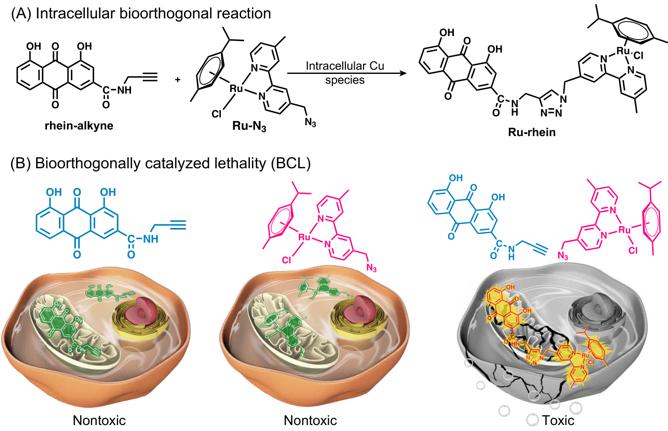
Recently, Professor Hongke Liu of Nanjing Normal University, Professor Jing Zhao and Academician Zijian Guo of Nanjing University have made breakthrough achievements in anticancer drug development. They proposed a “bio-orthogonally catalyzed lethality” (BCL) strategy (Figure 1) and published their results in “National Science Review” (National Science Review, NSR). The BCL strategy uses tumors as manufacturing factories to generate a highly potential tumor-targeted drug Ru-rhein, which can selectively kill cancer cells and tumors in tumor-bearing mice, while no toxicity on normal cells. BCL strategy generates targeting drugs from non-toxic compounds within the tumor, not only avoiding the decomposition and inactivation of the drug during transportation and storage, but also reducing the serious side effects caused by interacting with biologically active molecules during treatment.

The copper content in tumor cells is much higher than that in normal cells. The targeting drug Ru-rhein is generated from two non-toxic compounds Ru-N3 and rhein-alkyn within tumor with a yield of more than 80%, by using the endogenous copper-catalyzed bioorthogonal reactions. However, the above-mentioned reactions hardly occur in normal tissues. Thus tumor targeting and selectivity of Ru-rhein is realized by BCL strategy. Ru-rhein exhibits high anti-cancer activity, especially towards lung cancer cell A549, almost as toxic as cisplatin, while it is non-toxic to normal lung cell HLF and might be used as a candidate drug for clinical development (Figure 2). Ru-rhein targets the mitochondria of tumor cells and causes autophagic cell death through the mitochondrial pathway.

A mouse model was used to validate the BCL strategy. Compared with the control group, tumor growth of the tumor-bearing mice injected with Ru-N3 and rhein-alkyn was significantly inhibited, and other organs were almost undamaged (Figure 3). The generality of the BCL strategy was demonstrated in the generation of osmium and iridium-based metallodrugs within tumor cells.

The BCL method provides a general strategy for precise diseases treatment, and also reveals that tumor can provide copper species that efficiently catalyze orthogonal reactions. This research was funded by the National Natural Science Foundation of China. Dr. Xuling Xue, a postdoctoral fellow at Nanjing Normal University, is the first author of the paper.

###

See the article:

Xuling Xue, Chenggen Qian, Qin Tao, Yuanxin Dai, Mengdi Lv, Jingwen Dong, Zhi Su, Yong Qian, Jing Zhao, Hongke Liu, Zijian Guo

Using bioorthogonally catalyzed lethality strategy to generate mitochondria-targeting antitumor metallodrugs in vitro and in vivo

Natl Sci Rev, 2020, doi: 10.1093/nsr/nwaa286
https://doi.org/10.1093/nsr/nwaa286

Media Contact
Hongke Liu
[email protected]

Original Source

http://doi.org/10.1093/nsr/nwaa286

Related Journal Article

http://dx.doi.org/10.1093/nsr/nwaa286

Tags: Biology
Share13Tweet8Share2ShareShareShare2

Related Posts

Scientists Discover How Bacterial Enzyme Breaks Down Sturdy Collagen

Scientists Discover How Bacterial Enzyme Breaks Down Sturdy Collagen

April 3, 2026
Lipid Build-Up Blocks Immune Response in Tuberculosis

Lipid Build-Up Blocks Immune Response in Tuberculosis

April 3, 2026

How the Human Brain Constructs Our Sense of Time

April 3, 2026

Affordable Assembly of 1,000+ Human Genomes: A Breakthrough Powering the Future of Medicine

April 3, 2026
Please login to join discussion

POPULAR NEWS

  • blank

    Revolutionary AI Model Enhances Precision in Detecting Food Contamination

    97 shares
    Share 39 Tweet 24
  • Imagine a Social Media Feed That Challenges Your Views Instead of Reinforcing Them

    1007 shares
    Share 398 Tweet 249
  • Promising Outcomes from First Clinical Trials of Gene Regulation in Epilepsy

    51 shares
    Share 20 Tweet 13
  • Popular Anti-Aging Compound Linked to Damage in Corpus Callosum, Study Finds

    44 shares
    Share 18 Tweet 11

About

We bring you the latest biotechnology news from best research centers and universities around the world. Check our website.

Follow us

Recent News

New Study Uncovers How Calcium Channel Mutations Impact Early Brain Development in Childhood Epilepsy

iRGD-PLGA Nanocomplex Targets Colon Cancer Resistance

Modeling Olea and Quercus Pollen Seasons in Greece

Subscribe to Blog via Email

Enter your email address to subscribe to this blog and receive notifications of new posts by email.

Join 78 other subscribers
  • Contact Us

Bioengineer.org © Copyright 2023 All Rights Reserved.

Welcome Back!

Login to your account below

Forgotten Password?

Retrieve your password

Please enter your username or email address to reset your password.

Log In
No Result
View All Result
  • Homepages
    • Home Page 1
    • Home Page 2
  • News
  • National
  • Business
  • Health
  • Lifestyle
  • Science

Bioengineer.org © Copyright 2023 All Rights Reserved.