• HOME
  • NEWS
  • EXPLORE
    • CAREER
      • Companies
      • Jobs
    • EVENTS
    • iGEM
      • News
      • Team
    • PHOTOS
    • VIDEO
    • WIKI
  • BLOG
  • COMMUNITY
    • FACEBOOK
    • INSTAGRAM
    • TWITTER
Saturday, February 7, 2026
BIOENGINEER.ORG
No Result
View All Result
  • Login
  • HOME
  • NEWS
  • EXPLORE
    • CAREER
      • Companies
      • Jobs
        • Lecturer
        • PhD Studentship
        • Postdoc
        • Research Assistant
    • EVENTS
    • iGEM
      • News
      • Team
    • PHOTOS
    • VIDEO
    • WIKI
  • BLOG
  • COMMUNITY
    • FACEBOOK
    • INSTAGRAM
    • TWITTER
  • HOME
  • NEWS
  • EXPLORE
    • CAREER
      • Companies
      • Jobs
        • Lecturer
        • PhD Studentship
        • Postdoc
        • Research Assistant
    • EVENTS
    • iGEM
      • News
      • Team
    • PHOTOS
    • VIDEO
    • WIKI
  • BLOG
  • COMMUNITY
    • FACEBOOK
    • INSTAGRAM
    • TWITTER
No Result
View All Result
Bioengineer.org
No Result
View All Result
Home NEWS Science News Health

First observation of the early link between proteins linked to Alzheimer’s disease

Bioengineer by Bioengineer
January 25, 2021
in Health
Reading Time: 3 mins read
0
IMAGE
Share on FacebookShare on TwitterShare on LinkedinShare on RedditShare on Telegram

These results will help researchers to identify at an early stage the people most at risk of developing the disease, well before the first cognitive symptoms appear
IMAGE

Credit: ©ULiège/CRC In Vivo Imaging

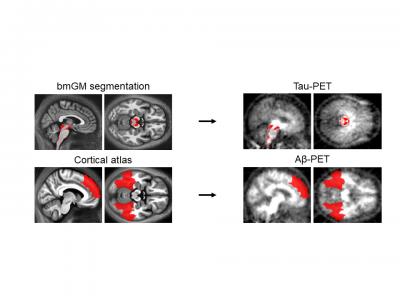
Study conducted by researchers from the GIGA CRC In vivo Imaging laboratory at ULiège demonstrates, for the first time in humans, how the first deposits of tau proteins in the brainstem are associated with neurophysiological processes specific to the early stages of Alzheimer’s disease development.

During the pre-clinical stages of Alzheimer’s disease, i.e. when subtle changes are taking place in the brain but no cognitive symptoms can be observed, the cortex presents a state of transient hyperexcitability. To date, several studies conducted in animals have shown that tau and beta-amyloid proteins – central to the development of Alzheimer’s disease – were associated with increased cortical excitability and dysfunction of brain networks. However, the relationship between the accumulation of Alzheimer’s disease-related proteins and cortical hyperexcitability during the earliest stages of the disease remains poorly understood in humans, in particular due to technological limitations in the precise quantification of early protein deposition.

A study, conducted by researchers from the Cyclotron Research Centre (CRC In vivo Imaging / GIGA) of ULiège studied whether the first deposits of tau and beta-amyloid proteins in the brains of healthy individuals aged between 50 and 70 years old could be linked to a higher level of cortical excitability. To do this, we combined different neuroimaging methodologies (magnetic resonance imaging, positron emission tomography) in order to characterise the quantity of tau and beta-amyloid proteins in their first agglomeration regions,” explains Gilles Vandewalle, head of the laboratory. That is to say, respectively, in the brainstem and in a series of upper cortical areas. “In addition, the researchers also measured the excitability of the participants’ cortex in a non-invasive manner, using transcranial magnetic stimulation techniques in conjunction with the acquisition of electroencephalographic recordings.

The results of this study show that an increased amount of tau protein in the brainstem – its primary site of agglomeration – is specifically associated with a higher level of cortical excitability, while the researchers did not observe a significant relationship for the amount of beta-amyloid protein in the upper cortical areas. These results constitute a first in vivo observation in humans of the early link between proteins linked to Alzheimer’s disease and their impact on brain function,” says Maxime Van Egroo, scientific collaborator at the CRC In Vivo Imaging and first author of the scientific article. Furthermore, they suggest that measuring the hyperexcitability of the cortex could be a useful marker to provide information on the progress of certain cerebral pathological processes linked to Alzheimer’s disease, and thus contribute to the early identification of people most at risk of developing the disease, well before the first cognitive symptoms appear. »

###

Media Contact
Gilles Vandewalle
[email protected]

Original Source

https://www.gigacrc.uliege.be/cms/c_6765953/en/first-observation-of-the-early-link-between-proteins-linked-to-alzheimer-s-disease-and-their-impact-on-brain-function?preview=true&stateChanged=true

Related Journal Article

http://dx.doi.org/10.1172/jci.insight.142514

Tags: AlzheimerDiagnosticsMedicine/Health
Share12Tweet8Share2ShareShareShare2

Related Posts

Evaluating Pediatric Emergency Care Quality in Ethiopia

February 7, 2026

TPMT Expression Predictions Linked to Azathioprine Side Effects

February 7, 2026

Improving Dementia Care with Enhanced Activity Kits

February 7, 2026

Decoding Prostate Cancer Origins via snFLARE-seq, mxFRIZNGRND

February 7, 2026
Please login to join discussion

POPULAR NEWS

  • Robotic Ureteral Reconstruction: A Novel Approach

    Robotic Ureteral Reconstruction: A Novel Approach

    82 shares
    Share 33 Tweet 21
  • Digital Privacy: Health Data Control in Incarceration

    63 shares
    Share 25 Tweet 16
  • Study Reveals Lipid Accumulation in ME/CFS Cells

    57 shares
    Share 23 Tweet 14
  • Breakthrough in RNA Research Accelerates Medical Innovations Timeline

    53 shares
    Share 21 Tweet 13

About

We bring you the latest biotechnology news from best research centers and universities around the world. Check our website.

Follow us

Recent News

Evaluating Pediatric Emergency Care Quality in Ethiopia

TPMT Expression Predictions Linked to Azathioprine Side Effects

Improving Dementia Care with Enhanced Activity Kits

Subscribe to Blog via Email

Enter your email address to subscribe to this blog and receive notifications of new posts by email.

Join 73 other subscribers
  • Contact Us

Bioengineer.org © Copyright 2023 All Rights Reserved.

Welcome Back!

Login to your account below

Forgotten Password?

Retrieve your password

Please enter your username or email address to reset your password.

Log In
No Result
View All Result
  • Homepages
    • Home Page 1
    • Home Page 2
  • News
  • National
  • Business
  • Health
  • Lifestyle
  • Science

Bioengineer.org © Copyright 2023 All Rights Reserved.