• HOME
  • NEWS
  • EXPLORE
    • CAREER
      • Companies
      • Jobs
    • EVENTS
    • iGEM
      • News
      • Team
    • PHOTOS
    • VIDEO
    • WIKI
  • BLOG
  • COMMUNITY
    • FACEBOOK
    • INSTAGRAM
    • TWITTER
Saturday, February 7, 2026
BIOENGINEER.ORG
No Result
View All Result
  • Login
  • HOME
  • NEWS
  • EXPLORE
    • CAREER
      • Companies
      • Jobs
        • Lecturer
        • PhD Studentship
        • Postdoc
        • Research Assistant
    • EVENTS
    • iGEM
      • News
      • Team
    • PHOTOS
    • VIDEO
    • WIKI
  • BLOG
  • COMMUNITY
    • FACEBOOK
    • INSTAGRAM
    • TWITTER
  • HOME
  • NEWS
  • EXPLORE
    • CAREER
      • Companies
      • Jobs
        • Lecturer
        • PhD Studentship
        • Postdoc
        • Research Assistant
    • EVENTS
    • iGEM
      • News
      • Team
    • PHOTOS
    • VIDEO
    • WIKI
  • BLOG
  • COMMUNITY
    • FACEBOOK
    • INSTAGRAM
    • TWITTER
No Result
View All Result
Bioengineer.org
No Result
View All Result
Home NEWS Science News Chemistry

Researchers turn coal powder into graphite in microwave oven

Bioengineer by Bioengineer
January 6, 2021
in Chemistry
Reading Time: 3 mins read
0
IMAGE
Share on FacebookShare on TwitterShare on LinkedinShare on RedditShare on Telegram

IMAGE

Credit: Chris Masi

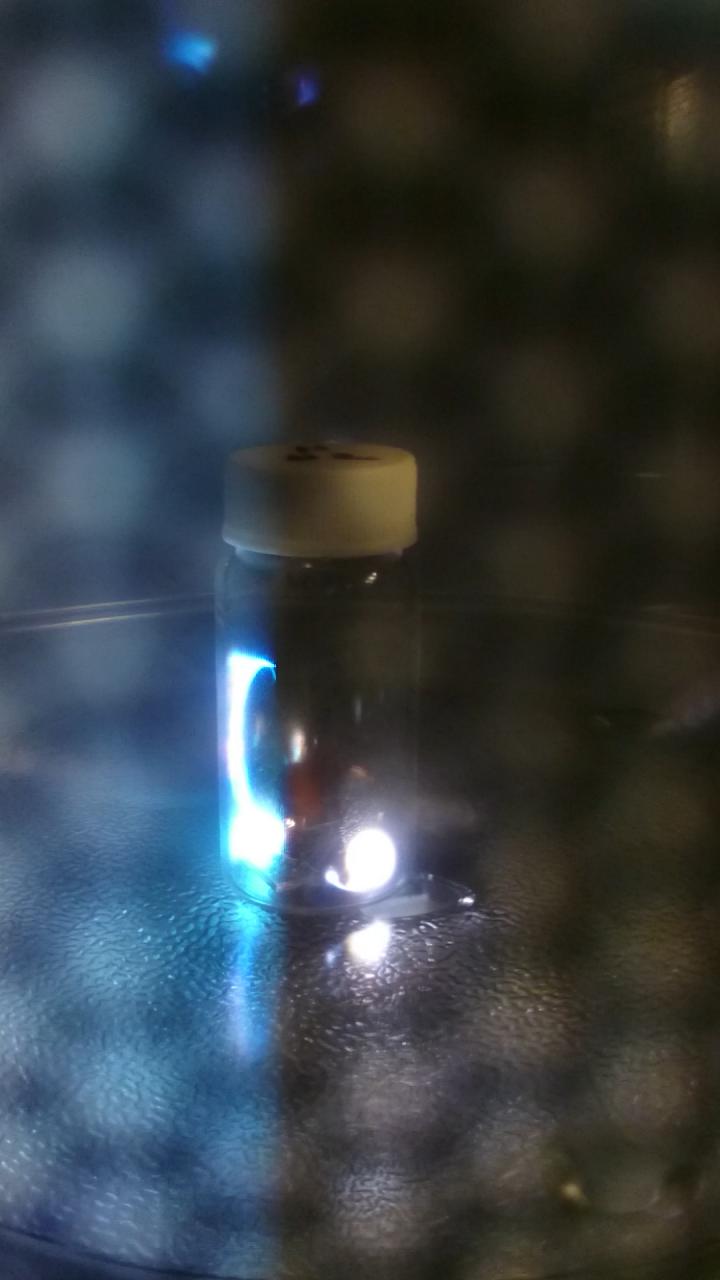
Using copper foil, glass containers and a conventional household microwave oven, University of Wyoming researchers have demonstrated that pulverized coal powder can be converted into higher-value nano-graphite.

The discovery is another step forward in the effort to find alternative uses for Wyoming’s Powder River Basin coal, at a time when demand for coal to generate electricity is declining due to concerns about climate change.

In a paper published in the journal Nano-Structures & Nano-Objects, the UW researchers report that they created an environment in a microwave oven to successfully convert raw coal powder into nano-graphite, which is used as a lubricant and in items ranging from fire extinguishers to lithium ion batteries. This “one-step method with metal-assisted microwave treatment” is a new approach that could represent a simple and relatively inexpensive coal-conversion technology.

“This method provides a new route to convert abundant carbon sources to high-value materials with ecological and economic benefits,” wrote the research team, led by Associate Professor TeYu Chien, in UW’s Department of Physics and Astronomy.

Others involved in the project were Professor Jinke Tang, in the Department of Physics and Astronomy; Associate Professor Brian Leonard, in the Department of Chemistry; Professor Maohong Fan, in the Department of Petroleum Engineering and the School of Energy Resources; graduate students Rabindra Dulal, of Nepal, Joann Hilman, of Laramie, Wyo., Chris Masi, of Syracuse, N.Y., and Teneil Schumacher, of Buffalo, Wyo.; and postdoctoral researchers Gaurab Rimal, of Nepal, and Bang Xu, of China.

While previous research has shown that microwaves can be used to reduce the moisture content of coal and remove sulfur and other minerals, most such methods require specific chemical pretreatment of the coal. In their experiment, the UW researchers simply ground raw Powder River Basin coal into powder.

That powder was then placed on copper foil and sealed in glass containers with a gas mixture of argon and hydrogen, before being placed in a microwave oven. A conventional microwave oven was chosen because of convenience and because it provided the desired levels of radiation.

“By cutting the copper foil into a fork shape, the sparks were induced by the microwave radiation, generating an extremely high temperature of more than 1,800 degrees Fahrenheit within a few seconds,” says Masi, lead author of the paper. “This is why you shouldn’t place a metal fork inside a microwave oven.”

The sparks caused by the microwaves generated the high temperatures necessary to transform the coal powder into polycrystalline graphite, with the copper foil and hydrogen gas also contributing to the process.

While the experiment included microwave durations ranging from 3 to 45 minutes, the optimal duration was found to be 15 minutes.

The researchers say this new method of coal conversion could be refined and performed at a larger scale to yield both a higher quality and quantity of nano-graphite materials.

“Finite graphite reserves and environmental concerns for the graphite extraction procedures make this method of converting coal to graphite a great alternative source of graphite production,” the scientists wrote.

###

Media Contact
TeYu Chien
[email protected]

Original Source

http://www.uwyo.edu/uw/news/2021/01/uw-researchers-turn-coal-powder-into-graphite-in-microwave-oven.html

Related Journal Article

http://dx.doi.org/10.1016/j.nanoso.2020.100660

Tags: Chemistry/Physics/Materials SciencesClimate ChangeEnergy SourcesEnergy/Fuel (non-petroleum)MaterialsMolecular PhysicsNanotechnology/Micromachines
Share13Tweet8Share2ShareShareShare2

Related Posts

blank

Breakthrough in Environmental Cleanup: Scientists Develop Solar-Activated Biochar for Faster Remediation

February 7, 2026
blank

Cutting Costs: Making Hydrogen Fuel Cells More Affordable

February 6, 2026

Scientists Develop Hand-Held “Levitating” Time Crystals

February 6, 2026

Observing a Key Green-Energy Catalyst Dissolve Atom by Atom

February 6, 2026
Please login to join discussion

POPULAR NEWS

  • Robotic Ureteral Reconstruction: A Novel Approach

    Robotic Ureteral Reconstruction: A Novel Approach

    82 shares
    Share 33 Tweet 21
  • Digital Privacy: Health Data Control in Incarceration

    63 shares
    Share 25 Tweet 16
  • Study Reveals Lipid Accumulation in ME/CFS Cells

    57 shares
    Share 23 Tweet 14
  • Breakthrough in RNA Research Accelerates Medical Innovations Timeline

    53 shares
    Share 21 Tweet 13

About

We bring you the latest biotechnology news from best research centers and universities around the world. Check our website.

Follow us

Recent News

Phage-Antibiotic Combo Beats Resistant Peritoneal Infection

Boosting Remote Healthcare: Stepped-Wedge Trial Insights

Barriers and Boosters of Seniors’ Physical Activity in Karachi

Subscribe to Blog via Email

Enter your email address to subscribe to this blog and receive notifications of new posts by email.

Join 73 other subscribers
  • Contact Us

Bioengineer.org © Copyright 2023 All Rights Reserved.

Welcome Back!

Login to your account below

Forgotten Password?

Retrieve your password

Please enter your username or email address to reset your password.

Log In
No Result
View All Result
  • Homepages
    • Home Page 1
    • Home Page 2
  • News
  • National
  • Business
  • Health
  • Lifestyle
  • Science

Bioengineer.org © Copyright 2023 All Rights Reserved.