• HOME
  • NEWS
  • EXPLORE
    • CAREER
      • Companies
      • Jobs
    • EVENTS
    • iGEM
      • News
      • Team
    • PHOTOS
    • VIDEO
    • WIKI
  • BLOG
  • COMMUNITY
    • FACEBOOK
    • INSTAGRAM
    • TWITTER
Saturday, February 7, 2026
BIOENGINEER.ORG
No Result
View All Result
  • Login
  • HOME
  • NEWS
  • EXPLORE
    • CAREER
      • Companies
      • Jobs
        • Lecturer
        • PhD Studentship
        • Postdoc
        • Research Assistant
    • EVENTS
    • iGEM
      • News
      • Team
    • PHOTOS
    • VIDEO
    • WIKI
  • BLOG
  • COMMUNITY
    • FACEBOOK
    • INSTAGRAM
    • TWITTER
  • HOME
  • NEWS
  • EXPLORE
    • CAREER
      • Companies
      • Jobs
        • Lecturer
        • PhD Studentship
        • Postdoc
        • Research Assistant
    • EVENTS
    • iGEM
      • News
      • Team
    • PHOTOS
    • VIDEO
    • WIKI
  • BLOG
  • COMMUNITY
    • FACEBOOK
    • INSTAGRAM
    • TWITTER
No Result
View All Result
Bioengineer.org
No Result
View All Result
Home NEWS Science News Biology

Scientists create a new phototoxic protein, SuperNova2

Bioengineer by Bioengineer
December 17, 2020
in Biology
Reading Time: 2 mins read
0
IMAGE
Share on FacebookShare on TwitterShare on LinkedinShare on RedditShare on Telegram

IMAGE

Credit: Skoltech

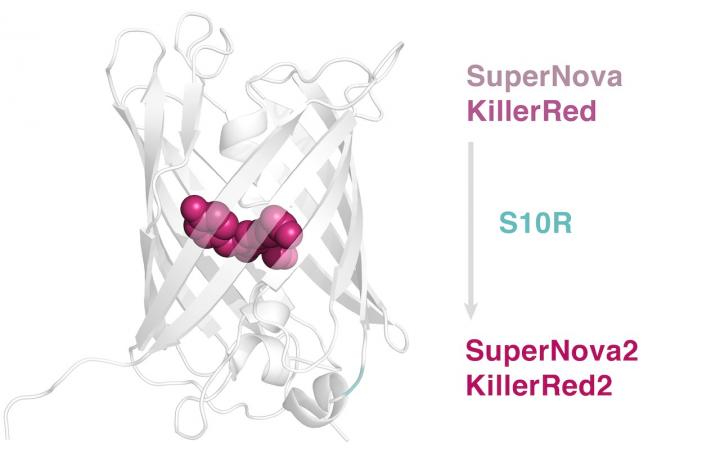
Scientists from Skoltech, the Institute of Bioorganic Chemistry of RAS, and the London Institute of Medical Sciences (LMS) have developed an enhanced version of SuperNova, a genetically encoded phototoxic synthesizer, that helps control intracellular processes by light exposure. The research was published in the International Journal of Molecular Sciences.

An important research tool, phototoxic proteins are used as genetically encoded photosensitizers to generate reactive oxygen species under light irradiation. In contrast to common chemical photosensitizers, phototoxic proteins are genetically encoded and expressed by the cell itself, which makes them easy to control and direct to any selected compartment in the cell. Thanks to reactive oxygen species formed by the action of light, phototoxic proteins can create strictly localized oxidative stress, for example, to destroy a selected cell population or disable target proteins ? a feature particularly sought after in the modeling of cellular processes.

The first phototoxic protein, KillerRed, was described by a team of Russian researchers led by Konstantin Lukyanov, a professor at the Skoltech Center of Life Sciences (CLS), in 2006. KillerRed was further enhanced by Japanese scientists and renamed SuperNova. In their recent study, professor Lukyanov’s team has developed SuperNova2, an improved version of SuperNova, which displays high speed and completeness of maturation and is monomeric, which makes the new protein easily usable and suitable for a broad variety of molecular biology tasks.

“We expect that the genetically encoded photosensitizer SuperNova2 will find use in a wide range of experimental models,” professor Lukyanov comments.

###

Media Contact
Ilyana Zolotareva
[email protected]

Original Source

https://www.skoltech.ru/en/2020/12/scientists-create-a-new-phototoxic-protein-supernova2/

Related Journal Article

http://dx.doi.org/10.3390/ijms21228800

Tags: BiodiversityBiologyBiomedical/Environmental/Chemical EngineeringBiotechnologyMolecular BiologyResearch/DevelopmentToxicology
Share12Tweet8Share2ShareShareShare2

Related Posts

Florida Cane Toad: Complex Spread and Selective Evolution

Florida Cane Toad: Complex Spread and Selective Evolution

February 7, 2026
New Study Uncovers Mechanism Behind Burn Pit Particulate Matter–Induced Lung Inflammation

New Study Uncovers Mechanism Behind Burn Pit Particulate Matter–Induced Lung Inflammation

February 6, 2026

DeepBlastoid: Advancing Automated and Efficient Evaluation of Human Blastoids with Deep Learning

February 6, 2026

Navigating the Gut: The Role of Formic Acid in the Microbiome

February 6, 2026
Please login to join discussion

POPULAR NEWS

  • Robotic Ureteral Reconstruction: A Novel Approach

    Robotic Ureteral Reconstruction: A Novel Approach

    82 shares
    Share 33 Tweet 21
  • Digital Privacy: Health Data Control in Incarceration

    63 shares
    Share 25 Tweet 16
  • Study Reveals Lipid Accumulation in ME/CFS Cells

    57 shares
    Share 23 Tweet 14
  • Breakthrough in RNA Research Accelerates Medical Innovations Timeline

    53 shares
    Share 21 Tweet 13

About

We bring you the latest biotechnology news from best research centers and universities around the world. Check our website.

Follow us

Recent News

Improving Dementia Care with Enhanced Activity Kits

Decoding Prostate Cancer Origins via snFLARE-seq, mxFRIZNGRND

Digital Health Perspectives from Baltic Sea Experts

Subscribe to Blog via Email

Enter your email address to subscribe to this blog and receive notifications of new posts by email.

Join 73 other subscribers
  • Contact Us

Bioengineer.org © Copyright 2023 All Rights Reserved.

Welcome Back!

Login to your account below

Forgotten Password?

Retrieve your password

Please enter your username or email address to reset your password.

Log In
No Result
View All Result
  • Homepages
    • Home Page 1
    • Home Page 2
  • News
  • National
  • Business
  • Health
  • Lifestyle
  • Science

Bioengineer.org © Copyright 2023 All Rights Reserved.