• HOME
  • NEWS
  • EXPLORE
    • CAREER
      • Companies
      • Jobs
    • EVENTS
    • iGEM
      • News
      • Team
    • PHOTOS
    • VIDEO
    • WIKI
  • BLOG
  • COMMUNITY
    • FACEBOOK
    • INSTAGRAM
    • TWITTER
Saturday, February 7, 2026
BIOENGINEER.ORG
No Result
View All Result
  • Login
  • HOME
  • NEWS
  • EXPLORE
    • CAREER
      • Companies
      • Jobs
        • Lecturer
        • PhD Studentship
        • Postdoc
        • Research Assistant
    • EVENTS
    • iGEM
      • News
      • Team
    • PHOTOS
    • VIDEO
    • WIKI
  • BLOG
  • COMMUNITY
    • FACEBOOK
    • INSTAGRAM
    • TWITTER
  • HOME
  • NEWS
  • EXPLORE
    • CAREER
      • Companies
      • Jobs
        • Lecturer
        • PhD Studentship
        • Postdoc
        • Research Assistant
    • EVENTS
    • iGEM
      • News
      • Team
    • PHOTOS
    • VIDEO
    • WIKI
  • BLOG
  • COMMUNITY
    • FACEBOOK
    • INSTAGRAM
    • TWITTER
No Result
View All Result
Bioengineer.org
No Result
View All Result
Home NEWS Science News Chemistry

Making cheaper, biocompatible E-skin electrodes

Bioengineer by Bioengineer
December 10, 2020
in Chemistry
Reading Time: 2 mins read
0
IMAGE
Share on FacebookShare on TwitterShare on LinkedinShare on RedditShare on Telegram

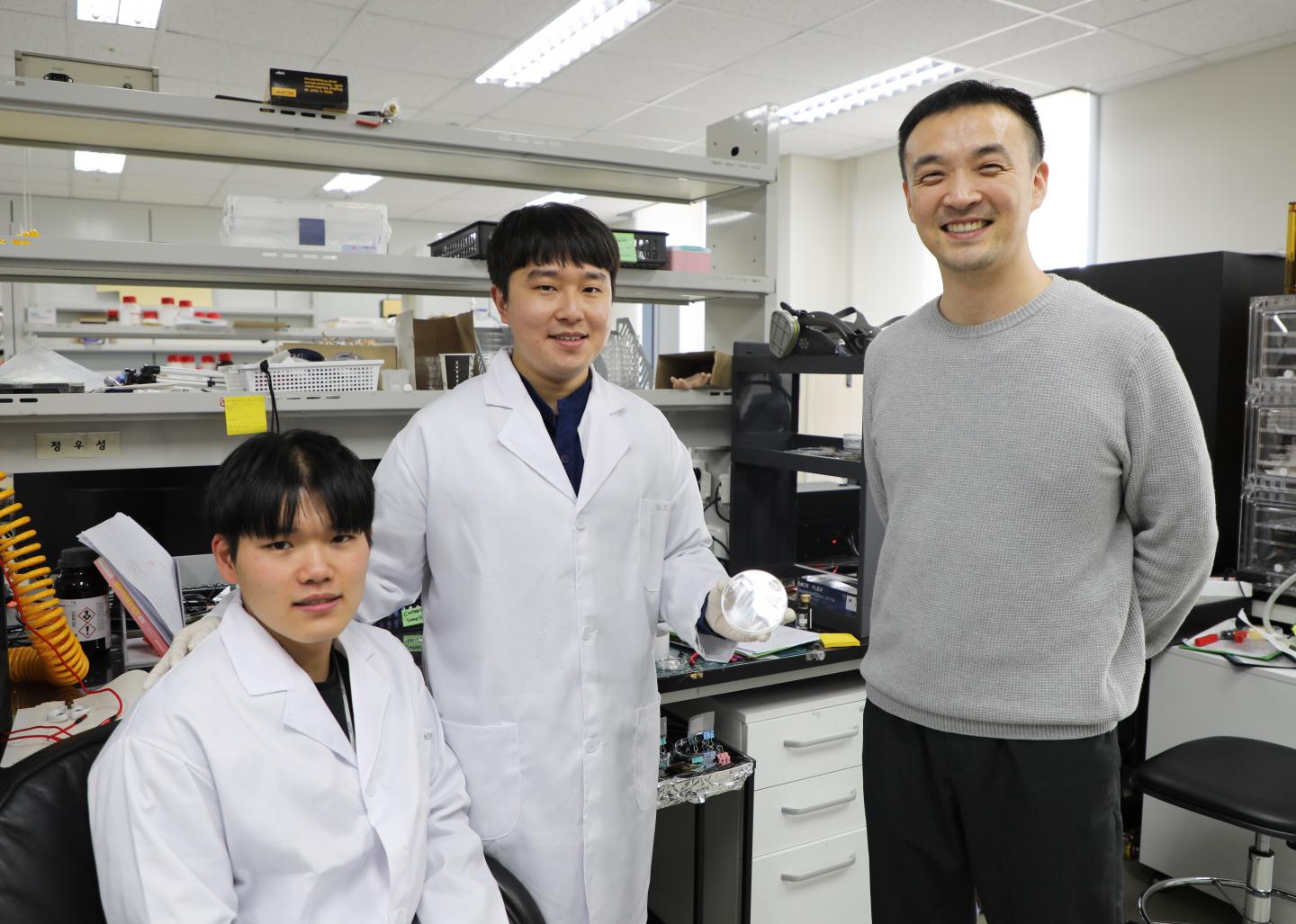
A polymer electrode gets an electrical boost for use in E-skin devices.
IMAGE

Credit: dgist

Scientists around the world are working to develop electronic skins that attach to the body and monitor vital signs. These E-skins need to be comfortable, breathable, and flexible for everyday use. Gold is typically used to fabricate the electrodes that conduct electric signals in these applications. But gold is expensive, involves a complicated manufacturing process, and must be sterilized for use on the human body.

Among promising alternative materials for electrodes is the polymer PEDOT:PSS. It is biocompatible with human skin, flexible, relatively cheap, and can be easily manufactured and made into an electrode. Unfortunately, it doesn’t conduct electricity as well as gold. Scientists have found ways to improve its conductivity, but these methods involve toxic products, like acids, which can leave residues and are therefore not ideal for E-skin applications.

Daegu Gyeongbuk Institute of Science & Technology (DGIST) researchers found a non-toxic method that significantly improves performance. “We developed a hydrothermal treatment, involving humidity and heat, that enhanced the conductivity of PEDOT:PSS films by a factor of 250,” says DGIST materials scientist Sungwon Lee, who led the study.

Specifically, the researchers found that applying 80% humidity and more than 60°C heat to a PEDOT:PSS thin film led to structural changes within the material that enhanced its ability to conduct electricity.

PEDOT:PSS is made up of water insoluble, conductive PEDOT molecules and water soluble, insulating PSS molecules. Adding humidity to a thin film of PEDOT:PSS separated the two types of molecules with a screen of water, while adding heat expanded the PEDOT chains, increasing the material’s overall crystallinity. These structural changes improved the material’s conductivity from 0.495 to 125.367 Siemens per centimetre (S/cm).

The scientists then made electrodes from the enhanced PEDOT:PSS material and found it stably conducted electricity when exposed to air, heat, bending, and stretching. They also found that the electrodes worked well when sprayed onto E-skin devices used for monitoring joint movements, skin temperature, and the heart’s electrical activity.

Further improvements are still needed, as treating PEDOT:PSS with acids can improve its electrical conductivity all the way up to 2,244 S/cm. “Our results are, nonetheless, noteworthy,” says Lee, “with our novel hydrothermal treatment showing significant potential for use in biomedical applications.”

###

Media Contact
Kwanghoon Choi
[email protected]

Original Source

https://dgist.ac.kr/en/html/sub06/060202.html

Related Journal Article

http://dx.doi.org/10.1016/j.bios.2020.112717

Tags: BiochemistryChemistry/Physics/Materials SciencesMaterialsNanotechnology/Micromachines
Share13Tweet8Share2ShareShareShare2

Related Posts

blank

Breakthrough in Environmental Cleanup: Scientists Develop Solar-Activated Biochar for Faster Remediation

February 7, 2026
blank

Cutting Costs: Making Hydrogen Fuel Cells More Affordable

February 6, 2026

Scientists Develop Hand-Held “Levitating” Time Crystals

February 6, 2026

Observing a Key Green-Energy Catalyst Dissolve Atom by Atom

February 6, 2026
Please login to join discussion

POPULAR NEWS

  • Robotic Ureteral Reconstruction: A Novel Approach

    Robotic Ureteral Reconstruction: A Novel Approach

    82 shares
    Share 33 Tweet 21
  • Digital Privacy: Health Data Control in Incarceration

    63 shares
    Share 25 Tweet 16
  • Study Reveals Lipid Accumulation in ME/CFS Cells

    57 shares
    Share 23 Tweet 14
  • Breakthrough in RNA Research Accelerates Medical Innovations Timeline

    53 shares
    Share 21 Tweet 13

About

We bring you the latest biotechnology news from best research centers and universities around the world. Check our website.

Follow us

Recent News

Decoding Prostate Cancer Origins via snFLARE-seq, mxFRIZNGRND

Digital Health Perspectives from Baltic Sea Experts

Florida Cane Toad: Complex Spread and Selective Evolution

Subscribe to Blog via Email

Enter your email address to subscribe to this blog and receive notifications of new posts by email.

Join 73 other subscribers
  • Contact Us

Bioengineer.org © Copyright 2023 All Rights Reserved.

Welcome Back!

Login to your account below

Forgotten Password?

Retrieve your password

Please enter your username or email address to reset your password.

Log In
No Result
View All Result
  • Homepages
    • Home Page 1
    • Home Page 2
  • News
  • National
  • Business
  • Health
  • Lifestyle
  • Science

Bioengineer.org © Copyright 2023 All Rights Reserved.