Manned space missions in spacecraft made of aluminium that is light yet resistant to radiation could be a step nearer following research involving a world-leading facility at the University of Huddersfield.
Credit: University of Huddersfield
The MIAMI-2 – Microscopes and Ion Accelerators for Materials Investigations – facility has helped Dr Matheus Tunes investigate a new alloy that will harden aluminium without increasing its weight significantly.
Spacecraft launched from Earth need to be light, but still have the right amount of fuel to see them achieve orbit. If too heavy, the amount of fuel required would be prohibitive. Once outside of the Earth’s protective magnetic field, a vehicle may then be exposed to potentially destructive amounts of solar radiation, which becomes more important for any long duration mission such as to Mars.
Making spacecraft from aluminium is one solution, as aluminium is a light yet strong material. Alloys help aluminium become harder via precipitation strengthening, but the radiation encountered in space can dissolve the hardening precipitates with potentially disastrous and fatal consequences for astronauts.
But the research carried out at MIAMI-2 in partnership with Montanuniversitaet Leoben (MUL) in Austria has discovered that a particular hardening precipitate of a new aluminium alloy – developed by a group of metallurgists led by Professor Stefan Pogatscher (MUL) – does not dissolve when bombarded with particle radiation when compared with existing data on irradiation of conventional aluminium alloys.
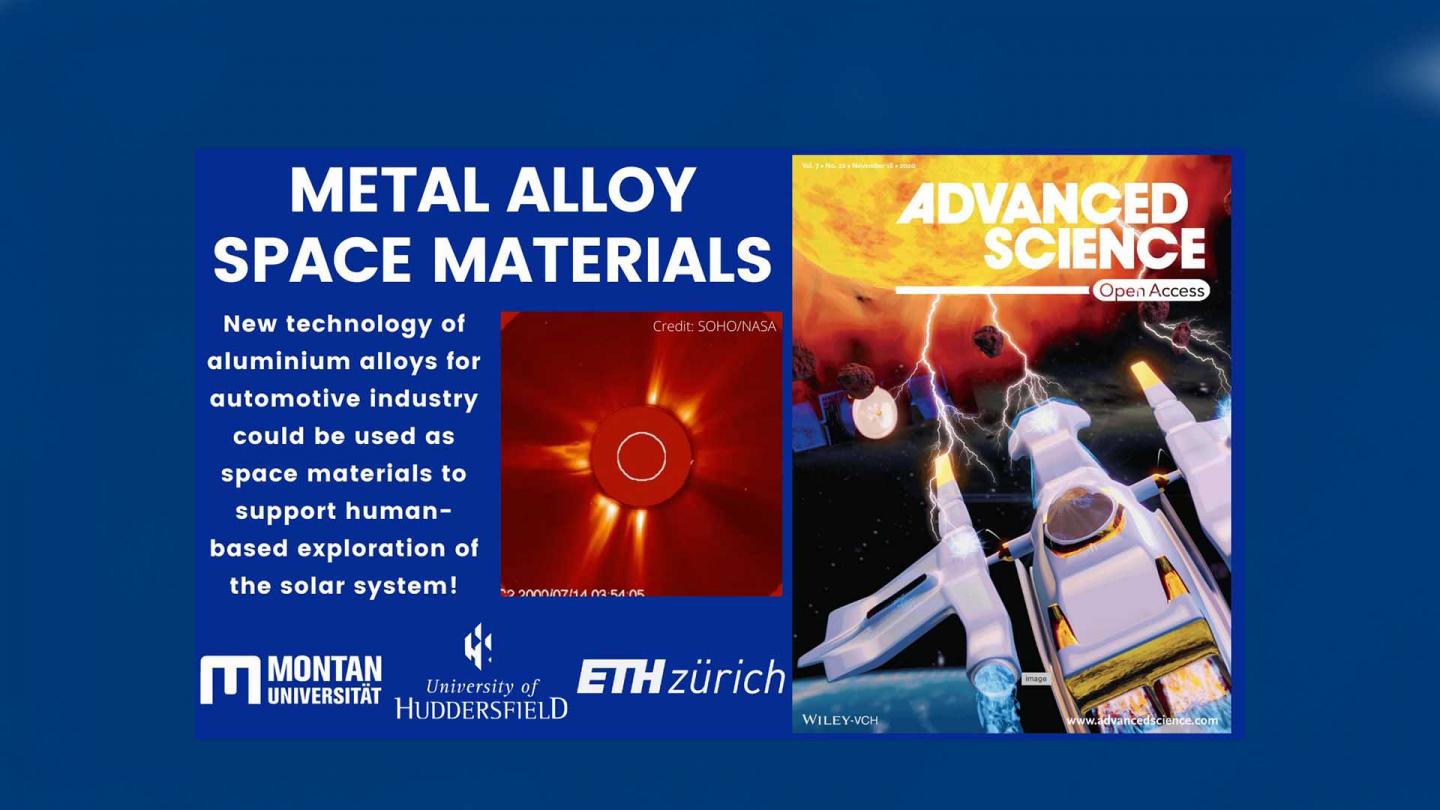
The result is an alloy with a radiation resistant hardening phase called a T-phase, which has a complex crystal structure of Mg32(Zn,Al)49. The research led to a paper that has been published in the prestigious journal Advanced Science, together with an eye-catching cover.
“The idea of the paper was testing these new alloys using the MIAMI facilities, because we can subject the alloy to energetic particle radiation and, at the same time, monitor the effect of this radiation on the alloy microstructure with a transmission electron microscope”, says Matheus.
“We monitored the crystallographic signal of the T-phase as the radiation increased and observed that compared with other conventional aluminium alloys, the alloy we developed was radiation tolerant – meaning that the hardening phase does not dissolve under high radiation doses.
“It sheds light on a very exciting new field of research we call ‘prototypic space materials for stellar-radiation environments’. A nuclear reactor is also an extreme environment, as is the sun with solar cycles, but dynamic instabilities on the sun such as solar flares and coronal mass ejections are more extreme than anything on Earth. The sun is a very efficient nuclear fusion reactor and high-energy particle accelerator.”
Dr Graeme Greaves, Senior Research Fellow at the MIAMI Facility, adds, “when Matt first came to us from Brazil as a postgraduate student he was always looking for new projects and created a number of new collaborations, and I’m very happy that as he is starting the next part of his career in Austria and expanding into new areas, he is continuing to collaborate with us here at the MIAMI facility, with this aluminium alloys project being just one example.”
With manned missions to the moon and Mars currently being planned, the advantages of spacecraft that are light enough to launch and withstand radiation to protect their crews are clear. Next on the agenda for Matheus, Graeme and colleagues is to find out why the alloy behaves the way it does and what further benefits there could be.
“I am particularly proud that I finished my PhD in Huddersfield, I’ve now moved to Austria but still continue to work with Graeme,” Matheus adds. “We have an active collaboration and 2021 will be a busy year for the joint Huddersfield-Leoben space materials research project”.
“We discovered the T-phase is radiation-tolerant, but we haven’t discovered why that is. We have an idea which involves the chemical complexity of the phase that we believe could lead to some very interesting research. We hope that we can make an important contribution to further human exploration of space.”
###
Media Contact
Graeme Greaves
[email protected]
Original Source
https:/
Related Journal Article
http://dx.