Specially engineered contact lenses use tears to monitor patient health
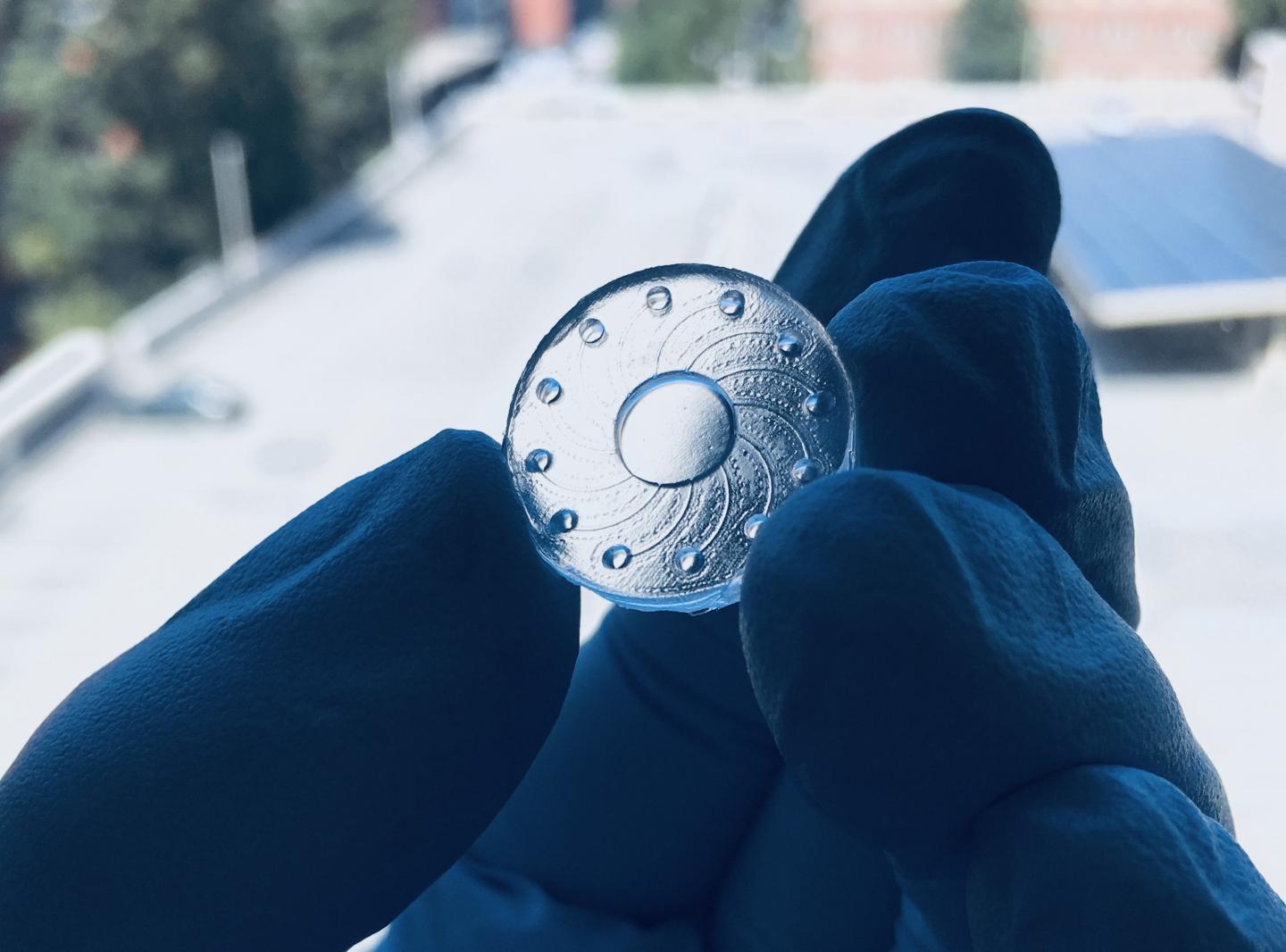
Credit: Khademhosseini Lab
(LOS ANGELES) – Human bodily fluids and secretions contain molecules known as biomarkers that contain a wealth of information about the body’s health and the presence of disease. Among secretions such as tears, sweat and saliva, tears are considered the best source of biomarkers, with concentrations similar to those found in blood. Tears are also sterile, readily available and less susceptible to the damaging effects of temperature change, evaporation and secretion rate.
Useful and measurable biomarkers found in tears include sodium ions, which are useful indicators of dry-eye disease, and glucose molecules, an early diagnostic tool for diabetes. Also, measuring the pH of tears can be used to check for cell viability, drug effectiveness and for signs of disease.
Therefore, the ability to collect tears in an effective way and to measure their pH and levels of biomarkers in real-time is highly desirable. One approach that is actively being explored is the idea of contact lens biosensors. Such contact lenses could be designed to include tiny channels on their surfaces for guiding the flow of tears into tiny reservoirs for collection and monitoring.
Pliable and transparent materials, known as hydrogels, are currently being used commercially to make contact lenses; they are easy to work with and cost effective. However, to date, they have not been shown to be ideal materials with which to fashion channels and reservoirs, as they are sensitive to the fabrication techniques needed. In previous efforts, hydrogels have been vulnerable to deformities caused by the solvents or the temperature and vacuum conditions required by some fabrication methods. Other methods have produced hydrogel channels with rough surfaces or non-uniform dimensions.
A collaborative team, which includes a group from the Terasaki Institute for Biomedical Innovation, has developed a fabrication method to meet all the challenges in making a hydrogel contact lens for biomarker sensing. The team began by optimizing the components of the hydrogel to obtain elastic characteristics which would allow it to be engineered into various shapes with a smooth surface profile. They next fashioned microchannels in the hydrogel with the use of a 3D printed mold. The final step in the fabrication process was to enclose the hydrogel channels by bonding an additional layer of hydrogel onto the microchannel surface.
Once the successful prototype was completed, it was extensively tested for its performance in channeling and collecting fluids. Flow rates of artificial tears in the channels were measured at different levels of hydration, with zero flow measured at complete dehydration and full spontaneous flow observed at full hydration.
A noteworthy observation during these tests was that when the hydrogel was mildly dehydrated, liquid flow in the channels would stop, but when additional rhythmic pressure was applied, the flow would resume. This was an important demonstration of support for the hypothesis that eye blinking would also provide the necessary pressure and additional hydration needed to allow for tear flow in the contact lens, and therefore, in the eye.
“In addition to our successful fabrication of microchannels in commercial contact lens hydrogels, we also found that eye-blinking pressure may facilitate tear exchange in the lens through these microchannels, said Shiming Zhang, Ph.D., from the Terasaki Institute’s research team. “This is an exciting finding because it opens the possibility for the lenses to be a means of preventing dry eye disease, a condition commonly found in contact lens wearers. We aim to develop a patented contact lens that actively treats this condition by enhancing tear flow in the eye.”
The team next prototyped sensors to collect, test for and measure pH levels of artificial tears flowing through the microchannels. Sodium levels were also tested, and the results showed an acceptable and predicted range of sodium detection for diagnostic purposes.
Additional goals would be to fine-tune factors such as humidity, hydrogel hydration and applied pressure in order to enhance all the flow rates and dynamics of the biosensing contact lens. There are also plans to experiment with smaller channels in thinner hydrogel films before a final contact lens is devised.
“The production of the successful prototype described here and the continuing efforts to perfect its capabilities mark a significant advance in contact lens biosensing,” said Ali Khademhosseini, Ph.D., director and CEO of the Terasaki Institute. “Such innovative work fits in well with our institute’s mission to create solutions that restore or enhance the health of individuals.”
###
Additional authors are Yihang Chen, Qingyu Cui, Jiahua Ni, Xiaochen Wang, Xuanbing Chen, Halima Alem, Peyton Tebon, Chun Xu, Changliang Guo, Rohollah Nasiri, Rosalia Moreddu, Ali Yetisen, Samad Ahadian, Nureddin Ashammakhi, Sam Emaminejad, Vadim Jucaud, Mehmet Dokmeci and Ali Khademhosseini.
This work was supported by a grant from CooperVision, Inc.
PRESS CONTACT
Stewart Han,
[email protected],
+1 818-836-4393
The Terasaki Institute for Biomedical Innovation (terasaki.org) is a non-profit research organization that invents and fosters practical solutions that restore or enhance the health of individuals. Research at the Terasaki Institute leverages scientific advancements that enable an understanding of what makes each person unique, from the macroscale of human tissues down to the microscale of genes, to create technological solutions for some of the most pressing medical problems of our time. We use innovative technology platforms to study human disease on the level of individual patients by incorporating advanced computational and tissue-engineering methods. Findings yielded by these studies are translated by our research teams into tailored diagnostic and therapeutic approaches encompassing personalized materials, cells and implants with unique potential and broad applicability to a variety of diseases, disorders and injuries.
The Institute is made possible through an endowment from the late Dr. Paul I. Terasaki, a pioneer in the field of organ transplant technology.
Media Contact
Stewart Han
[email protected]
Original Source
https:/
Related Journal Article
http://dx.