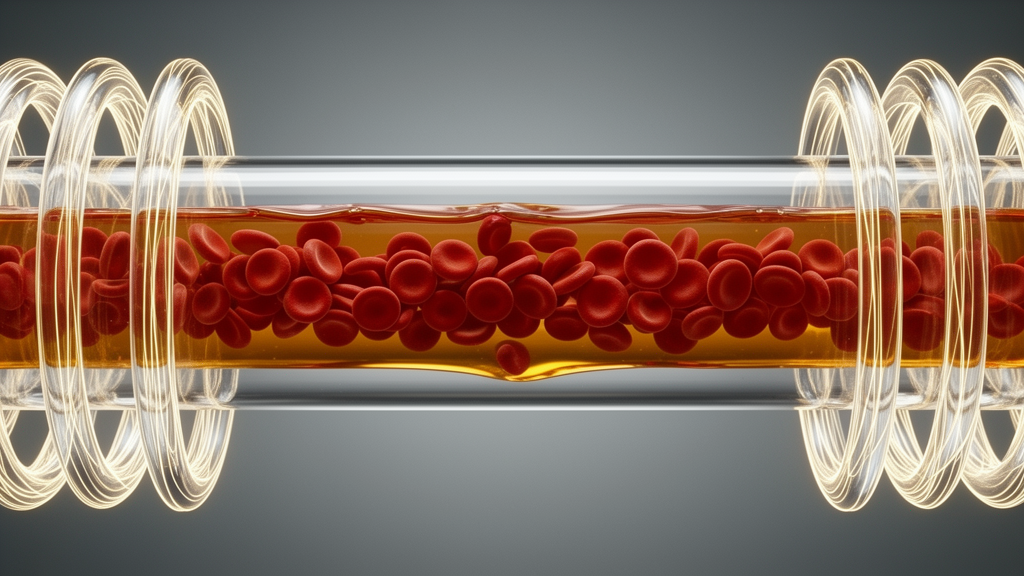
The study, conducted by researcher Arun Kumar Pandey and published in Discover Molecules, employs magnetohydrodynamic principles to model how biological fluids respond to external magnetic forces. By examining the distinct behaviors of the central red blood cell core and the surrounding plasma layer, the theoretical framework demonstrates that magnetic field parameters can systematically modulate hemodynamic resistance and velocity distributions.
Bio-magnetic fluid dynamics investigates biological fluid mechanics under the influence of magnetic fields, treating blood as an electrically conducting and magnetic fluid due to the presence of iron-containing hemoglobin molecules within erythrocytes. Erythrocyte concentrations typically range between 4.7 and 6.1 million cells per microliter in males and between 4.2 and 5.4 million cells per microliter in females. The magnetic characteristics of circulating blood fluctuate according to its oxygenation state, with oxygenated and deoxygenated hemoglobin displaying distinct magnetic behaviors. Whole blood functions as a viscous liquid carrying red blood cells, white blood cells, and platelets suspended in a plasma medium containing approximately seven percent proteins and ninety percent water.
The mathematical formulation treats blood as an incompressible, steady, laminar, and viscous Newtonian fluid traversing a cylindrical geometry where the overall vessel length and width substantially exceed the cross-sectional separation distance. This geometric condition enables Pandey to approximate the system as a one-dimensional steady flow confined between two infinite parallel plates separated by a total distance of 2d. The theoretical coordinate system aligns a uniform magnetic field along the x-direction while fluid motion progresses along the perpendicular z-direction, allowing velocity components to vary as functions of lateral position across the duct gap.
The fundamental fluid equations couple classical Navier-Stokes momentum formulations with Maxwell electromagnetic relations to describe the interaction between the moving fluid and the applied magnetic induction field. The momentum balance integrates fluid viscosity, dynamic pressure gradients, and magnetic permeability alongside induced magnetic field vectors. Through Cartesian decomposition across spatial coordinates, the governing differential equations account for transverse velocity variations, magnetic field gradients, and the constant axial pressure gradient driving fluid motion along the cylindrical duct.
To capture the multi-phase nature of microvascular circulation, the model divides the lumen into a central core region occupied by erythrocytes and a peripheral plasma layer of thickness delta adjacent to the vessel boundaries. Within this peripheral layer, plasma moves with a distinct velocity profile, maintaining continuous velocity matching at the interface separating the plasma sleeve from the central cellular core. Analytical solutions derived from the coupled momentum and induction equations yield closed-form expressions for local fluid velocity, showing that the central flow rate depends directly on the core viscosity, plasma viscosity, Hartmann number, and normalized plasma layer thickness.
A critical parameter governing the system is the Hartmann number, denoted as m, which characterizes the relative significance of magnetic forces compared to viscous hydrodynamic forces. Pandey evaluated the velocity equations across limiting Hartmann regimes, including conditions where the Hartmann number approaches zero and scenarios where magnetic forces predominate with Hartmann values exceeding one. Under zero-field conditions, the velocity expressions reduce to conventional hydrodynamic formulations for stratified channel flow, whereas elevated Hartmann numbers introduce exponential decay terms that suppress axial flow velocity near the center of the conduit.
Calculations of total volumetric flow rate demonstrate that flow volume increases linearly with peripheral plasma layer thickness under a constant Hartmann number. As the plasma layer widens relative to the vessel radius, red blood cells are pushed further away from the confining solid boundaries, substantially decreasing wall shear resistance.
The analytical results further show that effective blood viscosity increases systematically with higher Hartmann numbers but decreases as the peripheral plasma layer expands. Stronger magnetic fields amplify electromagnetic interactions within the conducting fluid core, creating an apparent rise in resistance to bulk deformation. However, widening the cell-depleted plasma layer shields the near-wall flow field from intense magnetic damping, thereby mitigating total effective viscosity and promoting smoother bulk fluid movement through the channel.
The theoretical model also tracks the spatial trajectory of magnetic lines of force across the duct gap, revealing that magnetic field lines emerge perpendicularly from the conduit walls before bulging outward in the direction of fluid motion. This outward distortion generates lateral forces that push red blood cells toward the core axis, a mechanism comparable to magnetic pinch phenomena described in earlier bio-magnetic literature. Minimizing red blood cell aggregation near physical walls helps lower mechanical shear stress and prevents cellular damage against artificial surfaces.
Pandey notes that these mathematical derivations offer operational insights for optimizing extracorporeal devices, such as dialyzers utilized to extract metabolic waste and unwanted chemical compounds from blood. By tailoring external magnetic field configurations to widen the peripheral plasma sleeve, medical systems could enhance plasma exposure across filtration membranes while preventing erythrocyte accumulation from blocking membrane pores. Such hydro-magnetic control mechanisms suggest theoretical pathways to shorten dialysis procedure times, reduce cellular trauma, and regulate microvascular flow dynamics across specialized medical interventions.
Beyond the primary equations governing two-layered flow, Pandey frames the investigation within a broader lineage of bio-magnetic fluid dynamics research examining how magnetic interventions influence complex fluids. The paper highlights prior foundational work by Tiwari and Chauhan in 2019, which explored the pulsatile behavior of blood flowing through porous blood vessels using a two-fluid framework with radially varying viscosity. That research laid groundwork for evaluating magnetic devices in specialized clinical contexts, including magnetic cell separation, targeted pharmacological delivery, magnetic wound and tumor treatments, the reduction of surgical blood loss, and the design of magnetic diagnostic tracers. Pandey also situates the present mathematical model alongside investigations by Gohar Ali and colleagues in 2022, who examined free convective heat transfer in electrically conducting magnetohydrodynamic two-phase flows of dusty Casson fluid between parallel plates, as well as 2023 analyses by Paul and associates on thermal and mass transfer in Casson-Maxwell hybrid nanofluids around horizontal cylinders, where increasing curvature parameters enhanced velocity, thermal, and concentration distributions to advance fluid motion.
The physical rationale for applying magnetic fields to alter blood rheology is further grounded in documented physiological and clinical precedents. Within the paper’s introductory review, blood viscosity is identified as a critical factor in cardiovascular health, referencing investigations by R. Tao and K. Huang demonstrating that elevated blood viscosity inflicts physical damage on vessel walls and substantially heightens the clinical likelihood of heart attacks. Although conventional pharmaceutical treatments such as aspirin are routinely prescribed to manage cardiovascular conditions, they often carry undesirable side effects for patients. To address these therapeutic limitations, prior experimental studies demonstrated that applying magnetic fields of 1 tesla or greater parallel to the direction of blood circulation can directly diminish blood viscosity. Specifically, the source documentation notes that applying an targeted magnetic field pulse of 1.3 tesla for approximately one minute produces a measurable reduction in blood viscosity of 20 percent to 30 percent. Following the cessation of the magnetic field, blood viscosity gradually climbs back toward baseline levels over several hours, and reapplying the magnetic field once again suppresses viscosity, offering a reversible physical mechanism to regulate fluid thickness within normal parameters without impairing normal red blood cell functionality.
The mathematical architecture of Pandey’s model also incorporates explicit magnetic field induction relationships to map electromagnetic field components throughout the channel geometry. By evaluating Maxwell’s magnetic field divergence conditions and cross-product relations alongside momentum equations, the model derives exact expressions for the induced magnetic field gradient along the axial direction. Integrating these coupled relations yields an analytical formulation for the magnetic Reynolds number, denoted as Rm, which reflects the combined product of fluid magnetic permeability, electrical conductivity, mid-plane baseline velocity, and channel half-width. This formulation describes how the ratio of magnetic line displacement relates to flow parameters and arbitrary integration constants, thereby linking electromagnetic field deformation directly to dynamic plasma layer properties and pressure gradients driving the flow.
In examining the physical consequences of magnetic retardation, the study notes that the applied magnetic field acts directly to suppress fluid and particle velocities, an electromagnetic braking mechanism that simultaneously leads to a marked increase in blood temperature. Furthermore, the governing derivations establish explicit limiting formulations for both volumetric flow rate and effective viscosity under conditions where the Hartmann number approaches zero. In this non-magnetic limiting case, the effective viscosity reduces to a closed-form algebraic expression governed strictly by the dynamic viscosities of the peripheral plasma and core cellular layers alongside third-degree polynomial terms of the normalized plasma sleeve thickness, confirming that the generalized magnetohydrodynamic model smoothly recovers classical hydrodynamic relationships when external magnetic fields are removed.
Ultimately, Pandey emphasizes that the derived mathematical relationships provide key operational boundaries for engineering high-efficiency blood-contacting apparatuses. Nonetheless, the analytical solutions demonstrate that precisely tuning external magnetic field strength and peripheral plasma layer thickness offers a controllable mechanical strategy to stabilize hemodynamic flow, mitigate bulk viscous resistance, and protect cellular integrity during continuous extracorporeal processing.
Subject of Research: Magnetohydrodynamic analysis of blood flow and viscosity in cylindrical tubes
Article Title: Impact of magnetic field theory on blood flow and viscosity in a cylindrical tube
Article References: Pandey, A. K. (2025). Impact of magnetic field theory on blood flow and viscosity in a cylindrical tube. Discover Molecules, 2(1), Article 23. https://doi.org/10.1007/s44345-025-00033-9
Image Credits: AI Generated
DOI: 10.1007/s44345-025-00033-9
Keywords: magnetohydrodynamics, bio-magnetic fluid dynamics, blood flow, blood viscosity, Hartmann number, peripheral plasma layer, cylindrical tube, erythrocytes, hemoglobin, dialyzer, rheology, fluid mechanics, mathematical modeling, Newtonian fluid, shear resistance, pinch effect, plasma layer thickness
News Source: Audrey Campbell. (November 13, 2026). Magnetic Fields Shape Blood Flow and Viscosity in Cylindrical Tube Model. Scienmag.