• HOME
  • NEWS
  • EXPLORE
    • CAREER
      • Companies
      • Jobs
    • EVENTS
    • iGEM
      • News
      • Team
    • PHOTOS
    • VIDEO
    • WIKI
  • BLOG
  • COMMUNITY
    • FACEBOOK
    • INSTAGRAM
    • TWITTER
Sunday, March 29, 2026
BIOENGINEER.ORG
No Result
View All Result
  • Login
  • HOME
  • NEWS
  • EXPLORE
    • CAREER
      • Companies
      • Jobs
        • Lecturer
        • PhD Studentship
        • Postdoc
        • Research Assistant
    • EVENTS
    • iGEM
      • News
      • Team
    • PHOTOS
    • VIDEO
    • WIKI
  • BLOG
  • COMMUNITY
    • FACEBOOK
    • INSTAGRAM
    • TWITTER
  • HOME
  • NEWS
  • EXPLORE
    • CAREER
      • Companies
      • Jobs
        • Lecturer
        • PhD Studentship
        • Postdoc
        • Research Assistant
    • EVENTS
    • iGEM
      • News
      • Team
    • PHOTOS
    • VIDEO
    • WIKI
  • BLOG
  • COMMUNITY
    • FACEBOOK
    • INSTAGRAM
    • TWITTER
No Result
View All Result
Bioengineer.org
No Result
View All Result
Home NEWS Science News Chemistry

Staying ahead of the curve with 3D curved graphene

Bioengineer by Bioengineer
November 20, 2020
in Chemistry
Reading Time: 2 mins read
0
IMAGE
Share on FacebookShare on TwitterShare on LinkedinShare on RedditShare on Telegram

IMAGE

Credit: Tohoku University

A team of researchers has amplified 3D graphene’s electrical properties by controlling its curvature.

“Our research showed the conservation and the degradation of the ultra-low dissipative transport of Dirac electrons on the 3D curved surface for the first time,” said Yoichi Tanabe, leading author of the study.

Graphene is a 2D atomic-layer material, shaped like honeycombs, which possesses excellent electrical, chemical, thermal, and mechanical properties for a wide range of applications such as semiconductors, electrical batteries, and composites.

Graphene sheets stacked together form graphite which makes up the lead in our pencils. However, packing together graphene tightly means it loses its 2D electronic properties.

One way to overcome this is to separate the graphene sheets with air-filled pores–like a sponge–at the nanometer scale and make it into a three-dimensional structure. This amplifies graphene’s properties for practical purposes.

But doing so is not without its challenges; converting 2D graphene into 3D graphene introduces crystal defects and a host of other problems that cause it to lose its desirable characteristics. Little is known about how the curved surface degrades the graphene’s electric transport properties and whether this is the reason for graphene losing its Dirac fermions.

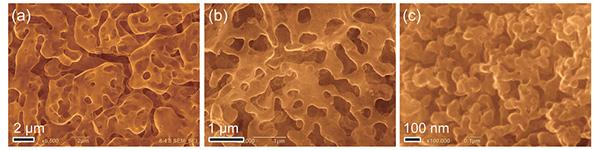
The research team sought to investigate this by taking a single, 2D graphene sheet and folding it into a 3D structure with a bicontinuous and open porous structure.

The structure, with a curvature radius down to 25-50 nanometers, retained the basic electronic properties of 2D graphene well. Meanwhile, the motion of electrons on the 3D curvature enhanced electron scattering that had originated from the intrinsic curvature effects. In fact, nanoscale curvature provides a new degree of freedom to manipulate graphene’s electronic behaviors for the emergent and unique electrical properties of 3D graphene.

###

Media Contact
Mingwei Chen
[email protected]

Original Source

https://www.tohoku.ac.jp/en/press/staying_ahead_of_the_curve.html

Related Journal Article

http://dx.doi.org/10.1002/adma.202005838

Tags: Chemistry/Physics/Materials SciencesMaterialsTechnology/Engineering/Computer Science
Share12Tweet8Share2ShareShareShare2

Related Posts

Isolated H2-Reduced Clusters Boost CO2-to-Methanol Catalysis

Isolated H2-Reduced Clusters Boost CO2-to-Methanol Catalysis

March 25, 2026
blank

Physicists Identify Electronic Drivers Behind Flat Band Quantum Materials

March 21, 2026

Würzburg Chemistry Professor Claudia Höbartner Receives Prestigious Honor

March 20, 2026

Scientists Reveal How Magnets Control Metamaterial Behavior

March 20, 2026
Please login to join discussion

POPULAR NEWS

  • blank

    Revolutionary AI Model Enhances Precision in Detecting Food Contamination

    96 shares
    Share 38 Tweet 24
  • Imagine a Social Media Feed That Challenges Your Views Instead of Reinforcing Them

    1004 shares
    Share 397 Tweet 248
  • Uncovering Functions of Cavernous Malformation Proteins in Organoids

    54 shares
    Share 22 Tweet 14
  • Promising Outcomes from First Clinical Trials of Gene Regulation in Epilepsy

    51 shares
    Share 20 Tweet 13

About

We bring you the latest biotechnology news from best research centers and universities around the world. Check our website.

Follow us

Recent News

In-Sensor Cryptography Links Physical Process to Digital Identity

Can Psychosocial Factors Influence Cancer Risk?

Depression Factors in Elderly: Pre vs. Post-COVID Analysis

Subscribe to Blog via Email

Enter your email address to subscribe to this blog and receive notifications of new posts by email.

Join 78 other subscribers
  • Contact Us

Bioengineer.org © Copyright 2023 All Rights Reserved.

Welcome Back!

Login to your account below

Forgotten Password?

Retrieve your password

Please enter your username or email address to reset your password.

Log In
No Result
View All Result
  • Homepages
    • Home Page 1
    • Home Page 2
  • News
  • National
  • Business
  • Health
  • Lifestyle
  • Science

Bioengineer.org © Copyright 2023 All Rights Reserved.