Credit: Author
In a paper published in TECHNOLOGY, a team of researchers from Massachusetts General Hospital (MGH) have demonstrated 24-hour rat liver viability in a normothermic machine perfusion (NMP) system. Rat liver perfusion is an efficient and cost-effective method to study how various pharmacologic agents impact liver parenchyma.
Normothermic machine perfusion (NMP) has the challenge of mirroring in-vivo settings as closely as possible for the liver allograft. This allows drugs, enzymatic reactions, repair processes, and metabolic pathways to affect liver function to their full capacity. However, under normothermic conditions (35-38°C), the perfusions become exponentially more complex when the perfusion duration is extended, severely limiting our ability to observe liver physiology and pharmacologic effects after 6 hours.
This work builds on existing NMP systems with critical modifications in technique and design to
extend the perfusion time of a rat liver allograft without complications or ischemic events. Addressing these issues in NMP greatly expands the armamentarium of experiments that can be conducted to assess how livers responds to physiologic insults and pharmacologic agents over time ex-vivo.
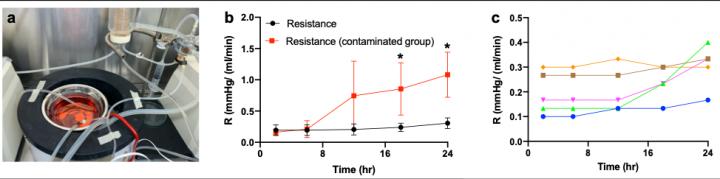
Another major achievement of this research is the identification of perfusion metrics that are predictive of long-term (24-hour) perfusion success. Liver oxygen consumption and rises in intra-hepatic resistance (see image) are shown to be early predictive markers of perfusion system contamination. These markers can be utilized in future experiments to assess the stability of long NMP experiments which can save valuable time and resources in pharmacologic studies.
The team from MGH is working now to utilize long-term rat liver normothermic perfusions to trial different pharmacologic delivery mechanisms, such as lipid nanoparticles, as a novel method of targeted drug delivery.
###
Corresponding author for this study in TECHNOLOGY is Dr. Korkut Uygun PhD ([email protected]).
Additional co-authors are Casie A. Pendexter, Stephanie E.J. Cronin, Dr. Siavash Raigani MD, Dr. Reiner J. de Vries MD PhD, Dr. Heidi Yeh MD, and Dr. James F. Mark-mann MD PhD.
This work was funded from the US National Institutes of Health (NSF ATP-Bio ERC grant (NSF 1941543), R01DK096075, R01DK114506, R01DK107875). Further, we gratefully acknowledge re-search support to Omar Haque by the American Liver Foundation (2019 Hans Popper Memorial Post-doctoral Research Fellowship) and the American College of Surgeons (Grant number 1123-39991 scholarship endowment fund).
For more insight into the research described, readers are invited to access the paper on TECHNOLOGY.
IMAGE
Caption: Normothermic machine perfusion system with rat liver perfused in William’s E based media. b) Intra-hepatic resistance levels at 12 hours predictive of contaminated versus uncontaminated 24-hour perfusions. c) Intra-hepatic resistance of five uncontaminated perfusions show relatively stable pressures over 24 hours.
Fashioned as a high-impact, high-visibility, top-echelon publication, this new ground-breaking journal – TECHNOLOGY – will feature the development of cutting-edge new technologies in a broad array of emerging fields of science and engineering. The content will have an applied science and technological slant with a focus on both innovation and application to daily lives. It will cover diverse disciplines such as health and life science, energy and environment, advanced materials, technology-based manufacturing, information science and technology, and marine and transportations technologies.
About World Scientific Publishing Co.
World Scientific Publishing is a leading independent publisher of books and journals for the scholarly, research, professional and educational communities. The company publishes about 600 books annually and about 135 journals in various fields. World Scientific collaborates with prestigious organizations like the Nobel Foundation and US National Academies Press to bring high quality academic and professional content to researchers and academics worldwide. To find out more about World Scientific, please visit http://www.
For more information, contact Tay Yu Shan at [email protected].
Media Contact
Yu Shan Tay
[email protected]
Original Source
https:/
Related Journal Article
http://dx.