• HOME
  • NEWS
  • EXPLORE
    • CAREER
      • Companies
      • Jobs
    • EVENTS
    • iGEM
      • News
      • Team
    • PHOTOS
    • VIDEO
    • WIKI
  • BLOG
  • COMMUNITY
    • FACEBOOK
    • INSTAGRAM
    • TWITTER
Monday, August 17, 2026
BIOENGINEER.ORG
No Result
View All Result
  • Login
  • HOME
  • NEWS
  • EXPLORE
    • CAREER
      • Companies
      • Jobs
        • Lecturer
        • PhD Studentship
        • Postdoc
        • Research Assistant
    • EVENTS
    • iGEM
      • News
      • Team
    • PHOTOS
    • VIDEO
    • WIKI
  • BLOG
  • COMMUNITY
    • FACEBOOK
    • INSTAGRAM
    • TWITTER
  • HOME
  • NEWS
  • EXPLORE
    • CAREER
      • Companies
      • Jobs
        • Lecturer
        • PhD Studentship
        • Postdoc
        • Research Assistant
    • EVENTS
    • iGEM
      • News
      • Team
    • PHOTOS
    • VIDEO
    • WIKI
  • BLOG
  • COMMUNITY
    • FACEBOOK
    • INSTAGRAM
    • TWITTER
No Result
View All Result
Bioengineer.org
No Result
View All Result
Home NEWS Science News Chemistry

Highly sensitive detection of circularly polarized light without a filter

Bioengineer by Bioengineer
November 16, 2020
in Chemistry
Reading Time: 2 mins read
0
IMAGE
Share on FacebookShare on TwitterShare on LinkedinShare on RedditShare on Telegram

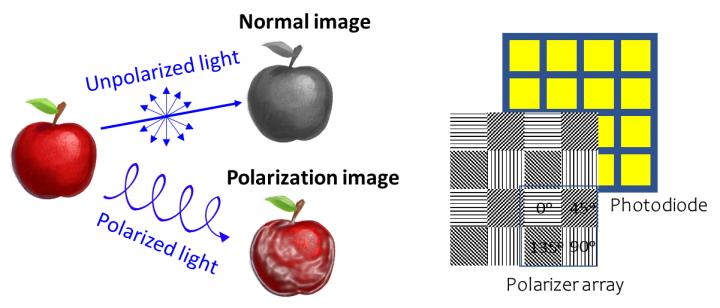
Expected as a technology for visualization of the invisible change of object surfaces such as stress intensity and distribution
IMAGE

Credit: Ayumi Ishii

Under JST Strategic Basic Research Programs, PRESTO researcher Ayumi Ishii, (Toin University of Yokohama, specially appointed lecturer) has developed a photodiode using a crystalline film composed of lead perovskite compounds with organic chiral molecules to detect circularly polarized light without a filter.

A technology to detect “polarization”, or oscillation direction of light can visualize object surfaces with damages, foreign objects, and distortions. Furthermore, detection of “circularly polarized light”, or rotating electric field of light makes it possible for us to identify stress intensity and distribution of objects. Conventional photodiodes for camera or sensor applications cannot detect polarization of light directly, and therefore, various types of filters must be attached on top of the device to separate the information of polarization spatially. These structures cause substantial losses of sensitivity and resolution in the light detection, especially detection of circularly polarized light is heretofore considered difficult. Thus, it has been much desired to develop a new sensor for detection of circularly polarized light without any filters.

In the present study, Dr. Ishii prepared an organic-inorganic hybrid chiral crystalline film consisting of lead perovskite compounds and organic molecules with chirality, which cannot be superposed on its mirror image like right and left hands. This study exhibited that the hybrid film forms a helical one-dimensional (1D) chain structure and the spiral direction allows for selective absorption of left or right-handed circularly polarized light. The photodiode based on this 1D chiral crystalline film successfully detected rotational direction of circularly polarized light without a filter. The ratio of sensitivities between left- and right-handed circularly polarized light detections achieved the world’s highest value of 25 or higher for a filterless circular polarization detector.

Direct detection of circularly polarized light without a filter as shown in the present result allows for higher sensitivity and miniaturization of photodetectors. It is anticipated to become a new sensor technology that would achieve acquisition of a previously unidentified information and recognition of stress.

###

Media Contact
Ayumi Ishii
[email protected]

Original Source

https://www.jst.go.jp/pr/announce/20201112/index_e.html

Related Journal Article

http://dx.doi.org/10.1126/sciadv.abd3274

Tags: Chemistry/Physics/Materials SciencesIndustrial Engineering/ChemistryMaterialsNanotechnology/MicromachinesOpticsResearch/Development
Share12Tweet8Share2ShareShareShare2

Related Posts

Butterfly-Inspired Technology Could Transform Air Quality Monitoring

August 15, 2026
Artesunate Targets GBA, Triggering Apoptosis in Liver Cancer Cells

Artesunate Targets GBA, Triggering Apoptosis in Liver Cancer Cells

August 15, 2026

New molecule may enable cleaner, more efficient metal recovery

August 15, 2026

Controlled sulfidation enhances supercapacitor electrode performance

August 15, 2026
Please login to join discussion

POPULAR NEWS

  • Pilot Study Examines Personal Care Use, Social Media Engagement Among NJ Students

    29 shares
    Share 12 Tweet 7
  • KAIST develops semiconductor neuron that harnesses noise to selectively process signals

    29 shares
    Share 12 Tweet 7
  • Imagining natural and extra robotic thumbs together strengthens kinesthetic sensorimotor networks

    29 shares
    Share 12 Tweet 7
  • PARP1 Drives Neuropathic Pain Through GPX4-Dependent Ferroptosis in Injured Mice’s Sensory Neurons

    29 shares
    Share 12 Tweet 7

About

We bring you the latest biotechnology news from best research centers and universities around the world. Check our website.

Follow us

Recent News

Pilot Study Examines Personal Care Use, Social Media Engagement Among NJ Students

KAIST develops semiconductor neuron that harnesses noise to selectively process signals

Imagining natural and extra robotic thumbs together strengthens kinesthetic sensorimotor networks

Subscribe to Blog via Email

Enter your email address to subscribe to this blog and receive notifications of new posts by email.

Join 85 other subscribers
  • Contact Us

Bioengineer.org © Copyright 2023 All Rights Reserved.

Welcome Back!

Login to your account below

Forgotten Password?

Retrieve your password

Please enter your username or email address to reset your password.

Log In
No Result
View All Result
  • Homepages
    • Home Page 1
    • Home Page 2
  • News
  • National
  • Business
  • Health
  • Lifestyle
  • Science

Bioengineer.org © Copyright 2023 All Rights Reserved.