• HOME
  • NEWS
  • EXPLORE
    • CAREER
      • Companies
      • Jobs
    • EVENTS
    • iGEM
      • News
      • Team
    • PHOTOS
    • VIDEO
    • WIKI
  • BLOG
  • COMMUNITY
    • FACEBOOK
    • INSTAGRAM
    • TWITTER
Tuesday, February 3, 2026
BIOENGINEER.ORG
No Result
View All Result
  • Login
  • HOME
  • NEWS
  • EXPLORE
    • CAREER
      • Companies
      • Jobs
        • Lecturer
        • PhD Studentship
        • Postdoc
        • Research Assistant
    • EVENTS
    • iGEM
      • News
      • Team
    • PHOTOS
    • VIDEO
    • WIKI
  • BLOG
  • COMMUNITY
    • FACEBOOK
    • INSTAGRAM
    • TWITTER
  • HOME
  • NEWS
  • EXPLORE
    • CAREER
      • Companies
      • Jobs
        • Lecturer
        • PhD Studentship
        • Postdoc
        • Research Assistant
    • EVENTS
    • iGEM
      • News
      • Team
    • PHOTOS
    • VIDEO
    • WIKI
  • BLOG
  • COMMUNITY
    • FACEBOOK
    • INSTAGRAM
    • TWITTER
No Result
View All Result
Bioengineer.org
No Result
View All Result
Home NEWS Science News Chemistry

Plasma treatments quickly kill coronavirus on surfaces

Bioengineer by Bioengineer
November 10, 2020
in Chemistry
Reading Time: 3 mins read
0
IMAGE
Share on FacebookShare on TwitterShare on LinkedinShare on RedditShare on Telegram

Using cold atmospheric plasma promises a breakthrough in stopping the spread of COVID-19
IMAGE

Credit: Wirz Research Group, UCLA

WASHINGTON, November 10, 2020 — Researchers from UCLA believe using plasma could promise a significant breakthrough in the fight against the spread of COVID-19.

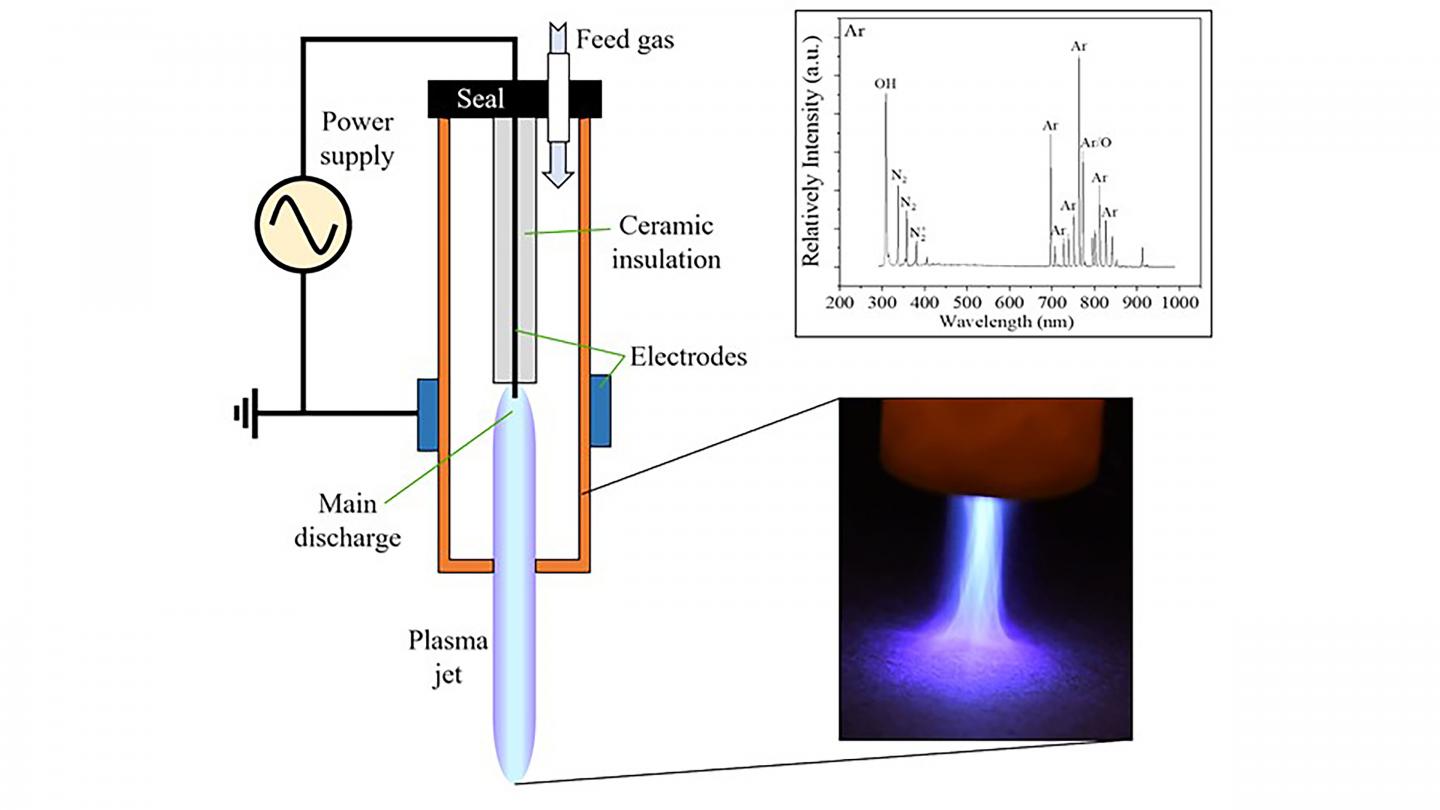
In Physics of Fluids, by AIP Publishing, modeling conducted in June showed strains of the novel coronavirus on surfaces like metal, leather, and plastic were killed in as little as 30 seconds of treatment with argon-fed, cold atmospheric plasma.

The researchers used an atmospheric pressure plasma jet they built with a 3D printer to spray surfaces that were treated with SARS-CoV-2 cultures. The surfaces included plastic, metal, cardboard, and basketball, football, and baseball leather.

The spray using plasma fed by argon killed all the coronavirus on the six surfaces in less than three minutes, and most of the virus was destroyed after 30 seconds. Additional testing showed the virus was destroyed in similar times on cotton from face masks.

The novel coronavirus can remain infectious on surfaces for several hours. Author Richard E. Wirz said the findings show great potential for the use of plasma in halting the virus’s transmission cycle.

“This is only the beginning,” Wirz said. “We are very confident and have very high expectations for plasma in future work. In the future, a lot of answers for the scientific community will come from plasma.”

Plasma is one of the four basic states of matter and can be created by heating a neutral gas or subjecting it to a strong electromagnetic field. A relatively new technology, cold atmospheric plasma is an ionized, near-room-temperature gas that has proven effective in cancer treatments, wound healing, dentistry, and other medical applications.

The authors ran a similar coronavirus test with helium-fed plasma, but the helium was not effective, even with treatments up to five minutes. The authors believe this was due to lower rates of reactive oxygen and reactive nitrogen when using helium-fed gas, compared to argon.

Zhitong Chen said the authors are building a compact device that could be used widely to treat surfaces for the coronavirus with plasma. It is a safer, healthier option than chemicals or other treatments, he said.

“Everything we use comes from the air,” he said. “Air and electricity: It’s a very healthy treatment with no side effects.”

The researchers hope the benefits of plasma, like those shown in this study, can be made available to people around the world.

###

The article, “Cold atmospheric plasma for SARS-CoV-2 inactivation,” is authored by Zhitong Chen, Gustavo Garcia, Vaithilingaraja Arumugaswami, and Richard Edward Wirz. The article will appear in Physics of Fluids on Nov. 10, 2020 (DOI: 10.1063/5.0031332). After that date, it can be accessed at https://aip.scitation.org/doi/10.1063/5.0031332.

ABOUT THE JOURNAL

Physics of Fluids is devoted to the publication of original theoretical, computational, and experimental contributions to the dynamics of gases, liquids, and complex or multiphase fluids. See https://aip.scitation.org/journal/phf.

Media Contact
Larry Frum
[email protected]

Related Journal Article

http://dx.doi.org/10.1063/5.0031332

Tags: BiologyBiomechanics/BiophysicsChemistry/Physics/Materials SciencesEpidemiologyInfectious/Emerging DiseasesMedicine/HealthParticle Physics
Share13Tweet8Share2ShareShareShare2

Related Posts

Cavendish Laboratory and FormationQ Partner to Launch Applied Quantum Program Powered by IonQ Technology

Cavendish Laboratory and FormationQ Partner to Launch Applied Quantum Program Powered by IonQ Technology

February 3, 2026
blank

Breakthrough in Solving a Classic Magnetism Mystery

February 3, 2026

UCLA Scientists Create Mineral Sunscreen That Minimizes White Residue

February 3, 2026

Discovering a Novel Class of Unusual One-Dimensional Particles

February 3, 2026
Please login to join discussion

POPULAR NEWS

  • Enhancing Spiritual Care Education in Nursing Programs

    158 shares
    Share 63 Tweet 40
  • Robotic Ureteral Reconstruction: A Novel Approach

    81 shares
    Share 32 Tweet 20
  • Digital Privacy: Health Data Control in Incarceration

    63 shares
    Share 25 Tweet 16
  • Study Reveals Lipid Accumulation in ME/CFS Cells

    57 shares
    Share 23 Tweet 14

About

We bring you the latest biotechnology news from best research centers and universities around the world. Check our website.

Follow us

Recent News

SCAI Expert Opinion Highlights Advances in Wire-Free Angiography-Derived Physiology for Coronary Assessment

Engineered Bacteria Combat E. coli via Metabolic Competition

Tai Chi Improves Blood Pressure and Inflammation Control

Subscribe to Blog via Email

Enter your email address to subscribe to this blog and receive notifications of new posts by email.

Join 73 other subscribers
  • Contact Us

Bioengineer.org © Copyright 2023 All Rights Reserved.

Welcome Back!

Login to your account below

Forgotten Password?

Retrieve your password

Please enter your username or email address to reset your password.

Log In
No Result
View All Result
  • Homepages
    • Home Page 1
    • Home Page 2
  • News
  • National
  • Business
  • Health
  • Lifestyle
  • Science

Bioengineer.org © Copyright 2023 All Rights Reserved.