• HOME
  • NEWS
  • EXPLORE
    • CAREER
      • Companies
      • Jobs
    • EVENTS
    • iGEM
      • News
      • Team
    • PHOTOS
    • VIDEO
    • WIKI
  • BLOG
  • COMMUNITY
    • FACEBOOK
    • INSTAGRAM
    • TWITTER
Saturday, February 7, 2026
BIOENGINEER.ORG
No Result
View All Result
  • Login
  • HOME
  • NEWS
  • EXPLORE
    • CAREER
      • Companies
      • Jobs
        • Lecturer
        • PhD Studentship
        • Postdoc
        • Research Assistant
    • EVENTS
    • iGEM
      • News
      • Team
    • PHOTOS
    • VIDEO
    • WIKI
  • BLOG
  • COMMUNITY
    • FACEBOOK
    • INSTAGRAM
    • TWITTER
  • HOME
  • NEWS
  • EXPLORE
    • CAREER
      • Companies
      • Jobs
        • Lecturer
        • PhD Studentship
        • Postdoc
        • Research Assistant
    • EVENTS
    • iGEM
      • News
      • Team
    • PHOTOS
    • VIDEO
    • WIKI
  • BLOG
  • COMMUNITY
    • FACEBOOK
    • INSTAGRAM
    • TWITTER
No Result
View All Result
Bioengineer.org
No Result
View All Result
Home NEWS Science News Biology

Novel mechanical mechanism of metastatic cancer cells in substrates of different stiffness revealed

Bioengineer by Bioengineer
October 16, 2020
in Biology
Reading Time: 2 mins read
0
IMAGE
Share on FacebookShare on TwitterShare on LinkedinShare on RedditShare on Telegram

IMAGE

Credit: HKUST

During metastasis, cancer cells actively interact with microenvironments of new tissues. How metastatic cancer cells respond to new environments in the secondary tissues is a crucial question in cancer research but still remains elusive. Recently, researchers from the Hong Kong University of Science and Technology (HKUST), along with their international collaborators, discovered a novel mechanical mechanism of metastatic cancer cells in substrates of different stiffness, which could contribute to developing diagnostic tools for metastatic cancer cells and cancer therapeutics.

This study was published in the Journal of Physical Chemistry Letters on Sept 18, 2020.

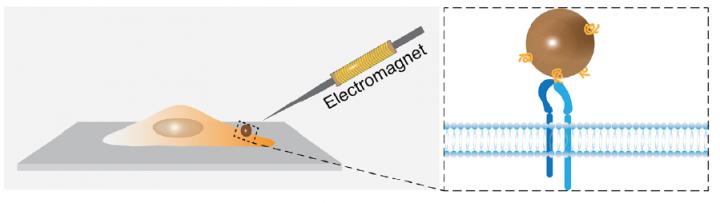
In the study, the team of researchers, led by Prof. Hyokeun Park, assistant professor at the Department of Physics and Division of Life Science, HKUST, mimicked mechanical stiffness of diverse tissues from soft brain to bone using polyacrylamide (PAA) substrates and measured the mechanical responses of single metastatic breast cancer cells (MDA-MB-231 cells) against different stiffness, using advanced imaging techniques and the state-of-the-art magnetic tweezers which Prof. Park’s group built in HKUST.

Using single-molecule tension sensors, they found that metastatic breast cancer cells change their tension in focal adhesions against the stiffness to adapt new environments whereas normal breast cells (MCF-10A cells) keep the similar tension regardless of stiffness. They also measured the viscoelasticity of single metastatic breast cancer cells using magnetic tweezers and found that metastatic cancer cells become more elastic on stiffer substrates while the viscoelasticity of normal cells remain similar.

These results show that metastatic breast cancer cells have stronger capacity to adapt to the mechanical environments of diverse tissues.

“How do metastatic breast cancer cells migrate and proliferate the secondary tissues of different stiffness from soft to hard tissue interface like brain to bone is a crucial question in cancer research,” said Prof. Park. “Our work addressed how metastatic breast cancer cells proliferate the substrate of varying stiffness from 1kPa (similar to brain) to 50GPa(similar to bone), and we discovered that metastatic cancer cells change their viscoelasticity depending on physical environment to adapt their new physical environment and survive their new environment. This is one of big achievements in cancer physics and mechanobiology. The findings will contribute to developing diagnostic tools for metastatic cancer cells and, eventually, treatment of cancer.”

This work was done in collaboration with Prof. Ching-Hwa Kiang at Rice University, Professor Jun Chu at Shenzhen Institutes of Advanced Technology and Prof. Ophelia Tsui in Department of Physics of HKUST.

The team is planning to develop a cancer diagnostic kit making use of the mechanism to measure tension of living potential cancer cells at different stiffness, which will be much simpler and more user-friendly than the existing diagnosis tools for metastatic cancer cells. Such mechanism could also be used to develop a drug-screening test for metastatic cancer to see how metastatic cancer cells’ focal adhesion and viscoelasticity respond to different drugs and find the most effective drug for them.

###

Media Contact
Johnny Tam
[email protected]

Related Journal Article

http://dx.doi.org/10.1021/acs.jpclett.0c02065

Tags: BiologyBiomechanics/BiophysicsBreast CancercancerCell BiologyMedicine/Health
Share12Tweet8Share2ShareShareShare2

Related Posts

Florida Cane Toad: Complex Spread and Selective Evolution

Florida Cane Toad: Complex Spread and Selective Evolution

February 7, 2026
New Study Uncovers Mechanism Behind Burn Pit Particulate Matter–Induced Lung Inflammation

New Study Uncovers Mechanism Behind Burn Pit Particulate Matter–Induced Lung Inflammation

February 6, 2026

DeepBlastoid: Advancing Automated and Efficient Evaluation of Human Blastoids with Deep Learning

February 6, 2026

Navigating the Gut: The Role of Formic Acid in the Microbiome

February 6, 2026
Please login to join discussion

POPULAR NEWS

  • Robotic Ureteral Reconstruction: A Novel Approach

    Robotic Ureteral Reconstruction: A Novel Approach

    82 shares
    Share 33 Tweet 21
  • Digital Privacy: Health Data Control in Incarceration

    63 shares
    Share 25 Tweet 16
  • Study Reveals Lipid Accumulation in ME/CFS Cells

    57 shares
    Share 23 Tweet 14
  • Breakthrough in RNA Research Accelerates Medical Innovations Timeline

    53 shares
    Share 21 Tweet 13

About

We bring you the latest biotechnology news from best research centers and universities around the world. Check our website.

Follow us

Recent News

Evaluating Pediatric Emergency Care Quality in Ethiopia

TPMT Expression Predictions Linked to Azathioprine Side Effects

Improving Dementia Care with Enhanced Activity Kits

Subscribe to Blog via Email

Success! An email was just sent to confirm your subscription. Please find the email now and click 'Confirm' to start subscribing.

Join 73 other subscribers
  • Contact Us

Bioengineer.org © Copyright 2023 All Rights Reserved.

Welcome Back!

Login to your account below

Forgotten Password?

Retrieve your password

Please enter your username or email address to reset your password.

Log In
No Result
View All Result
  • Homepages
    • Home Page 1
    • Home Page 2
  • News
  • National
  • Business
  • Health
  • Lifestyle
  • Science

Bioengineer.org © Copyright 2023 All Rights Reserved.