• HOME
  • NEWS
  • EXPLORE
    • CAREER
      • Companies
      • Jobs
    • EVENTS
    • iGEM
      • News
      • Team
    • PHOTOS
    • VIDEO
    • WIKI
  • BLOG
  • COMMUNITY
    • FACEBOOK
    • INSTAGRAM
    • TWITTER
Saturday, February 7, 2026
BIOENGINEER.ORG
No Result
View All Result
  • Login
  • HOME
  • NEWS
  • EXPLORE
    • CAREER
      • Companies
      • Jobs
        • Lecturer
        • PhD Studentship
        • Postdoc
        • Research Assistant
    • EVENTS
    • iGEM
      • News
      • Team
    • PHOTOS
    • VIDEO
    • WIKI
  • BLOG
  • COMMUNITY
    • FACEBOOK
    • INSTAGRAM
    • TWITTER
  • HOME
  • NEWS
  • EXPLORE
    • CAREER
      • Companies
      • Jobs
        • Lecturer
        • PhD Studentship
        • Postdoc
        • Research Assistant
    • EVENTS
    • iGEM
      • News
      • Team
    • PHOTOS
    • VIDEO
    • WIKI
  • BLOG
  • COMMUNITY
    • FACEBOOK
    • INSTAGRAM
    • TWITTER
No Result
View All Result
Bioengineer.org
No Result
View All Result
Home NEWS Science News Biology

The propagation of admixture-derived evolutionary potential

Bioengineer by Bioengineer
October 7, 2020
in Biology
Reading Time: 2 mins read
0
IMAGE
Share on FacebookShare on TwitterShare on LinkedinShare on RedditShare on Telegram

IMAGE

Credit: Tohoku University

Adaptive radiation – the rapid evolution of many new species from a single ancestor – is a major focus in evolutionary biology. Adaptive radiations often show remarkable repeatability where lineages have undergone multiple episodes of adaptive radiation in distant places and at various points in time – implying their extraordinary evolutionary potential.

Now, researchers from the Swiss Federal Institute of Aquatic Science and Technology and Tohoku University have developed a novel “individual-based model” that simulates the evolution of an ecosystem of virtual organisms. This model reveals additional information about recurrent adaptive radiation and the role that hybridization plays in that process.

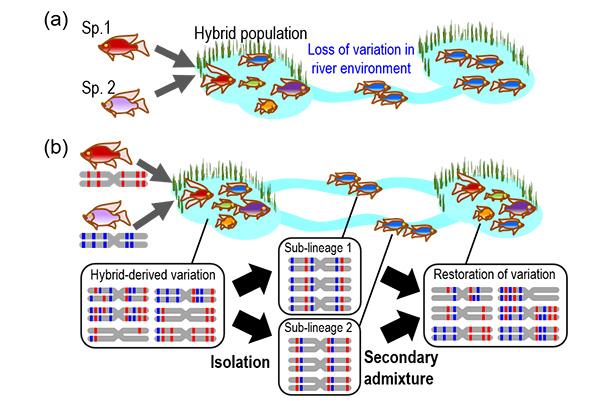
Hybridization – the interbreeding of different species – generates extraordinary genetic variation by mixing and recombining genetic materials from different species. Then the enriched genetic variation can facilitate rapid adaptive radiation into various unoccupied habitats if available. However, hybridization generates large genetic variation locally and for a short period, meaning the simultaneous coexistence of hybridization and unoccupied habits is rare. Because of this, hybridization seemed unlikely to explain the recurrent adaptive radiation in the same lineage.

Yet, a recent genomics study on adaptive radiations of East African cichlid fish caused researchers to reevaluate what they previously thought. The study discovered that a genetic variation generated through an ancient hybridization event permanently increased evolutionary potential of the descendant lineage and facilitated a recurrent adaptive radiation of the lineage in several geographically distant lakes – one of which started over 100000 years after the hybridization event.

To address this theoretical conundrum, Kotaro Kagawa and his colleague Ole Seehausen used their individual-based model to simulate the evolutionary dynamics caused by hybridization under various geographic, ecological, and historical scenarios. Results from over 15000 simulations provided two theoretical findings. First, simulations showed that hybridization-derived genetic variation geographically spreads and persists for long periods only if the hybrid population becomes separated into isolated sub-lineages. Subsequent secondary hybridization of the sub-lineages can potentially reestablish genetic polymorphisms from the ancestral hybridization in places far from the birthplace of the hybrid-clade and long after the ancestral hybridization event. This leads to the second finding: genetic variation generated through a single hybridization event could lead to multiple independent episodes of adaptive radiation far apart in location and time when ecological and geographic conditions promote the temporal isolation and subsequent admixture of sub-lineages.

“These findings provide not only an explanation for the recurrent adaptive radiation of African cichlids but also a novel insight that exceptional genetic variation, once generated through a rare hybridization event, may significantly influence clade-wide macroevolutionary trends ranging over large spatial and temporal scales,” said Dr. Kagawa.

###

Media Contact
Kotaro Kagawa
[email protected]

Original Source

https://www.tohoku.ac.jp/en/press/admixture_derived_evolutionary_potential.html

Related Journal Article

http://dx.doi.org/10.1098/rspb.2020.0941

Tags: BiologyGeneticsMarine/Freshwater Biology
Share12Tweet8Share2ShareShareShare2

Related Posts

Florida Cane Toad: Complex Spread and Selective Evolution

Florida Cane Toad: Complex Spread and Selective Evolution

February 7, 2026
New Study Uncovers Mechanism Behind Burn Pit Particulate Matter–Induced Lung Inflammation

New Study Uncovers Mechanism Behind Burn Pit Particulate Matter–Induced Lung Inflammation

February 6, 2026

DeepBlastoid: Advancing Automated and Efficient Evaluation of Human Blastoids with Deep Learning

February 6, 2026

Navigating the Gut: The Role of Formic Acid in the Microbiome

February 6, 2026
Please login to join discussion

POPULAR NEWS

  • Robotic Ureteral Reconstruction: A Novel Approach

    Robotic Ureteral Reconstruction: A Novel Approach

    82 shares
    Share 33 Tweet 21
  • Digital Privacy: Health Data Control in Incarceration

    63 shares
    Share 25 Tweet 16
  • Study Reveals Lipid Accumulation in ME/CFS Cells

    57 shares
    Share 23 Tweet 14
  • Breakthrough in RNA Research Accelerates Medical Innovations Timeline

    53 shares
    Share 21 Tweet 13

About

We bring you the latest biotechnology news from best research centers and universities around the world. Check our website.

Follow us

Recent News

Phage-Antibiotic Combo Beats Resistant Peritoneal Infection

Boosting Remote Healthcare: Stepped-Wedge Trial Insights

Barriers and Boosters of Seniors’ Physical Activity in Karachi

Subscribe to Blog via Email

Enter your email address to subscribe to this blog and receive notifications of new posts by email.

Join 73 other subscribers
  • Contact Us

Bioengineer.org © Copyright 2023 All Rights Reserved.

Welcome Back!

Login to your account below

Forgotten Password?

Retrieve your password

Please enter your username or email address to reset your password.

Log In
No Result
View All Result
  • Homepages
    • Home Page 1
    • Home Page 2
  • News
  • National
  • Business
  • Health
  • Lifestyle
  • Science

Bioengineer.org © Copyright 2023 All Rights Reserved.