• HOME
  • NEWS
  • EXPLORE
    • CAREER
      • Companies
      • Jobs
    • EVENTS
    • iGEM
      • News
      • Team
    • PHOTOS
    • VIDEO
    • WIKI
  • BLOG
  • COMMUNITY
    • FACEBOOK
    • INSTAGRAM
    • TWITTER
Thursday, March 26, 2026
BIOENGINEER.ORG
No Result
View All Result
  • Login
  • HOME
  • NEWS
  • EXPLORE
    • CAREER
      • Companies
      • Jobs
        • Lecturer
        • PhD Studentship
        • Postdoc
        • Research Assistant
    • EVENTS
    • iGEM
      • News
      • Team
    • PHOTOS
    • VIDEO
    • WIKI
  • BLOG
  • COMMUNITY
    • FACEBOOK
    • INSTAGRAM
    • TWITTER
  • HOME
  • NEWS
  • EXPLORE
    • CAREER
      • Companies
      • Jobs
        • Lecturer
        • PhD Studentship
        • Postdoc
        • Research Assistant
    • EVENTS
    • iGEM
      • News
      • Team
    • PHOTOS
    • VIDEO
    • WIKI
  • BLOG
  • COMMUNITY
    • FACEBOOK
    • INSTAGRAM
    • TWITTER
No Result
View All Result
Bioengineer.org
No Result
View All Result
Home NEWS Science News Chemistry

Sanders-brown research discovers new pathway in TDP-43 related dementias

Bioengineer by Bioengineer
September 23, 2020
in Chemistry
Reading Time: 3 mins read
0
IMAGE
Share on FacebookShare on TwitterShare on LinkedinShare on RedditShare on Telegram

IMAGE

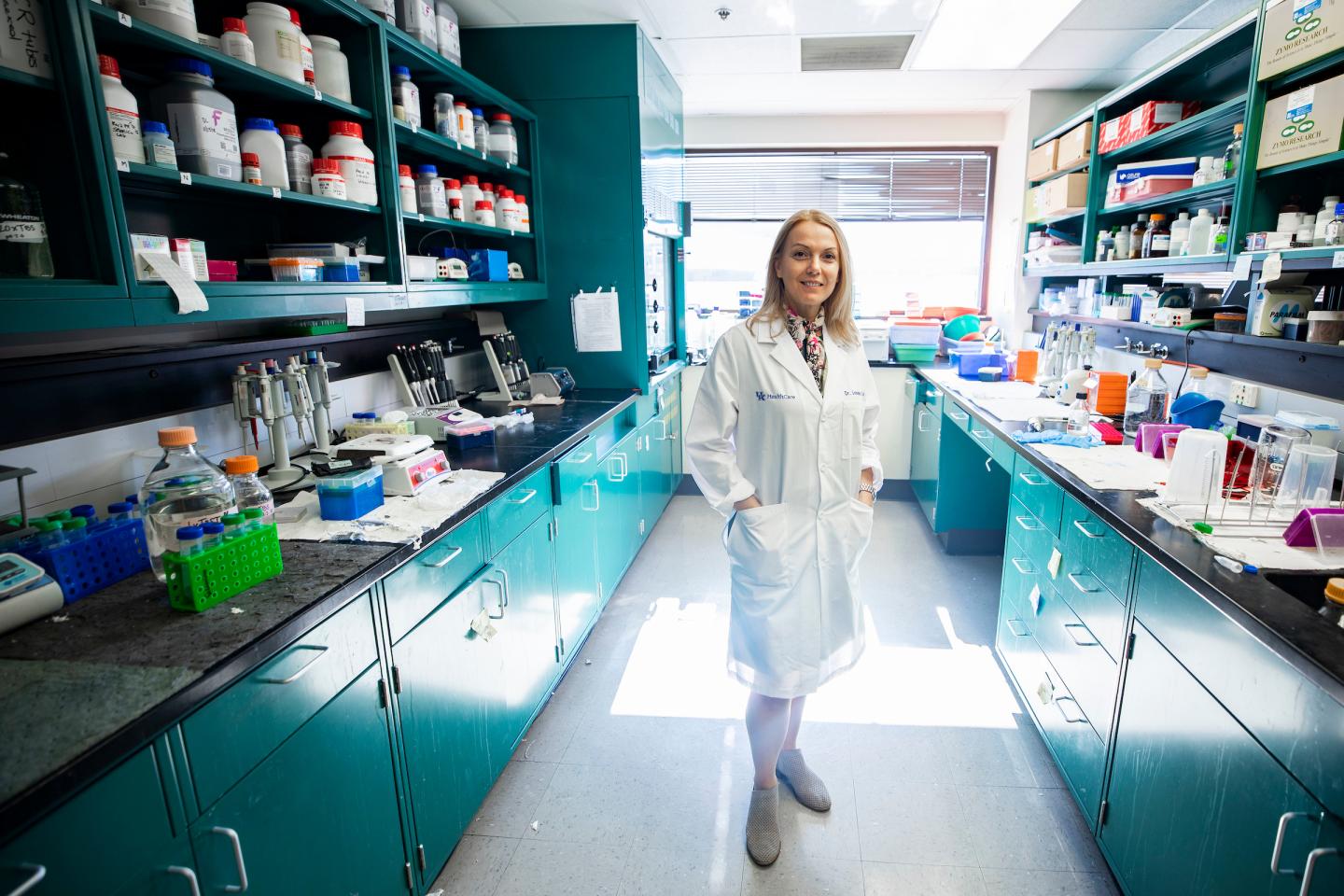
Credit: Photo by Pete Comparoni | UKphoto

Recent work published by researchers at the University of Kentucky’s Sanders-Brown Center on Aging (SBCoA) highlights what the lead investigator calls the “cornerstone” of her lab. Maj-Linda Selenica, assistant professor at SBCoA, led the study recently published in BBA Molecular Basis of Disease. She says their approach was unconventional as it looked at the molecular mechanisms implicated in TDP-43 biology, which is the focus of her lab.

TDP-43 is a DNA/RNA binding protein that has been found to be the hallmark pathology in a wide range of neurodegenerative diseases. Selenica says their study is the first to provide a novel pathway and identify potential therapeutic targets for TDP-43 proteinopathies – especially in Alzheimer’s disease and the newly characterized form of dementia known as LATE.

The new pathway discovered by Selenica and her team is known as Eukaryotic Translation Initiation Factor 5A (eIF5A). “Our study showed that eIF5A hypusination (a modification of the protein) governs TDP-43 accumulation and aggregation in the cytoplasm, as well as accumulation of TDP-43 in membranless organelles in the cytoplasm which are called stress granules. More importantly, pharmacological inhibition of an enzyme generating hypusinated eIF5A significantly reduced TDP-43 cytoplasmic accumulation and aggregation in the cells.”

Selenica says there are many important takeaways from this particular study including that this work has just scratched the surface of understanding the mechanism of hypusinated eIF5A in TDP-43 pathology. “Our understanding of TDP-43 function has advanced profoundly in the past several years; however, its complete role and the molecular mechanisms that lead to disease are not fully understood.”

A lot of recent work regarding TDP-43 has been the result of the work of some of Selenica’s colleagues at SBCoA, making this study important not only for Selenica’s lab in particular but for the combined effort at SBCoA to find a cure. Dr. Pete Nelson, senior pathologist at SBCoA, and his team recently identified TDP-43 as the defining feature of LATE (limbic predominant age-related TDP-43 encephalopathy), which mimics the clinical presentation of Alzheimer’s disease but has its own distinct pathology. Additionally, Erin Abner Ph.D., an associate professor at UK’s SBCoA and College of Public Health investigated the impact of co-morbid quadruple misfolded proteins (Aβ, tau, α-synuclein, and TDP-43). That study revealed that the prevalence of TDP-43 proteinopathy with AD pathology (tau and Aβ), correlated with increased early cognitive decline and severity of AD progression.

Altogether these pivotal findings signify the importance of TDP-43 in dementia, and especially Alzheimer’s disease and LATE. “Identifying new pathways implicated in TDP-43 pathology are extremely attractive as there are very limited therapeutic strategies for TDP-43 pathology – and there is no cure,” said Selenica.

Her lab has now moved into investigating their newly discovered pathway in animal models. Ultimately, they are aiming to develop therapeutic strategies and the utilization of hypusinated eIF5A as a fluid biomarker.

###

Media Contact
Hillary Smith
[email protected]

Original Source

https://uknow.uky.edu/research/sanders-brown-research-discovers-new-pathway-tdp-43-related-dementias

Related Journal Article

http://dx.doi.org/10.1016/j.bbadis.2020.165939

Tags: AgingAlzheimerBiochemistryGerontologyMedicine/HealthMolecular BiologyneurobiologyNeurochemistry
Share12Tweet8Share2ShareShareShare2

Related Posts

Isolated H2-Reduced Clusters Boost CO2-to-Methanol Catalysis

Isolated H2-Reduced Clusters Boost CO2-to-Methanol Catalysis

March 25, 2026
blank

Physicists Identify Electronic Drivers Behind Flat Band Quantum Materials

March 21, 2026

Würzburg Chemistry Professor Claudia Höbartner Receives Prestigious Honor

March 20, 2026

Scientists Reveal How Magnets Control Metamaterial Behavior

March 20, 2026
Please login to join discussion

POPULAR NEWS

  • blank

    Revolutionary AI Model Enhances Precision in Detecting Food Contamination

    96 shares
    Share 38 Tweet 24
  • Imagine a Social Media Feed That Challenges Your Views Instead of Reinforcing Them

    1003 shares
    Share 397 Tweet 248
  • Uncovering Functions of Cavernous Malformation Proteins in Organoids

    54 shares
    Share 22 Tweet 14
  • Promising Outcomes from First Clinical Trials of Gene Regulation in Epilepsy

    51 shares
    Share 20 Tweet 13

About

We bring you the latest biotechnology news from best research centers and universities around the world. Check our website.

Follow us

Recent News

In-Sensor Cryptography Links Physical Process to Digital Identity

Can Psychosocial Factors Influence Cancer Risk?

Depression Factors in Elderly: Pre vs. Post-COVID Analysis

Subscribe to Blog via Email

Success! An email was just sent to confirm your subscription. Please find the email now and click 'Confirm' to start subscribing.

Join 78 other subscribers
  • Contact Us

Bioengineer.org © Copyright 2023 All Rights Reserved.

Welcome Back!

Login to your account below

Forgotten Password?

Retrieve your password

Please enter your username or email address to reset your password.

Log In
No Result
View All Result
  • Homepages
    • Home Page 1
    • Home Page 2
  • News
  • National
  • Business
  • Health
  • Lifestyle
  • Science

Bioengineer.org © Copyright 2023 All Rights Reserved.