Reading difficulties can be improved with non-invasive brain electrical stimulation, a hope for people suffering from dyslexia
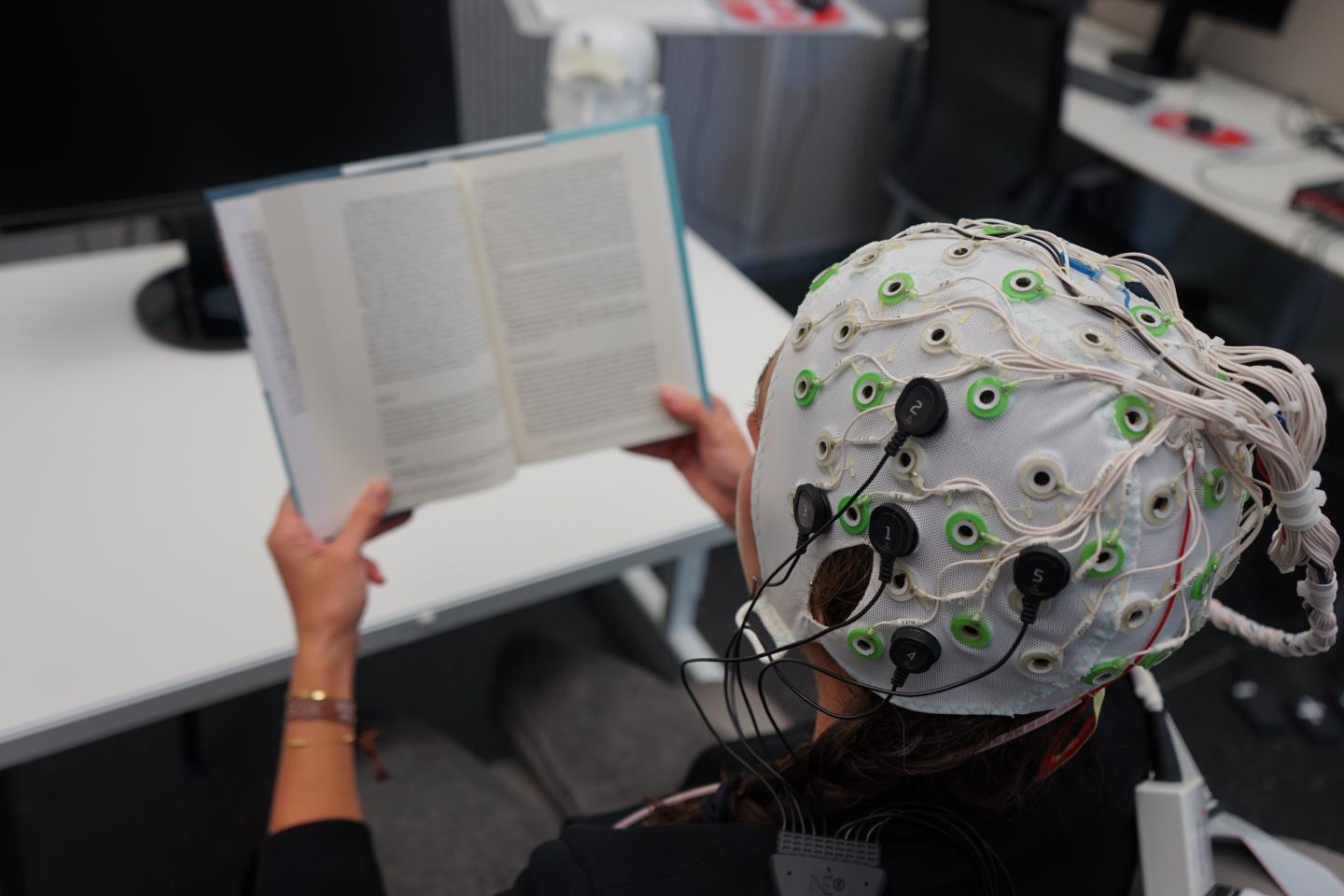
Credit: UNIGE/Silvia Marchesotti
Dyslexia is a frequent disorder of reading acquisition that affects up to 10% of the population, and is characterised by lifelong difficulties with written material. Although several possible causes have been proposed for dyslexia, the predominant one is a phonological deficit, a difficulty in processing language sounds. The phonological deficit in dyslexia is associated with changes in rhythmic or repetitive patterns of neural activity in a sound-processing region of the brain, the left auditory cortex. Neuroscientists from the University of Geneva (UNIGE) have demonstrated, in a study published in Plos Biology, a causal relationship between brain oscillations at a specific frequency (30 Hz) and the ability to process phonemes that is essential for reading. Using a non-invasive electrical stimulation technique capable of synchronizing neural activity at the stimulation frequency, phonological deficits and reading accuracy could be improved in adults with dyslexia.
Silvia Marchesotti and Anne-Lise Giraud, respectively researcher and professor in the Department of Basic Neurosciences of the Faculty of Medicine at UNIGE, together with their colleagues, investigated the main possible cause of dyslexia: the phonological deficit. “We know that during brain development, when children start to read, some experience tremendous difficulties matching speech sounds with letters ” explains Silvia Marchesotti. These specific difficulties are associated with anomalies of neural activity synchronization in the left auditory cortex at the frequency of 30 Hz. The Geneva study demonstrates for the first time that a causal relationship exists between these brain oscillations and the ability to process speech phonemes.
Reading stimulation
Neuroscientists applied the technique of transcranial alternating current stimulation (tACS), which is under investigation in medicine to treat illnesses such as depression. A twenty minute stimulation over the left auditory cortex in 15 dyslexic adults and 15 fluent control readers immediately improved phonological processing and reading accuracy in the dyslexia group. The beneficial effect of stimulation is most pronounced in people with poor reading skills, but neuroscientists have noted a slightly disruptive effect in very good readers.
Towards non-invasive treatments
The Geneva study paves the way for targeted non-invasive therapeutic interventions aimed at improving phonological processing in people with dyslexia. “The next steps for us are to investigate whether normalising oscillatory function in very young children could have a long-lasting effect on the organisation of the reading system,” says Silvia Marchesotti.
This study will continue within the new National Center of Competence in Research (NCCR) “Evolving Language.” The method will be different, however: instead of using electrical stimulation, neuroscientists will try to obtain equivalent results with neurofeedback, a non-invasive technique that involves teaching self-regulation of brain signals to patients. “The goal remains the same, but the use of an even less invasive method will allow conducting trials with children,” says Anne-Lise Giraud, the project leader.
###
Media Contact
Silvia Marchesotti
[email protected]
Original Source
https:/
Related Journal Article
http://dx.