• HOME
  • NEWS
  • EXPLORE
    • CAREER
      • Companies
      • Jobs
    • EVENTS
    • iGEM
      • News
      • Team
    • PHOTOS
    • VIDEO
    • WIKI
  • BLOG
  • COMMUNITY
    • FACEBOOK
    • INSTAGRAM
    • TWITTER
Thursday, March 26, 2026
BIOENGINEER.ORG
No Result
View All Result
  • Login
  • HOME
  • NEWS
  • EXPLORE
    • CAREER
      • Companies
      • Jobs
        • Lecturer
        • PhD Studentship
        • Postdoc
        • Research Assistant
    • EVENTS
    • iGEM
      • News
      • Team
    • PHOTOS
    • VIDEO
    • WIKI
  • BLOG
  • COMMUNITY
    • FACEBOOK
    • INSTAGRAM
    • TWITTER
  • HOME
  • NEWS
  • EXPLORE
    • CAREER
      • Companies
      • Jobs
        • Lecturer
        • PhD Studentship
        • Postdoc
        • Research Assistant
    • EVENTS
    • iGEM
      • News
      • Team
    • PHOTOS
    • VIDEO
    • WIKI
  • BLOG
  • COMMUNITY
    • FACEBOOK
    • INSTAGRAM
    • TWITTER
No Result
View All Result
Bioengineer.org
No Result
View All Result
Home NEWS Science News Chemistry

Decorating windows for optimal sound transmission

Bioengineer by Bioengineer
September 1, 2020
in Chemistry
Reading Time: 2 mins read
0
IMAGE
Share on FacebookShare on TwitterShare on LinkedinShare on RedditShare on Telegram

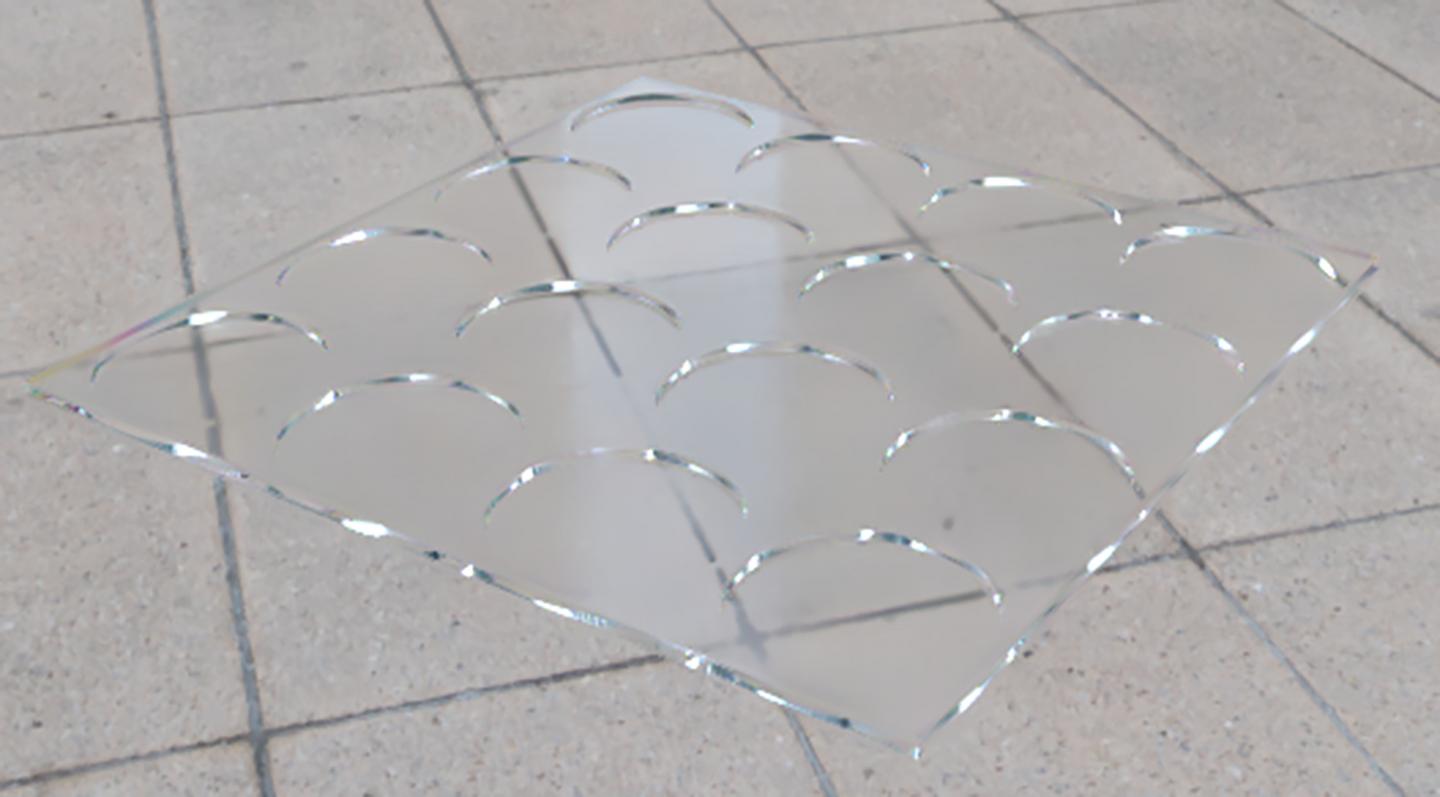
Optically transparent glass material allows sound to propagate efficiently without any airflow.
IMAGE

Credit: Xihan Tan

WASHINGTON, September 1, 2020 — Glass windows typically offer some amount of soundproofing, sometimes unintentionally. In general, ventilation is required to achieve large sound transmission.

But some applications — like gas explosion studies — require a transparent partition that allows for acoustic propagation without the presence of airflow. In those cases, ventilation is not allowed.

In Applied Physics Letters, from AIP Publishing, researchers from Chongqing University, Hong Kong University of Science and Technology, and Shenzhen Fantwave Tech. Co. discuss a layered glass material they developed that allows for efficient sound transmission with no air ventilation.

The window is comprised entirely of ordinary glass, resulting in an inexpensive and optically transparent material. It starts with a thick glass plate, which the researchers drilled holes into and filled with a thin, flat glass disk. They call these disks “decorations.”

“It’s almost totally transparent for human eyes, so we can distinguish objects across this meta-window,” Li Wang, one of the authors, said.

The group observed extraordinary levels of acoustic transmission within a certain frequency range through the decorated window. In its present configuration, peak transmission occurs near the G above middle C, or G4.

By adjusting the sizes of the disks, different acoustic frequencies can be chosen for transmission. Additionally, multiple decorated window layers can be placed sequentially to pick more than one transmission peak, but this comes at a decrease in overall transmission beyond the desired range.

Beyond chemical applications, the group envisions day-to-day scenarios where their decorated windows could be of great value.

For example, prison reception rooms and bank counters would benefit from enabling sound transfer while preventing airflow. Considering the current pandemic, the decorated windows could allow for socially distant concerts as a partial return to normalcy.

###

The article, “Extraordinary acoustic transmission of a decorated window without ventilation,” is authored by Xihan Tan, Xiao Xiang, Chuandeng Hu, Yingzhou Huang, Shuxia Wang, Li Wang, and Weijia Wen. The article will appear in Applied Physics Letters on Sept. 1, 2020 (DOI: 10.1063/5.0021091). After that date, it can be accessed at https://aip.scitation.org/doi/10.1063/5.0021091.

ABOUT THE JOURNAL

Applied Physics Letters features rapid reports on significant discoveries in applied physics. The journal covers new experimental and theoretical research on applications of physics phenomena related to all branches of science, engineering, and modern technology. See https://aip.scitation.org/journal/apl.

Media Contact
Larry Frum
[email protected]

Related Journal Article

http://dx.doi.org/10.1063/5.0021091

Tags: AcousticsChemistry/Physics/Materials SciencesMaterialsTechnology/Engineering/Computer Science
Share12Tweet8Share2ShareShareShare2

Related Posts

Isolated H2-Reduced Clusters Boost CO2-to-Methanol Catalysis

Isolated H2-Reduced Clusters Boost CO2-to-Methanol Catalysis

March 25, 2026
blank

Physicists Identify Electronic Drivers Behind Flat Band Quantum Materials

March 21, 2026

Würzburg Chemistry Professor Claudia Höbartner Receives Prestigious Honor

March 20, 2026

Scientists Reveal How Magnets Control Metamaterial Behavior

March 20, 2026
Please login to join discussion

POPULAR NEWS

  • blank

    Revolutionary AI Model Enhances Precision in Detecting Food Contamination

    96 shares
    Share 38 Tweet 24
  • Imagine a Social Media Feed That Challenges Your Views Instead of Reinforcing Them

    1003 shares
    Share 397 Tweet 248
  • Uncovering Functions of Cavernous Malformation Proteins in Organoids

    54 shares
    Share 22 Tweet 14
  • Promising Outcomes from First Clinical Trials of Gene Regulation in Epilepsy

    51 shares
    Share 20 Tweet 13

About

We bring you the latest biotechnology news from best research centers and universities around the world. Check our website.

Follow us

Recent News

In-Sensor Cryptography Links Physical Process to Digital Identity

Can Psychosocial Factors Influence Cancer Risk?

Depression Factors in Elderly: Pre vs. Post-COVID Analysis

Subscribe to Blog via Email

Enter your email address to subscribe to this blog and receive notifications of new posts by email.

Join 78 other subscribers
  • Contact Us

Bioengineer.org © Copyright 2023 All Rights Reserved.

Welcome Back!

Login to your account below

Forgotten Password?

Retrieve your password

Please enter your username or email address to reset your password.

Log In
No Result
View All Result
  • Homepages
    • Home Page 1
    • Home Page 2
  • News
  • National
  • Business
  • Health
  • Lifestyle
  • Science

Bioengineer.org © Copyright 2023 All Rights Reserved.