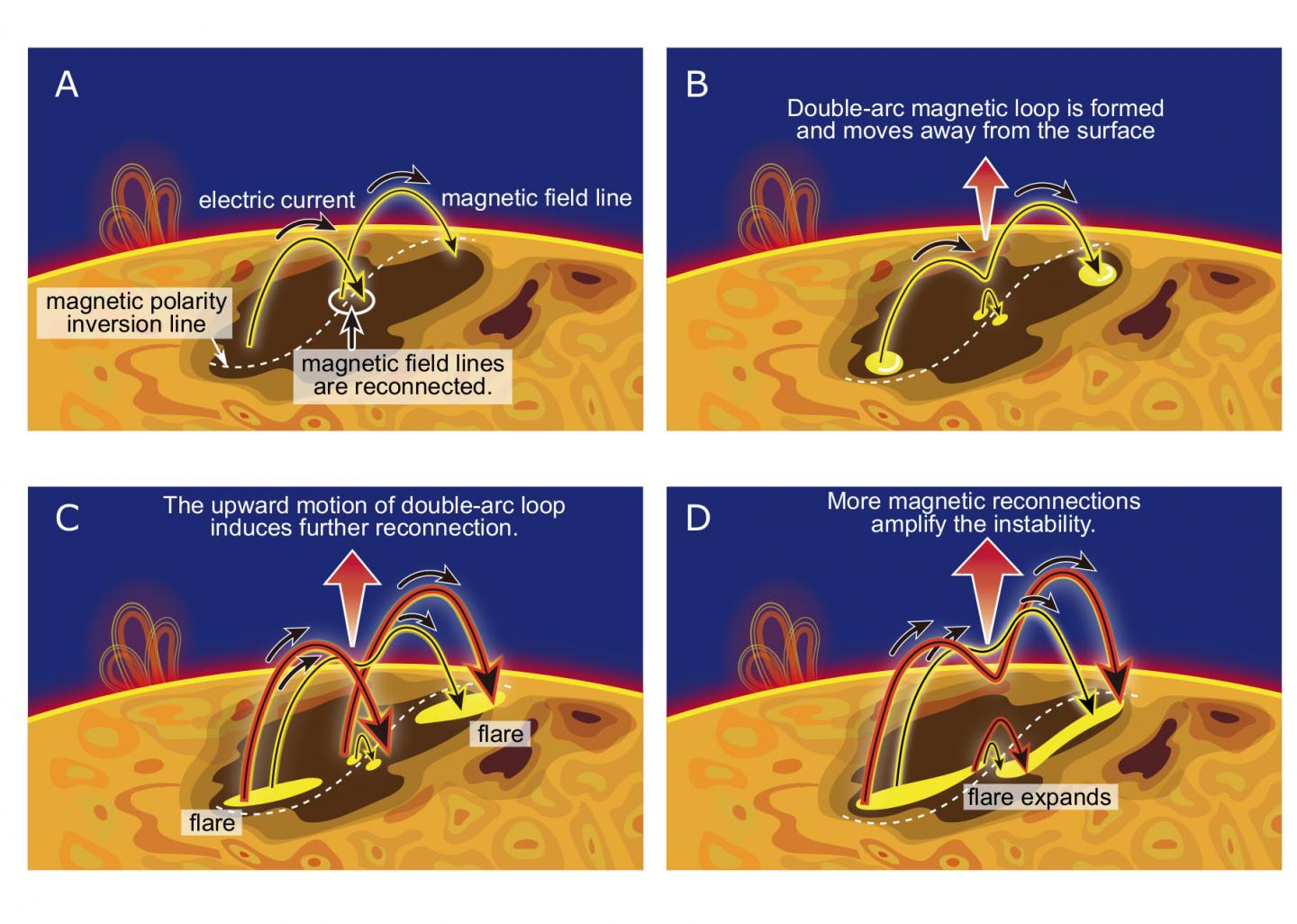
Credit: Institute for Space-Earth Environmental Research, Nagoya University
Solar flares emit sudden, strong bursts of electromagnetic radiation from the Sun’s surface and its atmosphere, and eject plasma and energetic particles into inter-planetary space. Since large solar flares can cause severe space weather disturbances affecting Earth, to mitigate their impact their occurrence needs to be predicted. However, as the onset mechanism of solar flares is unclear, most flare prediction methods so far have relied on empirical methods.
The research team led by Professor Kanya Kusano (Director of the Institute for Space-Earth Environmental Research, Nagoya University) recently succeeded in developing the first physics-based model that can accurately predict imminent large solar flares. The work was published in the journal Science on July 31, 2020.
The new method of flare prediction, called the kappa scheme, is based on the theory of “double-arc instability,” that is a magnetohydrodynamic (MHD) instability triggered by magnetic reconnection. The researchers assumed that a small-scale reconnection of magnetic field lines can form a double-arc (m-shape) magnetic field and trigger the onset of a solar flare. The kappa -scheme can predict how a small magnetic reconnection triggers a large flare and how a large solar flare can occur.
The predictive model was tested on about 200 active regions during solar cycle 24 from 2008 to 2019 using data obtained by NASA’s Solar Dynamics Observatory (SDO) satellite. It was demonstrated that with few exceptions, the kappa-scheme predicts most imminent solar flares, as well as the precise location they will emerge from. The researchers also discovered that a new parameter – the “magnetic twist flux density” close to a magnetic polarity inversion line on the solar surface – determines when and where solar flares probably occur and how large they are likely to be.
Previous flare prediction methods have relied on empirical relations in which the predictions of the previous day tend to continue into the next day even if flare activity changes. In contrast, the kappa-scheme predicts large solar flares through a physics-based approach regardless of previous flare activity. While it takes a lot more work to implement the scheme in real-time operational forecasting, this study shows that the physics-based approach may open a new direction for flare prediction research.
###
This research paper, “A physics-based method that can predict imminent large solar flares,” was published in Science on July 31, 2020, at DOI: 10.1126/science.aaz2511
About Nagoya University, Japan
Nagoya University has a history of about 150 years, with its roots in a temporary medical school and hospital established in 1871, and was formally instituted as the last Imperial University of Japan in 1939. Although modest in size compared to the largest universities in Japan, Nagoya University has been pursuing excellence since its founding. Six of the 18 Japanese Nobel Prize-winners since 2000 did all or part of their Nobel Prize-winning work at Nagoya University: four in Physics – Toshihide Maskawa and Makoto Kobayashi in 2008, and Isamu Akasaki and Hiroshi Amano in 2014; and two in Chemistry – Ryoji Noyori in 2001 and Osamu Shimomura in 2008. In mathematics, Shigefumi Mori did his Fields Medal-winning work at the University. A number of other important discoveries have also been made at the University, including the Okazaki DNA Fragments by Reiji and Tsuneko Okazaki in the 1960s; and depletion forces by Sho Asakura and Fumio Oosawa in 1954.
Media Contact
Kanya Kusano
[email protected]
Original Source
http://en.
Related Journal Article
http://dx.