• HOME
  • NEWS
  • EXPLORE
    • CAREER
      • Companies
      • Jobs
    • EVENTS
    • iGEM
      • News
      • Team
    • PHOTOS
    • VIDEO
    • WIKI
  • BLOG
  • COMMUNITY
    • FACEBOOK
    • INSTAGRAM
    • TWITTER
Monday, May 11, 2026
BIOENGINEER.ORG
No Result
View All Result
  • Login
  • HOME
  • NEWS
  • EXPLORE
    • CAREER
      • Companies
      • Jobs
        • Lecturer
        • PhD Studentship
        • Postdoc
        • Research Assistant
    • EVENTS
    • iGEM
      • News
      • Team
    • PHOTOS
    • VIDEO
    • WIKI
  • BLOG
  • COMMUNITY
    • FACEBOOK
    • INSTAGRAM
    • TWITTER
  • HOME
  • NEWS
  • EXPLORE
    • CAREER
      • Companies
      • Jobs
        • Lecturer
        • PhD Studentship
        • Postdoc
        • Research Assistant
    • EVENTS
    • iGEM
      • News
      • Team
    • PHOTOS
    • VIDEO
    • WIKI
  • BLOG
  • COMMUNITY
    • FACEBOOK
    • INSTAGRAM
    • TWITTER
No Result
View All Result
Bioengineer.org
No Result
View All Result
Home NEWS Science News Chemistry

Research team develops the first physics-based method for predicting large solar flares

Bioengineer by Bioengineer
August 21, 2020
in Chemistry
Reading Time: 3 mins read
0
IMAGE
Share on FacebookShare on TwitterShare on LinkedinShare on RedditShare on Telegram

IMAGE

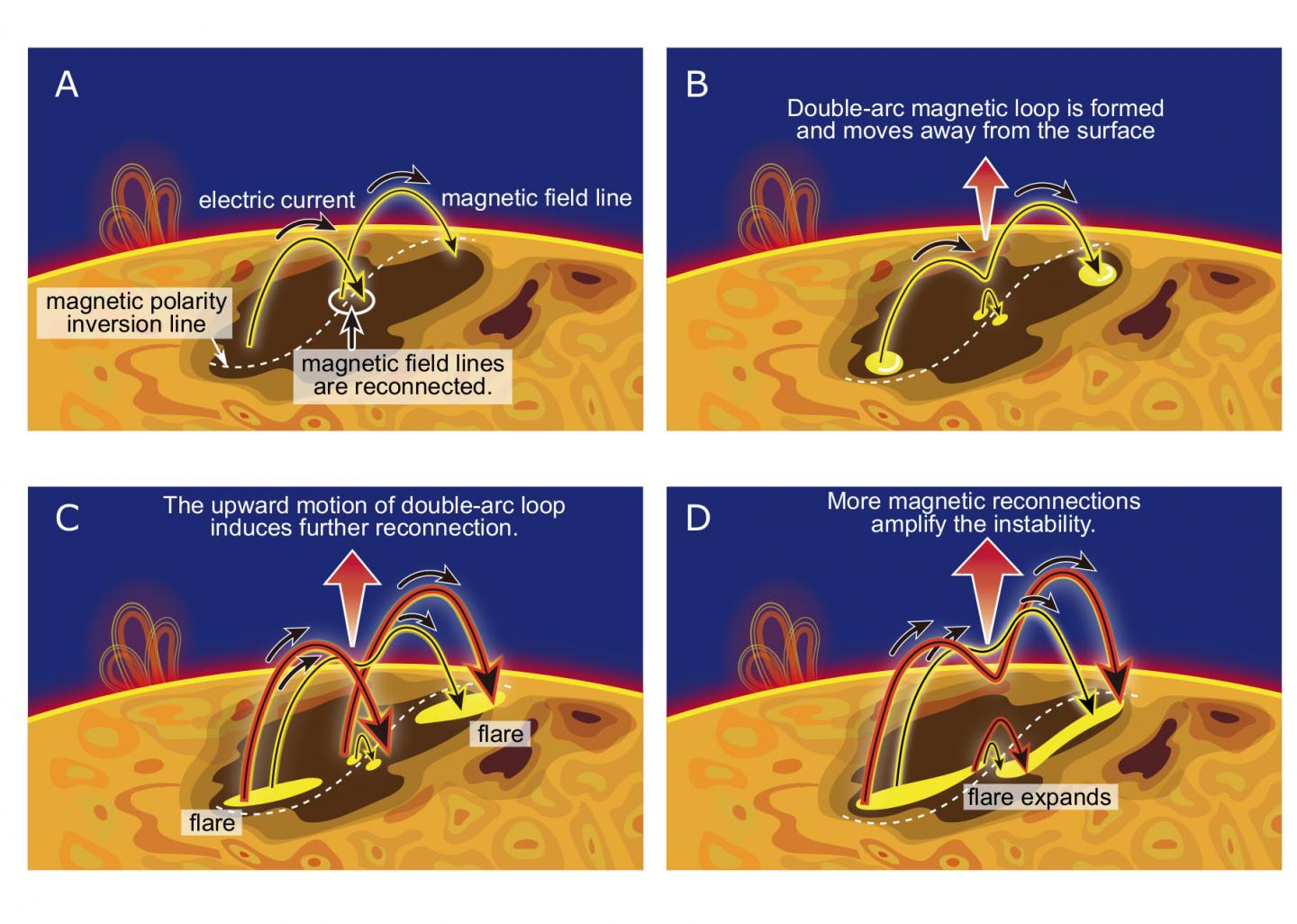
Credit: Institute for Space-Earth Environmental Research, Nagoya University

Solar flares emit sudden, strong bursts of electromagnetic radiation from the Sun’s surface and its atmosphere, and eject plasma and energetic particles into inter-planetary space. Since large solar flares can cause severe space weather disturbances affecting Earth, to mitigate their impact their occurrence needs to be predicted. However, as the onset mechanism of solar flares is unclear, most flare prediction methods so far have relied on empirical methods.

The research team led by Professor Kanya Kusano (Director of the Institute for Space-Earth Environmental Research, Nagoya University) recently succeeded in developing the first physics-based model that can accurately predict imminent large solar flares. The work was published in the journal Science on July 31, 2020.

The new method of flare prediction, called the kappa scheme, is based on the theory of “double-arc instability,” that is a magnetohydrodynamic (MHD) instability triggered by magnetic reconnection. The researchers assumed that a small-scale reconnection of magnetic field lines can form a double-arc (m-shape) magnetic field and trigger the onset of a solar flare. The kappa -scheme can predict how a small magnetic reconnection triggers a large flare and how a large solar flare can occur.

The predictive model was tested on about 200 active regions during solar cycle 24 from 2008 to 2019 using data obtained by NASA’s Solar Dynamics Observatory (SDO) satellite. It was demonstrated that with few exceptions, the kappa-scheme predicts most imminent solar flares, as well as the precise location they will emerge from. The researchers also discovered that a new parameter – the “magnetic twist flux density” close to a magnetic polarity inversion line on the solar surface – determines when and where solar flares probably occur and how large they are likely to be.

Previous flare prediction methods have relied on empirical relations in which the predictions of the previous day tend to continue into the next day even if flare activity changes. In contrast, the kappa-scheme predicts large solar flares through a physics-based approach regardless of previous flare activity. While it takes a lot more work to implement the scheme in real-time operational forecasting, this study shows that the physics-based approach may open a new direction for flare prediction research.

###

This research paper, “A physics-based method that can predict imminent large solar flares,” was published in Science on July 31, 2020, at DOI: 10.1126/science.aaz2511

About Nagoya University, Japan

Nagoya University has a history of about 150 years, with its roots in a temporary medical school and hospital established in 1871, and was formally instituted as the last Imperial University of Japan in 1939. Although modest in size compared to the largest universities in Japan, Nagoya University has been pursuing excellence since its founding. Six of the 18 Japanese Nobel Prize-winners since 2000 did all or part of their Nobel Prize-winning work at Nagoya University: four in Physics – Toshihide Maskawa and Makoto Kobayashi in 2008, and Isamu Akasaki and Hiroshi Amano in 2014; and two in Chemistry – Ryoji Noyori in 2001 and Osamu Shimomura in 2008. In mathematics, Shigefumi Mori did his Fields Medal-winning work at the University. A number of other important discoveries have also been made at the University, including the Okazaki DNA Fragments by Reiji and Tsuneko Okazaki in the 1960s; and depletion forces by Sho Asakura and Fumio Oosawa in 1954.

Media Contact
Kanya Kusano
[email protected]

Original Source

http://en.nagoya-u.ac.jp/research/activities/news/2020/08/research-team-develops-the-first-physics-based-method-for-predicting-large-solar-flares.html

Related Journal Article

http://dx.doi.org/10.1126/science.aaz2511

Tags: AstronomyAstrophysicsMeteorologySatellite Missions/ShuttlesSpace/Planetary ScienceStars/The Sun
Share14Tweet9Share2ShareShareShare2

Related Posts

Miniature Sensor Uses Light to Detect Touch — Chemistry

Miniature Sensor Uses Light to Detect Touch

May 8, 2026
Iron Minerals Determine Whether Dissolved Organic Matter Fuels Microbes or Becomes Long-Term Carbon Storage — Chemistry

Iron Minerals Determine Whether Dissolved Organic Matter Fuels Microbes or Becomes Long-Term Carbon Storage

May 8, 2026

Kate Evans Appointed Associate Lab Director for Biological and Environmental Systems Science at ORNL

May 8, 2026

Advancing Multiscale Modeling and Overcoming Operational Challenges in Autothermal COâ‚‚-to-Methanol Reactors

May 8, 2026
Please login to join discussion

POPULAR NEWS

  • Research Indicates Potential Connection Between Prenatal Medication Exposure and Elevated Autism Risk

    840 shares
    Share 336 Tweet 210
  • New Study Reveals Plants Can Detect the Sound of Rain

    727 shares
    Share 290 Tweet 181
  • Salmonella Haem Blocks Macrophages, Boosts Infection

    61 shares
    Share 24 Tweet 15
  • Breastmilk Balances E. coli and Beneficial Bacteria in Infant Gut Microbiomes

    57 shares
    Share 23 Tweet 14

About

We bring you the latest biotechnology news from best research centers and universities around the world. Check our website.

Follow us

Recent News

New Post-Hoc Analysis Explores Daily Oral Orforglipron Use in Adults Over 65 with Obesity, Regardless of Diabetes Status

Evaluating Digoxin Use in Patients with Symptomatic Rheumatic Heart Disease

Evaluating the Effectiveness and Safety of Digitalis Glycosides in Treating Heart Failure

Subscribe to Blog via Email

Enter your email address to subscribe to this blog and receive notifications of new posts by email.

Join 82 other subscribers
  • Contact Us

Bioengineer.org © Copyright 2023 All Rights Reserved.

Welcome Back!

Login to your account below

Forgotten Password?

Retrieve your password

Please enter your username or email address to reset your password.

Log In
No Result
View All Result
  • Homepages
    • Home Page 1
    • Home Page 2
  • News
  • National
  • Business
  • Health
  • Lifestyle
  • Science

Bioengineer.org © Copyright 2023 All Rights Reserved.