• HOME
  • NEWS
  • EXPLORE
    • CAREER
      • Companies
      • Jobs
    • EVENTS
    • iGEM
      • News
      • Team
    • PHOTOS
    • VIDEO
    • WIKI
  • BLOG
  • COMMUNITY
    • FACEBOOK
    • INSTAGRAM
    • TWITTER
Thursday, March 26, 2026
BIOENGINEER.ORG
No Result
View All Result
  • Login
  • HOME
  • NEWS
  • EXPLORE
    • CAREER
      • Companies
      • Jobs
        • Lecturer
        • PhD Studentship
        • Postdoc
        • Research Assistant
    • EVENTS
    • iGEM
      • News
      • Team
    • PHOTOS
    • VIDEO
    • WIKI
  • BLOG
  • COMMUNITY
    • FACEBOOK
    • INSTAGRAM
    • TWITTER
  • HOME
  • NEWS
  • EXPLORE
    • CAREER
      • Companies
      • Jobs
        • Lecturer
        • PhD Studentship
        • Postdoc
        • Research Assistant
    • EVENTS
    • iGEM
      • News
      • Team
    • PHOTOS
    • VIDEO
    • WIKI
  • BLOG
  • COMMUNITY
    • FACEBOOK
    • INSTAGRAM
    • TWITTER
No Result
View All Result
Bioengineer.org
No Result
View All Result
Home NEWS Science News

NASA infrared data shows Genevieve strengthening into a hurricane

Bioengineer by Bioengineer
August 17, 2020
in Science News
Reading Time: 2 mins read
0
IMAGE
Share on FacebookShare on TwitterShare on LinkedinShare on RedditShare on Telegram

IMAGE

Credit: redit: NASA/NRL

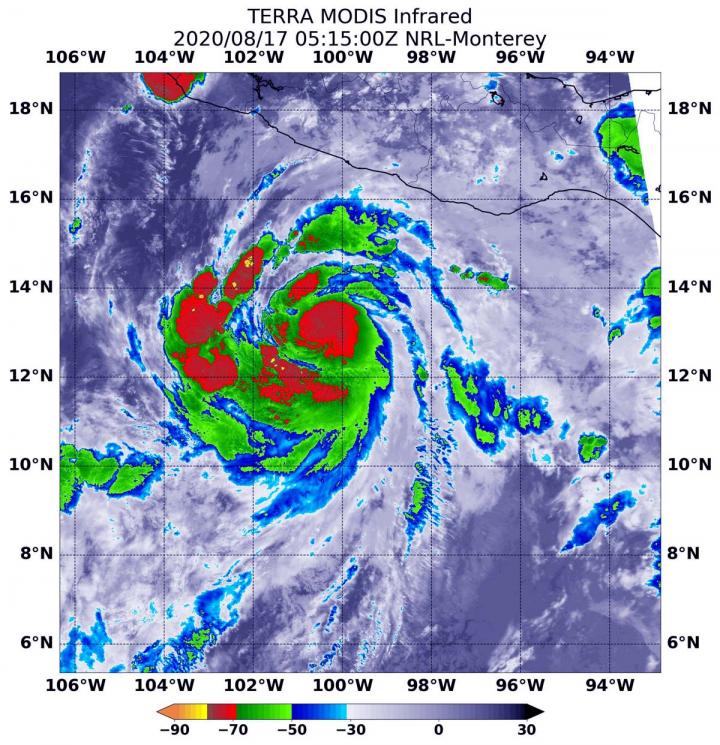
NASA’s Terra satellite used infrared light to identify strongest storms and coldest cloud top temperatures and found them surrounding a developing eyewall around Genevieve as it was strengthening into a hurricane.

Genevieve formed on Sunday by 11 a.m. EDT (1500 UTC) as Tropical Depression 12E. Six hours later, by 5 p.m. EDT, it had strengthened into a tropical storm and was renamed Tropical Storm Genevieve. The storm continued to intensify rapidly and by 11 a.m. EDT on Monday, Aug. 17, it strengthened to a hurricane.

Infrared Data Reveals Powerful Storms

On Aug. 17 at 1:15 a.m. EDT (0515 UTC), the Moderate Resolution Imaging Spectroradiometer or MODIS instrument aboard NASA’s Terra satellite gathered temperature information about Genevieve’s cloud tops. Infrared data provides temperature information, and the strongest thunderstorms that reach high into the atmosphere have the coldest cloud top temperatures.

MODIS found the most powerful thunderstorms were in the eyewall, where temperatures were as cold as or colder than minus 70 degrees Fahrenheit (minus 56.6 Celsius) around the center of circulation and in thick, fragmented bands south and west of the center. Cloud top temperatures that cold indicate strong storms with the potential to generate heavy rainfall.

Genevieve’s Status

At 11 a.m. EDT (1500 UTC) on Aug. 17, NOAA’s National Hurricane Center reported the center of Hurricane Genevieve was located near latitude 14.3 degrees north and longitude 103.0 degrees west. The storm was about 250 miles (405 km) south-southwest of Zihuatanejo, Mexico.

Genevieve is moving toward the west-northwest near 18 mph (30 kph), and this motion is expected to continue through tonight. Maximum sustained winds are near 75 mph (120 kph) with higher gusts.

Forecast Track

NHC forecasters said, “A turn to the northwest and a decrease in forward speed is forecast to occur on Tuesday and continue through at least early Thursday. Rapid strengthening if forecast to continue over the next day or so, and Genevieve is expected to become a major hurricane on Tuesday. A weakening trend should begin on Wednesday. On the forecast track, the center of Genevieve is expected to move parallel to but well offshore the coast of southwestern Mexico during the next couple of days.”

Genevieve Causing Dangerous Ocean Swells Near Mexico

Large swells produced by Genevieve will begin affecting portions of the southern coast of Mexico today and will spread northward along the southwestern and west-central coast of Mexico to the Baja California peninsula through Wednesday. These swells are likely to cause life-threatening surf and rip current conditions.

NASA Researches Tropical Cyclones

Tropical cyclones/hurricanes are the most powerful weather events on Earth. NASA’s expertise in space and scientific exploration contributes to essential services provided to the American people by other federal agencies, such as hurricane weather forecasting.

###

For updated forecasts, visit: http://www.nhc.noaa.gov

By Rob Gutro,
NASA’s Goddard Space Flight Center

Media Contact
Rob Gutro
[email protected]

Original Source

https://blogs.nasa.gov/hurricanes/2020/08/17/genevieve-eastern-pacific-ocean/

Tags: Atmospheric ChemistryAtmospheric ScienceClimate ChangeClimate ScienceEarth ScienceMeteorologyTechnology/Engineering/Computer ScienceTemperature-Dependent PhenomenaWeather/Storms
Share13Tweet8Share2ShareShareShare2

Related Posts

Starburst Winds Drain Supernova Energy Quickly

Starburst Winds Drain Supernova Energy Quickly

March 26, 2026
Decoding the Phosphorus Puzzle: How Microplastics and Hydrochar Transform Nutrient Dynamics in Rice Paddies

Decoding the Phosphorus Puzzle: How Microplastics and Hydrochar Transform Nutrient Dynamics in Rice Paddies

March 26, 2026

Microtubules Found to Actively Ensure Accurate Chromosome Distribution During Cell Division

March 25, 2026

Aversive Learning Hijacks Brain Sugar Sensor

March 25, 2026
Please login to join discussion

POPULAR NEWS

  • blank

    Revolutionary AI Model Enhances Precision in Detecting Food Contamination

    96 shares
    Share 38 Tweet 24
  • Imagine a Social Media Feed That Challenges Your Views Instead of Reinforcing Them

    1003 shares
    Share 397 Tweet 248
  • Uncovering Functions of Cavernous Malformation Proteins in Organoids

    54 shares
    Share 22 Tweet 14
  • Promising Outcomes from First Clinical Trials of Gene Regulation in Epilepsy

    51 shares
    Share 20 Tweet 13

About

We bring you the latest biotechnology news from best research centers and universities around the world. Check our website.

Follow us

Recent News

In-Sensor Cryptography Links Physical Process to Digital Identity

Can Psychosocial Factors Influence Cancer Risk?

Depression Factors in Elderly: Pre vs. Post-COVID Analysis

Subscribe to Blog via Email

Success! An email was just sent to confirm your subscription. Please find the email now and click 'Confirm' to start subscribing.

Join 78 other subscribers
  • Contact Us

Bioengineer.org © Copyright 2023 All Rights Reserved.

Welcome Back!

Login to your account below

Forgotten Password?

Retrieve your password

Please enter your username or email address to reset your password.

Log In
No Result
View All Result
  • Homepages
    • Home Page 1
    • Home Page 2
  • News
  • National
  • Business
  • Health
  • Lifestyle
  • Science

Bioengineer.org © Copyright 2023 All Rights Reserved.