• HOME
  • NEWS
  • EXPLORE
    • CAREER
      • Companies
      • Jobs
    • EVENTS
    • iGEM
      • News
      • Team
    • PHOTOS
    • VIDEO
    • WIKI
  • BLOG
  • COMMUNITY
    • FACEBOOK
    • INSTAGRAM
    • TWITTER
Friday, March 27, 2026
BIOENGINEER.ORG
No Result
View All Result
  • Login
  • HOME
  • NEWS
  • EXPLORE
    • CAREER
      • Companies
      • Jobs
        • Lecturer
        • PhD Studentship
        • Postdoc
        • Research Assistant
    • EVENTS
    • iGEM
      • News
      • Team
    • PHOTOS
    • VIDEO
    • WIKI
  • BLOG
  • COMMUNITY
    • FACEBOOK
    • INSTAGRAM
    • TWITTER
  • HOME
  • NEWS
  • EXPLORE
    • CAREER
      • Companies
      • Jobs
        • Lecturer
        • PhD Studentship
        • Postdoc
        • Research Assistant
    • EVENTS
    • iGEM
      • News
      • Team
    • PHOTOS
    • VIDEO
    • WIKI
  • BLOG
  • COMMUNITY
    • FACEBOOK
    • INSTAGRAM
    • TWITTER
No Result
View All Result
Bioengineer.org
No Result
View All Result
Home NEWS Science News Biology

Desert greenhouses offer growth opportunities

Bioengineer by Bioengineer
August 17, 2020
in Biology
Reading Time: 2 mins read
0
IMAGE
Share on FacebookShare on TwitterShare on LinkedinShare on RedditShare on Telegram

IMAGE

Credit: © 2020 KAUST; Ivan Gromicho

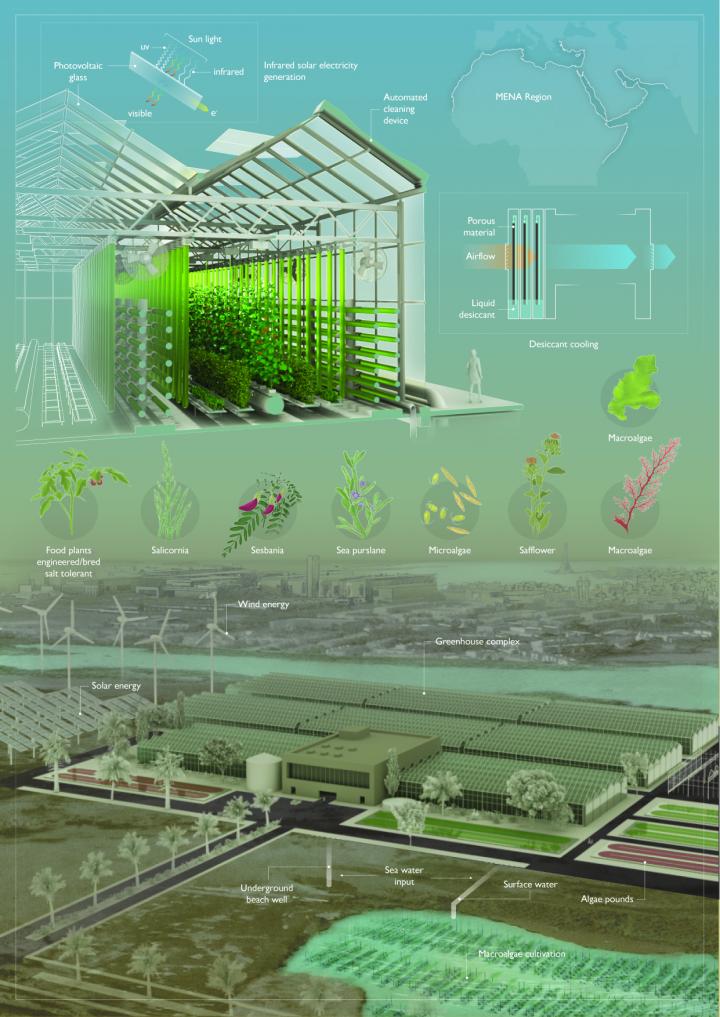
Emerging technologies can be harnessed to use the strengths of hot, humid coastal deserts of the Middle East and North Africa (MENA) region to grow food and other crops.

KAUST researchers are calling for a new generation of vast greenhouse complexes, supported by novel solar panels, air-cooling technologies, and advances in salt-tolerant agriculture. Their concept could kickstart a sustainable agriculture revolution in coastal desert regions across the world.

“Controlled environment agriculture (CEA) uses integrated systems to facilitate sustainable, local crop growth on a large scale,” says Kyle Lauersen, synthetic biologist. “Our vision combines several technologies currently in development at KAUST: energy-efficient, transparent solar panels; low-energy desiccant cooling; salt-tolerant edible plants; and algal biotechnology.”

Coastal locations in the MENA region have ample access to seawater and year-round intense sunlight. CEA makes it possible to use seawater to use grow salt-tolerant crops, such as newly identified varieties of tomatoes and green vegetables. Mixed irrigation means that CEA would have a lower impact on municipal supplies. To source extra freshwater, the researchers plan to harvest from humid air.

“We are excited by developments in cooling technologies that leverage liquid desiccants,” says research scientist Ryan Lefers. “Desiccants are highly concentrated substances that absorb water from the air–think of the silica packs found in electronic packaging. When humid air is pumped through a liquid desiccant system, it uses a highly saline liquid solution to absorb the moisture.”

The air released by the system is drier and cooler and can be circulated in the greenhouses, while the captured freshwater is recovered. The buildup of excessive heat inside greenhouses is a major concern in the MENA region. One solution comes from KAUST start-up iyris: which uses semitransparent solar panels as windows. Such panels allow visible light through for plant growth, while converting infrared energy (heat) into electricity.

The researchers also hope to combine plant and algae growth to generate not just food, but also biomass feedstocks for aquaculture, animal feed, chemical industry products and bioplastics. Algae can be grown in photobioreactors inside CEA, and this co-cultivation would increase the system’s value output.

“We see incredible potential for regionally inspired mixtures of salt-tolerant and freshwater species in different facilities, depending on market demands,” says Lauersen. “It’s becoming increasingly important to produce food and products in closer proximity to communities that need it. CEA will also provide food security, jobs and an economic base for year-round exports.”

“This is where multidisciplinary research comes into its own,” says plant scientist Mark Tester. “A pilot CEA greenhouse is under construction at KAUST as part of our spin-off company Red Sea Farms, and we will collaborate with colleagues across the university and beyond to demonstrate the exciting potential for CEA.”

###

Media Contact
Carolyn Unck
[email protected]

Original Source

https://discovery.kaust.edu.sa/en/article/999/desert-greenhouses-offer-growth-opportunities

Related Journal Article

http://dx.doi.org/10.3389/fpls.2020.00801

Tags: Agricultural Production/EconomicsAgricultureFood/Food SciencePlant SciencesTechnology/Engineering/Computer Science
Share12Tweet8Share2ShareShareShare2

Related Posts

How to sway group opinions: Encourage opponents to stay undecided

How to sway group opinions: Encourage opponents to stay undecided

March 23, 2026
Deep Learning Model Maps How Individual Cells Shape Disease Outcomes

Deep Learning Model Maps How Individual Cells Shape Disease Outcomes

March 20, 2026

Removing only 15 female sharks annually could endanger the entire population, scientists warn

March 20, 2026

Scientists Urge Fragrance Industry to Transition from Sustainability Talk to Active Funding of Plant Conservation

March 20, 2026
Please login to join discussion

POPULAR NEWS

  • blank

    Revolutionary AI Model Enhances Precision in Detecting Food Contamination

    96 shares
    Share 38 Tweet 24
  • Imagine a Social Media Feed That Challenges Your Views Instead of Reinforcing Them

    1003 shares
    Share 397 Tweet 248
  • Uncovering Functions of Cavernous Malformation Proteins in Organoids

    54 shares
    Share 22 Tweet 14
  • Promising Outcomes from First Clinical Trials of Gene Regulation in Epilepsy

    51 shares
    Share 20 Tweet 13

About

We bring you the latest biotechnology news from best research centers and universities around the world. Check our website.

Follow us

Recent News

In-Sensor Cryptography Links Physical Process to Digital Identity

Can Psychosocial Factors Influence Cancer Risk?

Depression Factors in Elderly: Pre vs. Post-COVID Analysis

Subscribe to Blog via Email

Success! An email was just sent to confirm your subscription. Please find the email now and click 'Confirm' to start subscribing.

Join 78 other subscribers
  • Contact Us

Bioengineer.org © Copyright 2023 All Rights Reserved.

Welcome Back!

Login to your account below

Forgotten Password?

Retrieve your password

Please enter your username or email address to reset your password.

Log In
No Result
View All Result
  • Homepages
    • Home Page 1
    • Home Page 2
  • News
  • National
  • Business
  • Health
  • Lifestyle
  • Science

Bioengineer.org © Copyright 2023 All Rights Reserved.