• HOME
  • NEWS
  • EXPLORE
    • CAREER
      • Companies
      • Jobs
    • EVENTS
    • iGEM
      • News
      • Team
    • PHOTOS
    • VIDEO
    • WIKI
  • BLOG
  • COMMUNITY
    • FACEBOOK
    • INSTAGRAM
    • TWITTER
Saturday, February 7, 2026
BIOENGINEER.ORG
No Result
View All Result
  • Login
  • HOME
  • NEWS
  • EXPLORE
    • CAREER
      • Companies
      • Jobs
        • Lecturer
        • PhD Studentship
        • Postdoc
        • Research Assistant
    • EVENTS
    • iGEM
      • News
      • Team
    • PHOTOS
    • VIDEO
    • WIKI
  • BLOG
  • COMMUNITY
    • FACEBOOK
    • INSTAGRAM
    • TWITTER
  • HOME
  • NEWS
  • EXPLORE
    • CAREER
      • Companies
      • Jobs
        • Lecturer
        • PhD Studentship
        • Postdoc
        • Research Assistant
    • EVENTS
    • iGEM
      • News
      • Team
    • PHOTOS
    • VIDEO
    • WIKI
  • BLOG
  • COMMUNITY
    • FACEBOOK
    • INSTAGRAM
    • TWITTER
No Result
View All Result
Bioengineer.org
No Result
View All Result
Home NEWS Science News Chemistry

Stars rich in phosphorus: Seeds of life in the universe

Bioengineer by Bioengineer
August 4, 2020
in Chemistry
Reading Time: 3 mins read
0
IMAGE
Share on FacebookShare on TwitterShare on LinkedinShare on RedditShare on Telegram

IMAGE

Credit: Gabriel Pérez Díaz, SMM (IAC)

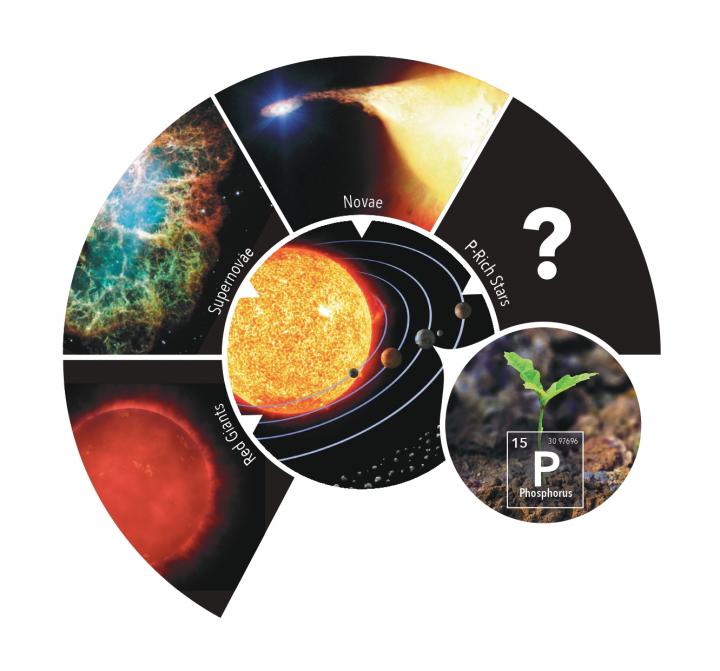
All the chemical elements in the universe, except for hydrogen and most of the helium, were produced inside stars. But among them there are a few (carbon, nitrogen, oxygen, sulphur and phosphorus) which are particularly interesting because they are basic to life as we know it on Earth. Phosphorus is of special interest because it forms part of the DNA and RNA molecules and is a necessary element in the energetic interchange within cells, and for the development of their membranes.

The study published in Nature, based on an analysis of a large number of infrared spectra (in the H band, with APOGEE) from the public data base of the Sloan Digital Sky Survey, could offer a clear set of promising stellar candidates to clarify the origin and the quantity observed of phosphorus in the Galaxy, and specifically, in our Solar System, which until now none of the current models of Galactic chemical evolution have been able to explain.

However, the peculiar chemistry which these stars show is still disconcerting. In fact, not only are they rich in phosphorus, but also in certain other elements, such as magnesium, silicon, oxygen, aluminium and even of heavier elements such as cerium. Suprisingly, after an extensive analysis of all the possible stellar sources and processes known to form chemical elements in the interiors of stars, this chemical pattern is not predicted by the current theories of stellar evolution and nucleosynthesis.

“These results show that not only are we dealing with a new type of objects, but that their discovery opens the way for the exploration of new physical mechanisms and nuclear reactions which occur in stellar interiors” explains IAC researcher Thomas Masseron, the leader of the project and the first author of the article.

“It could be an important clue about the origin of the phosphorus, which is a fundamental component of life”, says Aníbal García-Hernández, another IAC researcher, who is the second author of the article.

In addition, thanks to Spanish service time, they could obtain the optical spectrum of the most brilliant of the phosphorus stars with the Echelle spectrograph (FIES) on the Nordic Optical Telescope (NOT) at the Roque de los Muchachos Observatory, (Garafía, La Palma).

“This spectrum allowed us to obtain the chemical abundances of further elements in these stars which are peculiar and rich in phosphorus, and to rule out definitively any known stellar candidate which could explain the stars which are rich in this elements”, indicates Olga Zamora, a co-author of the article, and an IAC support astronomer.

“A discovery which is so unexpected and extraordinary could not have been made without a close interdisciplinary collaboration between astronomers and experts in computation”, points out Arturo Manchado, an IAC research and a co-author of the article.

###

Article: T. Masseron, D. A. García-Hernández, R. Santoveña, A. Manchado, O. Zamora, M. Manteiga and C. Dafonte. “Phosphorus-rich stars with unusual abundances are challenging theoretical predictions”. Nature Communications. DOI: https://www.nature.com/articles/s41467-020-17649-9

Media Contact
Prensa IAC
[email protected]

Original Source

https://www.iac.es/en/outreach/news/stars-rich-phosphorus-seeds-life-universe

Related Journal Article

http://dx.doi.org/10.1038/s41467-020-17649-9

Tags: AstronomyAstrophysicsSpace/Planetary ScienceStars/The Sun
Share12Tweet8Share2ShareShareShare2

Related Posts

blank

Breakthrough in Environmental Cleanup: Scientists Develop Solar-Activated Biochar for Faster Remediation

February 7, 2026
blank

Cutting Costs: Making Hydrogen Fuel Cells More Affordable

February 6, 2026

Scientists Develop Hand-Held “Levitating” Time Crystals

February 6, 2026

Observing a Key Green-Energy Catalyst Dissolve Atom by Atom

February 6, 2026
Please login to join discussion

POPULAR NEWS

  • Robotic Ureteral Reconstruction: A Novel Approach

    Robotic Ureteral Reconstruction: A Novel Approach

    82 shares
    Share 33 Tweet 21
  • Digital Privacy: Health Data Control in Incarceration

    63 shares
    Share 25 Tweet 16
  • Study Reveals Lipid Accumulation in ME/CFS Cells

    57 shares
    Share 23 Tweet 14
  • Breakthrough in RNA Research Accelerates Medical Innovations Timeline

    53 shares
    Share 21 Tweet 13

About

We bring you the latest biotechnology news from best research centers and universities around the world. Check our website.

Follow us

Recent News

Decoding Prostate Cancer Origins via snFLARE-seq, mxFRIZNGRND

Digital Health Perspectives from Baltic Sea Experts

Florida Cane Toad: Complex Spread and Selective Evolution

Subscribe to Blog via Email

Enter your email address to subscribe to this blog and receive notifications of new posts by email.

Join 73 other subscribers
  • Contact Us

Bioengineer.org © Copyright 2023 All Rights Reserved.

Welcome Back!

Login to your account below

Forgotten Password?

Retrieve your password

Please enter your username or email address to reset your password.

Log In
No Result
View All Result
  • Homepages
    • Home Page 1
    • Home Page 2
  • News
  • National
  • Business
  • Health
  • Lifestyle
  • Science

Bioengineer.org © Copyright 2023 All Rights Reserved.