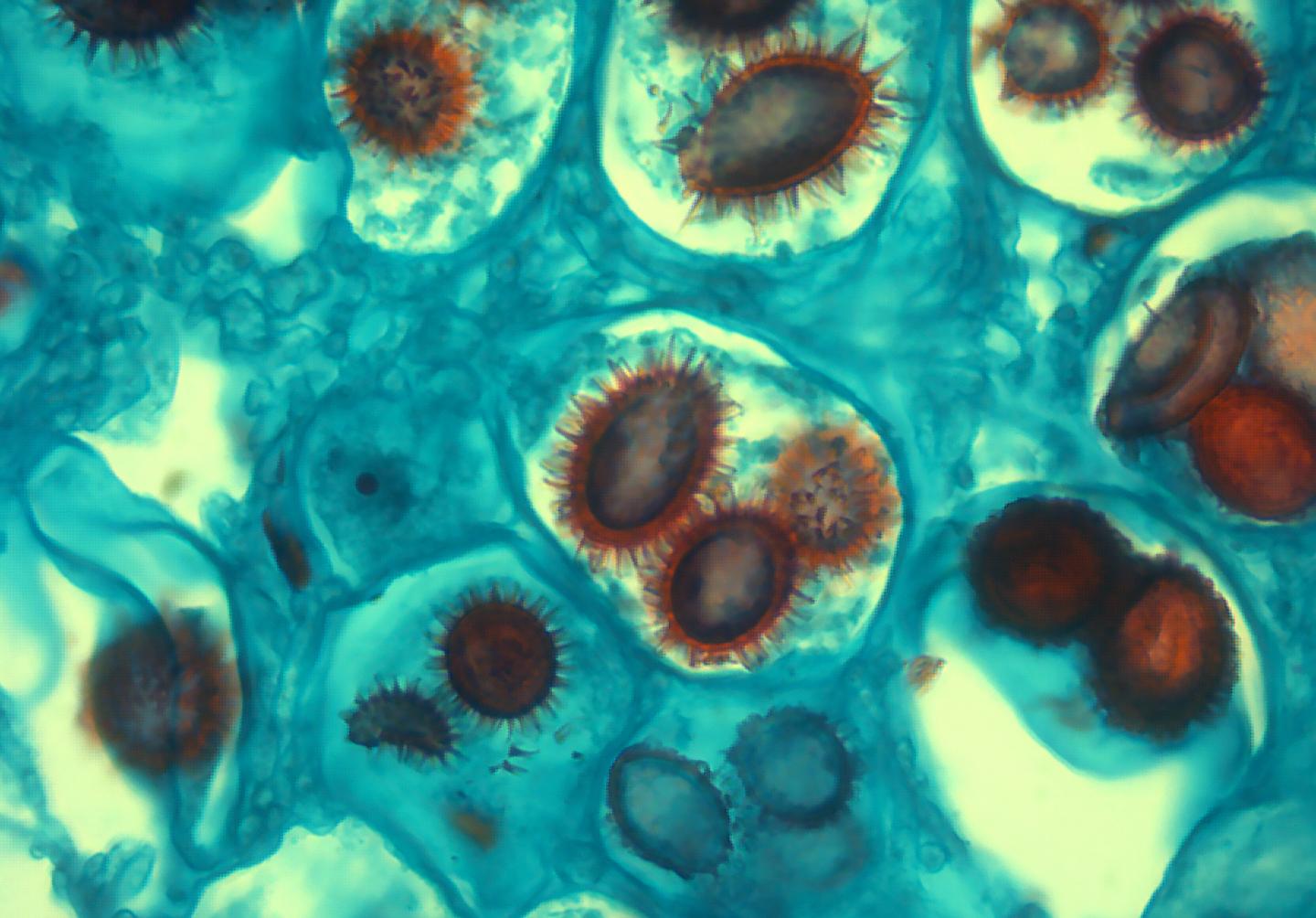
Credit: Joyce Eberhart
CORVALLIS, Ore. – As a first-year graduate student studying truffle ecology at Oregon State University, Dan Luoma attended a scientific meeting in 1981 on Orcas Island in Washington. Having recently learned how to search for truffles, he went out one day of the meeting looking for the prized fungi and found a collection.
He brought them back to Oregon State and showed them to his mentor James Trappe, who confirmed the collection was of an undescribed species. Trappe added it to the university’s collection. Then it sat there.
Almost four decades later, with the help of new scientific technologies, Trappe and several other scientists confirmed that the truffle is unique. They recently published their findings in the journal Fungal Systematics and Evolution recognizing it as a new species. Fittingly, it’s named Tuber luomae after Luoma, who retired this year after 40 years at Oregon State.
“This truffle in 1981 was among the first truffles I ever found,” Luoma said. “To have it named in my honor the year I retired completes the circle for me. It’s a wonderful way to celebrate retirement.”
Some truffle species are highly prized for culinary purposes because of their distinct flavor. These species, which are black, white or brown, are hard to find and exist in limited geographic areas, meaning they command high prices.
Oregon and the Pacific Northwest are home to several of those prized species, making the region one of the world’s hot spots for truffle hunting. The species discovered by Luoma, though, is a red truffle, which doesn’t have the distinct flavor sought by chefs and cooks.
While the culinary use of truffles and the thrill of searching for them gets a lot of attention, they and other fungi are important for the health of forests. They provide nutrients to plants and can also help plants withstand drought.
Luoma studied the ecology of truffles and fungi while earning his doctorate from Oregon State in 1988 and until earlier this year worked as a researcher at the university.
Several graduate students who worked with him during his early years planned to name the truffle species he found on Orcas Island in honor of Luoma, but they graduated before doing so.
Then about 10 years ago Trappe, now Luoma’s colleague, searched the Oregon State truffle collections, the largest in the world with about 50,000 collections, looking for truffles similar to the one Luoma found on Orcas Island. Trappe found three.
Joyce Eberhart, a truffle researcher at Oregon State and Luoma’s wife, and Greg Bonito, an assistant professor at Michigan State University, studied the DNA of those three and determined they were the same species as the Orcas Island truffle.
Those three were all found in Oregon – one each in Benton (found in 1962), Clackamas (1995) and Jackson (2012) counties. While the Benton County specimen was found before Luoma dug up the Orcas Island one, it was never fully described until Trappe noticed the similarities between the two. Now the known distribution of the new species extends from southwestern Oregon to northwestern Washington.
Carolina Piña Páez, a doctoral student at Oregon State who also does truffle research, provided the final piece by documenting the microscopic structures inside the truffle with photos, confirming that the spores and outer layers were that of a unique species.
Trappe, who has studied truffles for more than 60 years and has discovered 230 new truffle species, still gets excited about a new species, such as this one named after Luoma.
“Many dozens of professional and amateur mycologists have sought truffles in western Oregon for over 100 years, but only these four collections of Luoma’s truffle have been found. Each of those seems to be quite local in distribution, indicating that it’s a very rare fungus,” Trappe said.
###
Media Contact
Sean Nealon
[email protected]
Original Source
https:/
Related Journal Article
http://dx.