• HOME
  • NEWS
  • EXPLORE
    • CAREER
      • Companies
      • Jobs
    • EVENTS
    • iGEM
      • News
      • Team
    • PHOTOS
    • VIDEO
    • WIKI
  • BLOG
  • COMMUNITY
    • FACEBOOK
    • INSTAGRAM
    • TWITTER
Sunday, March 29, 2026
BIOENGINEER.ORG
No Result
View All Result
  • Login
  • HOME
  • NEWS
  • EXPLORE
    • CAREER
      • Companies
      • Jobs
        • Lecturer
        • PhD Studentship
        • Postdoc
        • Research Assistant
    • EVENTS
    • iGEM
      • News
      • Team
    • PHOTOS
    • VIDEO
    • WIKI
  • BLOG
  • COMMUNITY
    • FACEBOOK
    • INSTAGRAM
    • TWITTER
  • HOME
  • NEWS
  • EXPLORE
    • CAREER
      • Companies
      • Jobs
        • Lecturer
        • PhD Studentship
        • Postdoc
        • Research Assistant
    • EVENTS
    • iGEM
      • News
      • Team
    • PHOTOS
    • VIDEO
    • WIKI
  • BLOG
  • COMMUNITY
    • FACEBOOK
    • INSTAGRAM
    • TWITTER
No Result
View All Result
Bioengineer.org
No Result
View All Result
Home NEWS Science News Chemistry

Robust high-performance data storage through magnetic anisotropy

Bioengineer by Bioengineer
July 10, 2020
in Chemistry
Reading Time: 2 mins read
0
IMAGE
Share on FacebookShare on TwitterShare on LinkedinShare on RedditShare on Telegram

IMAGE

Credit: M. Bargheer/ Uni Potsdam

In thermal equilibrium, iron-platinum (FePt) belongs to the class of invar materials, which hardly expand at all when heated. This phenomenon was observed as early as 1897 in the nickel-iron alloy “Invar”, but it is only in recent years that experts have been able to understand which mechanism are driving it: Normally, heating of solids leads to lattice vibrations which cause expansion because the vibrating atoms need more space. Surprisingly, however, heating the spins in FePt leads to the opposite effect: the warmer the spins are, the more the material contracts along the direction of magnetisation. The result is the property known from Invar: minimal expansion.

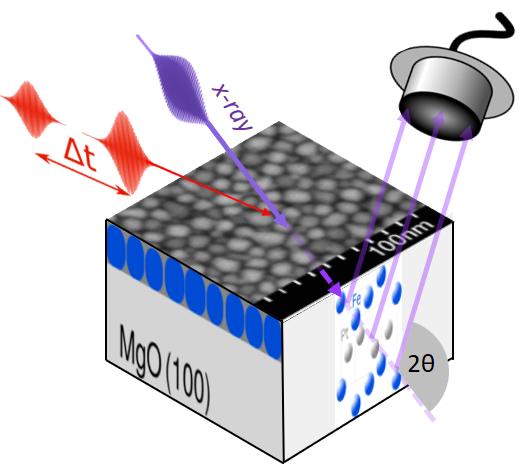
A team led by Prof. Matias Bargheer has now experimentally compared this fascinating phenomenon for the first time on different iron-platinum thin films. Bargheer heads a joint research group at Helmholtz-Zentrum Berlin and the University of Potsdam. Together with colleagues from Lyon, Brno and Chemnitz, he wanted to investigate how the behavior of perfectly crystalline FePt layers differs from the FePt thin films used for HAMR memories. These consist of crystalline nanograins of stacked monatomic layers of iron and platinum embedded in a carbon matrix.

The samples were locally heated and excited with two laser pulses in quick succession and then measured by X-ray diffraction to determine how strongly the crystal lattice expands or contracts locally.

“We were surprised to find that the continuous crystalline layers expand when heated briefly with laser light, while loosely arranged nano grains contract in the same crystal orientation,” explains Bargheer. “HAMR data memories, on the other hand, whose nano-grains are embedded in a carbon matrix and grown on a substrate react much weaker to laser excitation: They first contract slightly and then expand slightly.”

“Through these experiments with ultrashort X-ray pulses, we have been able to determine how important the morphology of such thin films is,” says Alexander von Reppert, first author of the study and PhD student in Bargheer’s group. The secret is transverse contraction, also known as the Poisson effect. “Everyone who has ever pressed firmly on an eraser knows this,” says Bargheer. “The rubber gets thicker in the middle.” And Reppert adds: “The nanoparticles can do that too, whereas in the perfect film there is no room for expansion in the plane, which would have to go along with the spin driven contraction perpendicular to the film.”

So FePt, embedded in a carbon matrix, is a very special material. It not only has exceptionally robust magnetic properties. Its thermomechanical properties also prevent excessive tension from being created when heated, which would destroy the material – and that is important for HAMR!

###

Media Contact
Antonia Roetger
[email protected]

Original Source

https://www.helmholtz-berlin.de/pubbin/news_seite?nid=21603;sprache=en;seitenid=1

Related Journal Article

http://dx.doi.org/10.1126/sciadv.aba1142

Tags: Atomic/Molecular/Particle PhysicsChemistry/Physics/Materials SciencesElectromagneticsIndustrial Engineering/ChemistryMaterials
Share12Tweet8Share2ShareShareShare2

Related Posts

Biochar Boosts Forest Resilience Against Acid Rain by Restoring Essential Soil Nitrogen

Biochar Boosts Forest Resilience Against Acid Rain by Restoring Essential Soil Nitrogen

March 27, 2026
Isolated H2-Reduced Clusters Boost CO2-to-Methanol Catalysis

Isolated H2-Reduced Clusters Boost CO2-to-Methanol Catalysis

March 25, 2026

Physicists Identify Electronic Drivers Behind Flat Band Quantum Materials

March 21, 2026

Würzburg Chemistry Professor Claudia Höbartner Receives Prestigious Honor

March 20, 2026
Please login to join discussion

POPULAR NEWS

  • blank

    Revolutionary AI Model Enhances Precision in Detecting Food Contamination

    96 shares
    Share 38 Tweet 24
  • Imagine a Social Media Feed That Challenges Your Views Instead of Reinforcing Them

    1004 shares
    Share 397 Tweet 248
  • Uncovering Functions of Cavernous Malformation Proteins in Organoids

    54 shares
    Share 22 Tweet 14
  • Promising Outcomes from First Clinical Trials of Gene Regulation in Epilepsy

    51 shares
    Share 20 Tweet 13

About

We bring you the latest biotechnology news from best research centers and universities around the world. Check our website.

Follow us

Recent News

In-Sensor Cryptography Links Physical Process to Digital Identity

Can Psychosocial Factors Influence Cancer Risk?

Depression Factors in Elderly: Pre vs. Post-COVID Analysis

Subscribe to Blog via Email

Enter your email address to subscribe to this blog and receive notifications of new posts by email.

Join 78 other subscribers
  • Contact Us

Bioengineer.org © Copyright 2023 All Rights Reserved.

Welcome Back!

Login to your account below

Forgotten Password?

Retrieve your password

Please enter your username or email address to reset your password.

Log In
No Result
View All Result
  • Homepages
    • Home Page 1
    • Home Page 2
  • News
  • National
  • Business
  • Health
  • Lifestyle
  • Science

Bioengineer.org © Copyright 2023 All Rights Reserved.