• HOME
  • NEWS
  • EXPLORE
    • CAREER
      • Companies
      • Jobs
    • EVENTS
    • iGEM
      • News
      • Team
    • PHOTOS
    • VIDEO
    • WIKI
  • BLOG
  • COMMUNITY
    • FACEBOOK
    • INSTAGRAM
    • TWITTER
Saturday, February 7, 2026
BIOENGINEER.ORG
No Result
View All Result
  • Login
  • HOME
  • NEWS
  • EXPLORE
    • CAREER
      • Companies
      • Jobs
        • Lecturer
        • PhD Studentship
        • Postdoc
        • Research Assistant
    • EVENTS
    • iGEM
      • News
      • Team
    • PHOTOS
    • VIDEO
    • WIKI
  • BLOG
  • COMMUNITY
    • FACEBOOK
    • INSTAGRAM
    • TWITTER
  • HOME
  • NEWS
  • EXPLORE
    • CAREER
      • Companies
      • Jobs
        • Lecturer
        • PhD Studentship
        • Postdoc
        • Research Assistant
    • EVENTS
    • iGEM
      • News
      • Team
    • PHOTOS
    • VIDEO
    • WIKI
  • BLOG
  • COMMUNITY
    • FACEBOOK
    • INSTAGRAM
    • TWITTER
No Result
View All Result
Bioengineer.org
No Result
View All Result
Home NEWS Science News Chemistry

Self-compacting concrete becomes more sustainable thanks to using granite residue

Bioengineer by Bioengineer
June 25, 2020
in Chemistry
Reading Time: 2 mins read
0
IMAGE
Share on FacebookShare on TwitterShare on LinkedinShare on RedditShare on Telegram

IMAGE

Credit: University of Córdoba

The basis of the construction industry clashes head-on with environmental sustainability. Extracting raw materials and turning them into building materials has high energetic costs. Granite production, totaling 614,000 tons in Spain in 2013, leaves behind it a series of residues that are difficult to manage. This is the case of granite sludge, the material that results from the mixture of dust particles given off during the cutting process and the water used to cool the blade. When granite sludge is dumped at a landfill and the water evaporates, the silicon dust ends up going into the atmosphere and can be inhaled, with negative health consequences. It can also interfere with normal soil mechanics.

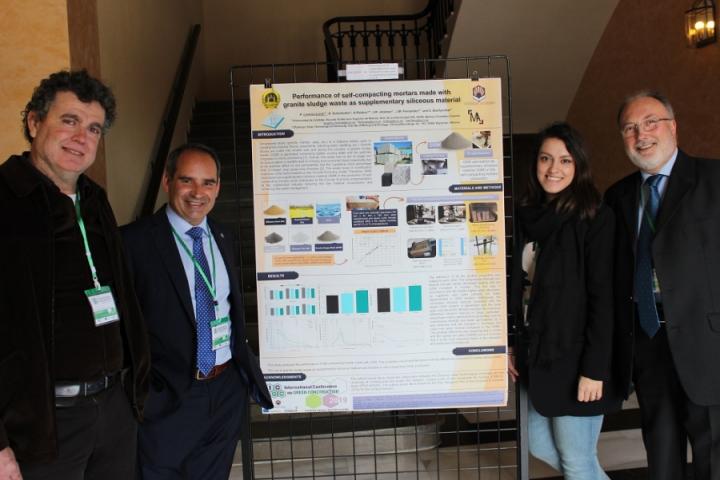
Aiming to properly manage these residues and in doing so prevent health and environmental problems, three University of Cordoba research groups have joined forces to analyze the feasibility of using granite sludge to substitute conventional aggregates in self-compacting mortar.

In this vein, “it is possible to substitute up to 40% of conventional aggregates for granite sludge while still maintaining the mortar’s qualities of durability, strength and compaction” according to the lead researcher working on the study, Angélica Lozano, from the the Construction Engineering group at UCO. Thus, granite sludge becomes a sustainable alternative to using conventional aggregates.

Working in synergy with each other are the groups of “Construction Engineering”, “Materials and Applications” and “Plasma Physics: Characterization, Models and Applications”, led by Professors José Ramón Jiménez, José María Fernández and Antonio Rodero respectively. Two aims are accomplished: managing a residue that is bad for our health, and the environmental sustainability of self-compacting concrete, currently one of the most sought-after materials in the building industry since it can be compacted without having to apply compaction energy. Despite the advantages of this new material, the need for a high percentage of aggregates to be extracted is not environmentally sustainable. However, using granite sludge will greatly help solve the problem of this lack of sustainability.

###

Lozano-Lunar, A., Dubchenko, I., Bashynskyi, S., Rodero A., Fernández J.M., Jiménez, J.R. (2020 Performance of self-compacting mortars with granite sludge as aggregate. Construction and Building Materials. Volume 251, 118998, ISSN 0950-0618 https://doi.org/10.1016/j.conbuildmat.2020.118998

Media Contact
Elena Lázaro
[email protected]

Related Journal Article

http://dx.doi.org/10.1016/j.conbuildmat.2020.118998

Tags: Chemistry/Physics/Materials SciencesMaterials
Share12Tweet8Share2ShareShareShare2

Related Posts

blank

Breakthrough in Environmental Cleanup: Scientists Develop Solar-Activated Biochar for Faster Remediation

February 7, 2026
blank

Cutting Costs: Making Hydrogen Fuel Cells More Affordable

February 6, 2026

Scientists Develop Hand-Held “Levitating” Time Crystals

February 6, 2026

Observing a Key Green-Energy Catalyst Dissolve Atom by Atom

February 6, 2026
Please login to join discussion

POPULAR NEWS

  • Robotic Ureteral Reconstruction: A Novel Approach

    Robotic Ureteral Reconstruction: A Novel Approach

    82 shares
    Share 33 Tweet 21
  • Digital Privacy: Health Data Control in Incarceration

    63 shares
    Share 25 Tweet 16
  • Study Reveals Lipid Accumulation in ME/CFS Cells

    57 shares
    Share 23 Tweet 14
  • Breakthrough in RNA Research Accelerates Medical Innovations Timeline

    53 shares
    Share 21 Tweet 13

About

We bring you the latest biotechnology news from best research centers and universities around the world. Check our website.

Follow us

Recent News

Decoding Prostate Cancer Origins via snFLARE-seq, mxFRIZNGRND

Digital Health Perspectives from Baltic Sea Experts

Florida Cane Toad: Complex Spread and Selective Evolution

Subscribe to Blog via Email

Enter your email address to subscribe to this blog and receive notifications of new posts by email.

Join 73 other subscribers
  • Contact Us

Bioengineer.org © Copyright 2023 All Rights Reserved.

Welcome Back!

Login to your account below

Forgotten Password?

Retrieve your password

Please enter your username or email address to reset your password.

Log In
No Result
View All Result
  • Homepages
    • Home Page 1
    • Home Page 2
  • News
  • National
  • Business
  • Health
  • Lifestyle
  • Science

Bioengineer.org © Copyright 2023 All Rights Reserved.