• HOME
  • NEWS
  • EXPLORE
    • CAREER
      • Companies
      • Jobs
    • EVENTS
    • iGEM
      • News
      • Team
    • PHOTOS
    • VIDEO
    • WIKI
  • BLOG
  • COMMUNITY
    • FACEBOOK
    • INSTAGRAM
    • TWITTER
Wednesday, July 8, 2026
BIOENGINEER.ORG
No Result
View All Result
  • Login
  • HOME
  • NEWS
  • EXPLORE
    • CAREER
      • Companies
      • Jobs
        • Lecturer
        • PhD Studentship
        • Postdoc
        • Research Assistant
    • EVENTS
    • iGEM
      • News
      • Team
    • PHOTOS
    • VIDEO
    • WIKI
  • BLOG
  • COMMUNITY
    • FACEBOOK
    • INSTAGRAM
    • TWITTER
  • HOME
  • NEWS
  • EXPLORE
    • CAREER
      • Companies
      • Jobs
        • Lecturer
        • PhD Studentship
        • Postdoc
        • Research Assistant
    • EVENTS
    • iGEM
      • News
      • Team
    • PHOTOS
    • VIDEO
    • WIKI
  • BLOG
  • COMMUNITY
    • FACEBOOK
    • INSTAGRAM
    • TWITTER
No Result
View All Result
Bioengineer.org
No Result
View All Result
Home NEWS Science News Chemistry

Self-compacting concrete becomes more sustainable thanks to using granite residue

Bioengineer by Bioengineer
June 25, 2020
in Chemistry
Reading Time: 2 mins read
0
IMAGE
Share on FacebookShare on TwitterShare on LinkedinShare on RedditShare on Telegram

IMAGE

Credit: University of Córdoba

The basis of the construction industry clashes head-on with environmental sustainability. Extracting raw materials and turning them into building materials has high energetic costs. Granite production, totaling 614,000 tons in Spain in 2013, leaves behind it a series of residues that are difficult to manage. This is the case of granite sludge, the material that results from the mixture of dust particles given off during the cutting process and the water used to cool the blade. When granite sludge is dumped at a landfill and the water evaporates, the silicon dust ends up going into the atmosphere and can be inhaled, with negative health consequences. It can also interfere with normal soil mechanics.

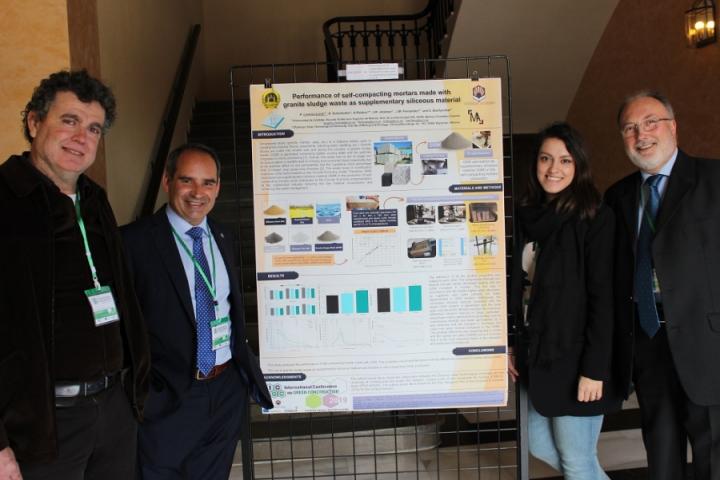
Aiming to properly manage these residues and in doing so prevent health and environmental problems, three University of Cordoba research groups have joined forces to analyze the feasibility of using granite sludge to substitute conventional aggregates in self-compacting mortar.

In this vein, “it is possible to substitute up to 40% of conventional aggregates for granite sludge while still maintaining the mortar’s qualities of durability, strength and compaction” according to the lead researcher working on the study, Angélica Lozano, from the the Construction Engineering group at UCO. Thus, granite sludge becomes a sustainable alternative to using conventional aggregates.

Working in synergy with each other are the groups of “Construction Engineering”, “Materials and Applications” and “Plasma Physics: Characterization, Models and Applications”, led by Professors José Ramón Jiménez, José María Fernández and Antonio Rodero respectively. Two aims are accomplished: managing a residue that is bad for our health, and the environmental sustainability of self-compacting concrete, currently one of the most sought-after materials in the building industry since it can be compacted without having to apply compaction energy. Despite the advantages of this new material, the need for a high percentage of aggregates to be extracted is not environmentally sustainable. However, using granite sludge will greatly help solve the problem of this lack of sustainability.

###

Lozano-Lunar, A., Dubchenko, I., Bashynskyi, S., Rodero A., Fernández J.M., Jiménez, J.R. (2020 Performance of self-compacting mortars with granite sludge as aggregate. Construction and Building Materials. Volume 251, 118998, ISSN 0950-0618 https://doi.org/10.1016/j.conbuildmat.2020.118998

Media Contact
Elena Lázaro
[email protected]

Related Journal Article

http://dx.doi.org/10.1016/j.conbuildmat.2020.118998

Tags: Chemistry/Physics/Materials SciencesMaterials
Share12Tweet8Share2ShareShareShare2

Related Posts

Over 90% of Mar Menor nutrient pollution stems from underground water flows

Over 90% of Mar Menor nutrient pollution stems from underground water flows

July 8, 2026
Weakening Atlantic current drives stronger California storms

Weakening Atlantic current drives stronger California storms

July 8, 2026

New approach simplifies black hole mergers, universe’s most violent events.

July 8, 2026

Salt adaptation linked to higher disease risk, Mizzou study finds

July 6, 2026
Please login to join discussion

POPULAR NEWS

  • Detection of EDCs in Breast Milk and Infant Urine Up to Six Months Highlights Early Exposure Risks

    77 shares
    Share 31 Tweet 19
  • New Drug Candidate Developed at McMaster Shows Potential for Treating Brain Cancer

    58 shares
    Share 23 Tweet 15
  • KTU Researchers Explore Ultrasound’s Role in Enhancing Blood Flow Beyond Diagnostics

    53 shares
    Share 21 Tweet 13
  • 高齢者の骨粗鬆症治療の持続性比較

    51 shares
    Share 20 Tweet 13

About

We bring you the latest biotechnology news from best research centers and universities around the world. Check our website.

Follow us

Recent News

Harnessing Neglected Livestock for Sustainable Food Systems in the Global South

Proteomic Analysis Identifies Prognostic Subgroups in SMARCA-Deficient Esophageal Cancer

DNA from bees and honey reveals honeybee ecology and interactions over time

Subscribe to Blog via Email

Enter your email address to subscribe to this blog and receive notifications of new posts by email.

Join 83 other subscribers
  • Contact Us

Bioengineer.org © Copyright 2023 All Rights Reserved.

Welcome Back!

Login to your account below

Forgotten Password?

Retrieve your password

Please enter your username or email address to reset your password.

Log In
No Result
View All Result
  • Homepages
    • Home Page 1
    • Home Page 2
  • News
  • National
  • Business
  • Health
  • Lifestyle
  • Science

Bioengineer.org © Copyright 2023 All Rights Reserved.